

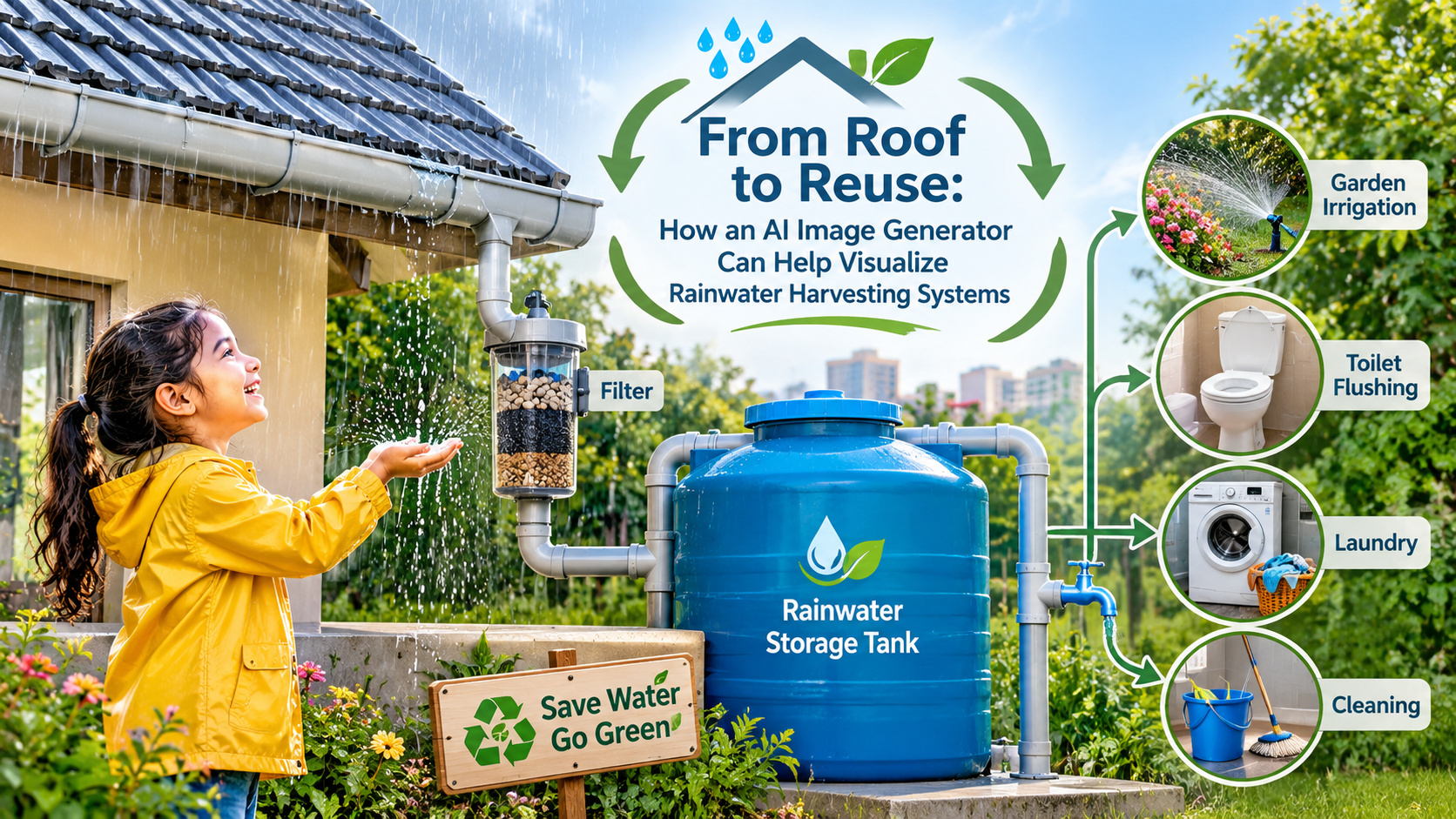
Rainwater harvesting is a practical way to make better use of a resource that often flows straight from rooftops into drains. A well-planned system can collect rainfall, store it, and make it available for suitable tasks such as watering plants or cleaning outdoor areas. However, understanding how all the parts fit together can be difficult when a project exists only as a written description. An ai image generator can help turn these ideas into visual concepts. By creating images of possible collection points, storage arrangements, and outdoor spaces, it gives homeowners, students, and community groups a clearer starting point for planning. These images are not engineering plans, but they can make early discussions more practical and help people compare different approaches before making decisions.
Start by Following the Journey of a Raindrop
A useful way to approach rainwater harvesting is to think about the route water takes from the moment it reaches a building. It may begin on a roof, travel through gutters and downpipes, pass through a filter, and eventually reach a storage tank. From there, it can be directed toward an appropriate use. An image-generation prompt can describe this journey as a connected system rather than a collection of separate objects. For example, a concept image might show a small home with a sloped roof, visible guttering, a covered storage tank, and a garden watering point.
This type of visual helps viewers understand the relationship between the components. It can also reveal questions that might otherwise be overlooked, such as where a tank could fit or how a pipe might run along an exterior wall.
Make Space and Practical Constraints Visible
Available space plays a major role in choosing a rainwater harvesting arrangement. A large property may have room for a substantial tank, while a narrow urban home might need a compact solution beside a wall or beneath a raised outdoor platform. Instead of generating a single attractive image, create several concepts based on the actual setting. Describe the approximate building style, available outdoor area, surrounding surfaces, and preferred tank location. Ask for alternatives that show different arrangements without changing the basic property.
The resulting images can help compare the visual impact of above-ground tanks, discreet installations, and covered storage areas. They may also encourage useful conversations about access for maintenance and the need to keep overflow away from building foundations.
Compare Designs Before Choosing Materials
Rainwater systems can look very different depending on the materials and surrounding environment. A simple household setup might use a modest plastic tank, while a larger shared project could include several connected storage units. Some installations may be screened with outdoor panels or positioned behind existing landscaping. An AI image generator can present these options side by side, making it easier to discuss appearance and placement. A prompt might request a compact tank beside a brick house, followed by another concept showing a similar system with a different enclosure.
The images can also help people consider how equipment will fit with existing features. For instance, a tank placed near a pathway should not make the route awkward to use, while a decorative screen should not prevent someone from inspecting the system. Dreamina can be used to explore different visual directions from a written description, helping users develop a clearer concept before discussing construction details with a qualified professional.
Think Beyond Storage: Show How Collected Water Will Be Used
A storage tank is only one part of a successful harvesting project. It is equally important to consider what happens after water has been collected. Depending on the system and local requirements, suitable non-drinking uses may include garden irrigation, washing outdoor surfaces, or other approved purposes. Visual concepts can show how the stored water might reach its intended destination. A small garden, for example, could include a simple hose connection or a drip-irrigation arrangement. A shared building might show a separate outdoor tap near a maintenance area.
These illustrations help connect the collection with everyday use. They can also prompt discussions about who will operate the system, how water levels will be monitored, and whether the proposed arrangement is convenient for the people who will rely on it.
Use Images to Improve Project Discussions
Rainwater harvesting may involve homeowners, architects, plumbers, landscapers, property managers, or local community members. Each person may focus on a different part of the project. A homeowner might care about appearance, while an installer may be more concerned with pipe routes, access, and drainage. A visual concept gives everyone a common reference. Instead of relying entirely on verbal explanations, people can point to a proposed tank position, identify an awkward feature, or suggest a different layout.
For community projects, several images can help residents compare possible locations and understand how a shared system could fit into an existing space. The visuals are most useful when accompanied by clear notes describing what is confirmed, what is only an idea, and which details still need professional assessment.
Know Where Visual Concepts Have Limits
Generated images can make a system look complete even when important practical details are missing. They may show unrealistic pipe connections, unsuitable tank proportions, or equipment positioned in ways that would be difficult to maintain. They should therefore be treated as planning aids, not technical specifications. An image cannot establish how much rainwater a roof can collect, whether a structure can support a particular tank, or which filtration and overflow arrangements are required.
Real decisions should account for roof area, local rainfall patterns, intended water use, storage capacity, plumbing rules, and safety requirements. A qualified professional can assess these factors and turn a suitable concept into a workable design.
Final Thoughts
Rainwater harvesting becomes easier to discuss when people can see how collection, storage, and reuse might work together. An AI image generator can support this early stage by presenting different layouts, showing how equipment may fit into available space, and helping project participants communicate their ideas. The strongest results come from combining visual exploration with real measurements and professional advice. When used in that way, generated images can help turn a broad sustainability goal into a clearer and more practical starting point.
Frequently Asked Questions
Can an AI image generator design a complete rainwater harvesting system?
It can create visual concepts showing possible components and layouts, but it cannot verify technical requirements. Measurements, calculations, plumbing decisions, and safety checks still need appropriate professional input.
What details should be included in a prompt?
Describe the building, roof style, available space, approximate tank location, surrounding environment, and intended water use. Specific details usually produce more relevant concepts than a general request for a rainwater system.
Can generated images help compare different tank locations?
Yes. You can request separate concepts showing alternative positions, such as beside a building, near a boundary wall, or in a screened outdoor area. Compare them against actual site conditions before selecting a location.
Are AI-generated rainwater system images suitable for construction?
Not on their own. They are illustrative references rather than accurate construction drawings. A professional should check dimensions, connections, drainage, materials, and compliance with local requirements.
Can these visuals be used for community sustainability projects?
Yes. They can help explain proposed ideas during meetings, educational activities, or early planning discussions. Label concepts clearly so viewers understand that the images represent possibilities rather than approved designs.
