

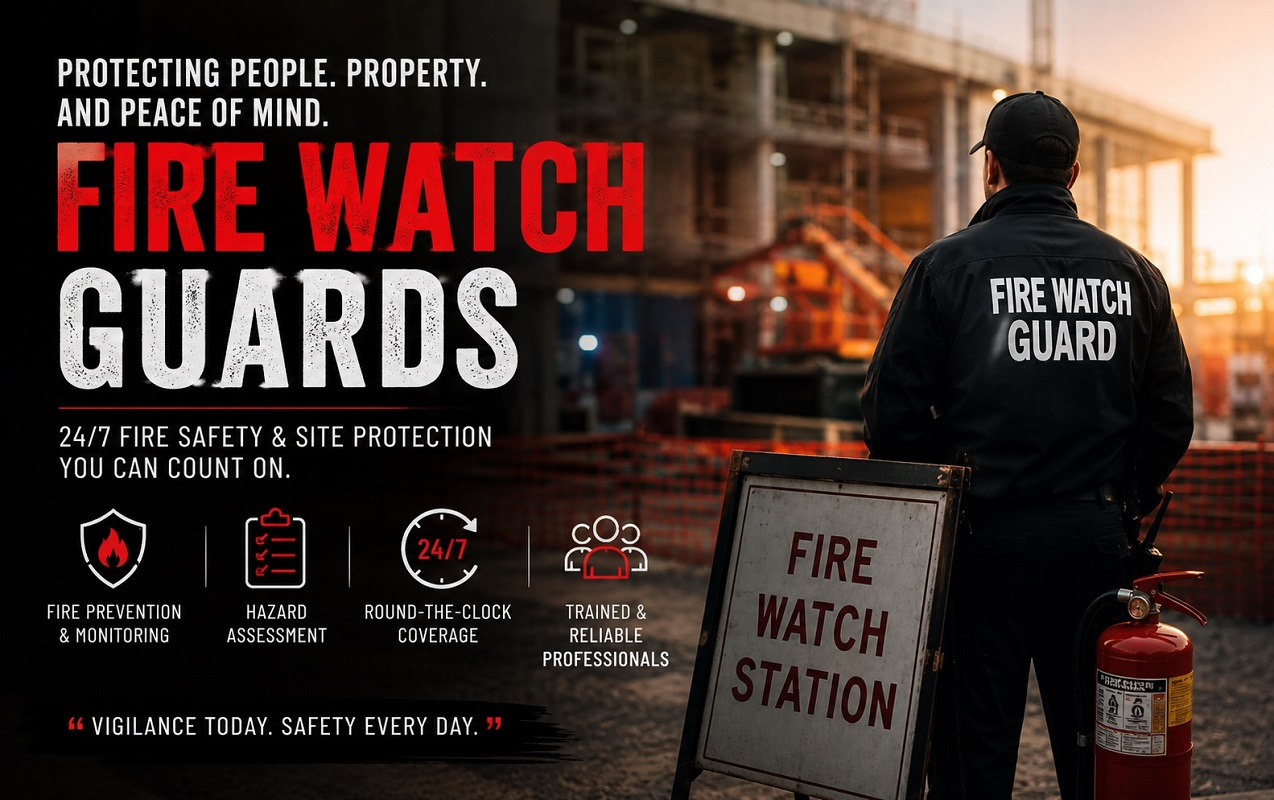
There’s a reason seasoned construction managers lose sleep over fire safety compliance. One gap in coverage — one unmonitored night, one malfunctioning sprinkler system left unattended — can turn a multi-million dollar project into rubble and litigation. Fire watch guards stand between that nightmare and operational reality, yet they remain one of the most underestimated assets in commercial risk management today.
The cost of ignoring fire watch requirements isn’t theoretical. It shows up in insurance claims, OSHA penalties, project delays, and in the worst cases, lives lost. What’s remarkable is how many businesses treat fire watch as a bureaucratic checkbox rather than a genuine line of defense.
The Gap That Gets Businesses Burned
Every building — under construction, under renovation, or simply aging — goes through moments of vulnerability. Sprinkler systems get taken offline during upgrades. Fire alarms malfunction. Hot work like welding and cutting creates ignition hazards that linger long after the sparks stop flying.
During these windows of exposure, the National Fire Protection Association and local fire codes mandate continuous human surveillance. That mandate exists because fire doesn’t wait for a system to come back online.
The gap between when a fire suppression system goes down and when it’s restored is where businesses hemorrhage money — either through preventable fire damage or through compliance violations that trigger immediate project shutdowns. A single citation can cost tens of thousands of dollars. A fire during an unguarded window? The financial damage is exponential.
What Fire Watch Guards Actually Do
The role is deceptively simple on the surface: patrol assigned areas, identify fire hazards, and respond immediately if smoke or fire is detected. But the execution demands vigilance, training, and situational awareness that most untrained personnel simply don’t have.
Qualified fire watch personnel understand NFPA 101 and local fire code requirements. They know how to document their rounds with timestamps and incident logs — documentation that becomes critical evidence during insurance claims or regulatory audits. They recognize early warning signs: the smell of overheated wiring, unusual heat near electrical panels, smoldering materials from earlier hot work operations.
Beyond detection, they serve as a direct communication link between a potential emergency and the fire department. In a scenario where every second matters, having a trained professional on-site who can place that call accurately and immediately — rather than a panicked worker fumbling with a phone — is the difference between a contained incident and a catastrophic loss.
The Hidden Economics of Fire Risk
Most business owners calculate fire watch costs as a line item expense. What they rarely calculate is the cost of not having it.
The Insurance Information Institute estimates that structural fires in commercial properties cause billions of dollars in losses annually across the United States. But the raw damage figure only tells part of the story. Factor in business interruption losses — the revenue stopped cold while a property is uninhabitable — and the numbers become staggering. For manufacturers, that can mean idle supply chains. For contractors, it means missed deadlines and penalty clauses. For hospitality businesses, it means empty rooms during peak season.
Fire watch services, by contrast, represent a fraction of those potential losses. Experienced providers like Just Fire Watch have built their model around this exact value proposition: professional protection delivered at a cost that makes the risk calculus obvious for any serious operator.
The calculation isn’t complex. It’s a matter of whether a business treats fire risk as a genuine liability or dismisses it as something that happens to someone else.
Construction Sites: Where Risk Is Highest
No environment concentrates fire hazards quite like an active construction site. Combustible materials are stacked floor by floor. Electrical work creates ignition points at every turn. Welders and torch operators work in proximity to wood framing, insulation, and adhesives that catch fast and burn hot.
OSHA and local fire marshals don’t view construction fire safety as optional. Hot work permits require post-operation fire watch for a minimum of 30 minutes after welding or cutting — and often longer depending on the materials involved. During system impairment, that watch extends around the clock.
The challenge for general contractors is that compliance doesn’t pause because the crew goes home. A fire started by smoldering material at 2 AM doesn’t care that the project manager is asleep. This is precisely why professional fire watch services operate on rotating shifts, maintaining coverage through nights, weekends, and holidays.
General contractors who partner with dedicated fire watch providers gain more than just compliance coverage. They gain documentation that protects them during insurance audits and legal disputes. They signal to project owners and municipalities that safety is baked into their operations, not bolted on as an afterthought.
Renovations, Hospitals, and High-Stakes Environments
The construction site isn’t the only environment where fire watch becomes mission-critical. Hospitals and healthcare facilities present uniquely complex fire safety challenges. Life safety systems cannot simply be shut down — patients depend on them — yet renovations and repairs demand temporary impairments.
In these environments, fire watch guards operate with heightened protocols. They coordinate directly with facility managers and often with fire department liaisons to ensure response times are compressed. They understand the building’s evacuation procedures and can guide staff and patients if an emergency unfolds. The liability exposure in a healthcare setting is enormous; the human cost is even greater.
Industrial facilities present their own set of challenges. Chemical storage, high-heat processes, and large footprints mean fire can spread rapidly and unpredictably. A qualified fire watch professional stationed in a processing plant during suppression system impairment isn’t just following a code requirement — they’re actively reducing a catastrophic risk that could affect employees, neighboring properties, and the environment.
Why Experience and Certification Matter
Not all fire watch providers are created equal. This is a space where cutting corners carries genuine consequences.
Providers with proper training programs ensure their guards understand NFPA standards, can read a building’s fire suppression layout, and know how to interact with emergency responders. They carry documentation proving their certifications. Their logs are thorough, timestamped, and defensible.
Fly-by-night operators offering discounted rates often deploy untrained personnel who treat the assignment as glorified security work. The difference becomes obvious fast — especially during an actual incident, when a guard’s response speed, communication clarity, and situational knowledge directly impact outcomes.
Businesses that have worked with experienced fire watch specialists describe a noticeable difference in operational confidence. Knowing that qualified professionals are actively protecting the property overnight allows project managers and executives to focus on moving the work forward rather than worrying about what might happen in the dark.
The Regulatory Landscape Is Tightening
Fire codes across U.S. municipalities have grown more stringent in recent years, and that trajectory isn’t reversing. Cities and counties that once tolerated loose compliance interpretations are now deploying more rigorous inspection protocols, particularly in the wake of high-profile fire incidents that drew public scrutiny.
Insurance underwriters are following the same direction. Carriers are requiring more detailed documentation of fire safety compliance as a condition of coverage. Some are outright excluding claims related to hot work or system impairment if proper watch protocols weren’t followed and logged.
This regulatory and underwriting pressure is reshaping how smart operators think about fire watch. It’s no longer a reactive measure deployed only when a fire marshal requires it. Forward-thinking companies are building fire watch coverage into project planning from day one — budgeting it alongside other safety costs and selecting providers with the documentation infrastructure to satisfy both regulators and insurers.
The Standard That Separates Prepared from Exposed
There’s a pattern visible across industries where fire safety is taken seriously: the organizations that treat it as infrastructure rather than insurance tend to have better outcomes across the board. They finish projects on schedule. Their insurance premiums reflect a track record of responsible operations. Their relationships with local fire marshals are collaborative rather than adversarial.
Fire watch guards are a core part of that infrastructure. They represent human intelligence deployed in spaces where automated systems don’t exist, are temporarily offline, or simply can’t match the judgment of a trained professional reading a live environment.
The companies that understand this don’t debate whether fire watch is worth the investment. They debate which provider offers the most rigorous standards, the most reliable coverage, and the documentation that will hold up when it matters most.
That question has a clear answer for operators who take their risk management seriously — and the cost of getting it wrong is one no business should be willing to absorb.
