

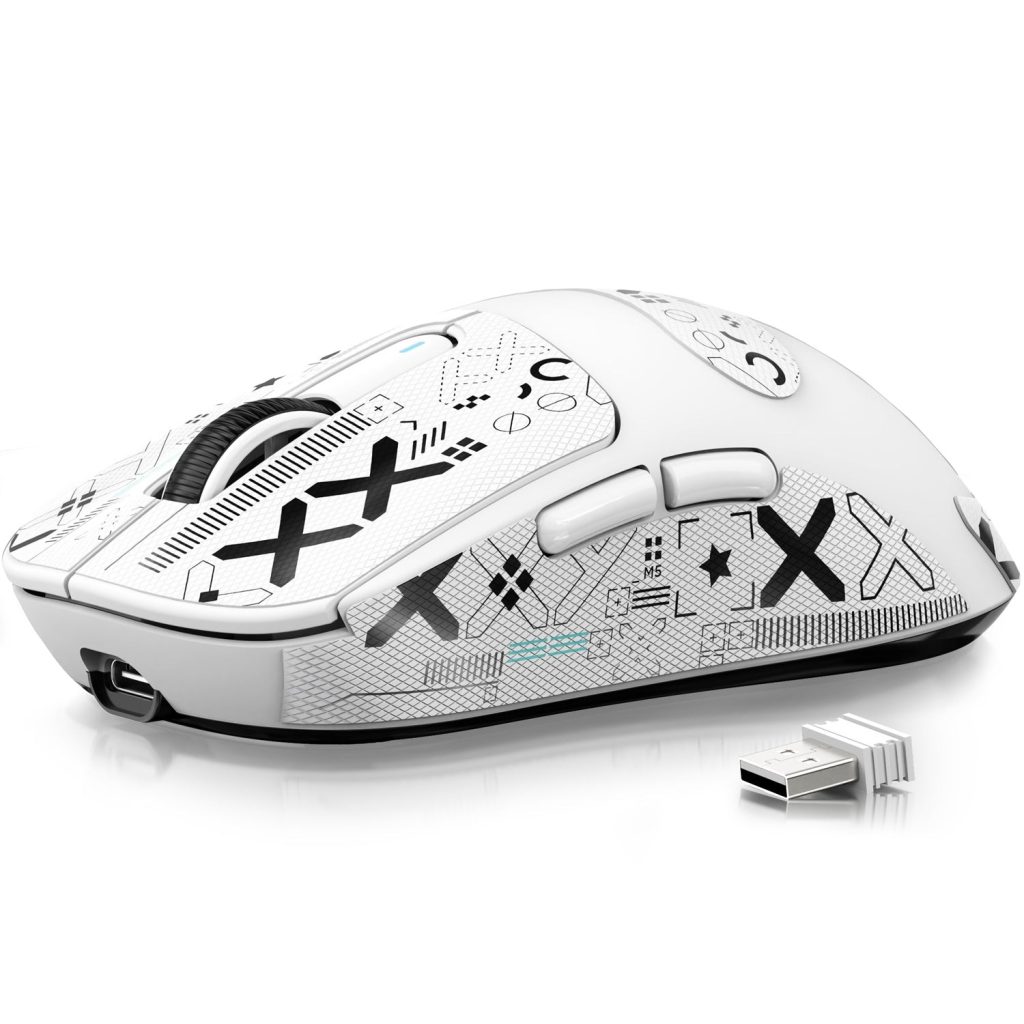
In competitive gaming, milliseconds separate victory from defeat. The peripheral in your hand becomes an extension of your reflexes, and any friction between intention and execution can cost you a crucial play. Over the past several years, gaming mice have undergone a dramatic transformation—shedding weight at an unprecedented pace as manufacturers discovered that lighter designs fundamentally change how players interact with their games. This shift raises a compelling question: how does reducing a mouse’s weight actually impact the performance of a programmable gaming mouse, particularly when advanced features like customizable buttons and onboard profiles demand internal components?
The answer lies in an intricate balance between engineering innovation and player biomechanics. From cutting-edge sensor technology that delivers flawless tracking to tri-mode connectivity options that eliminate cable resistance, ultralight mice represent a convergence of design philosophy and competitive necessity. In this exploration, we’ll examine why going lighter doesn’t mean sacrificing functionality—and how it may actually unlock the full potential of every programmable feature at your fingertips.
The Fundamentals of Ultralight Gaming Mice
An ultralight gaming mouse typically weighs under 70 grams—some pushing below 50 grams—achieved through strategic material choices, honeycomb shell designs, and minimalist internal layouts. This category represents a stark departure from the early 2010s, when flagship gaming mice routinely exceeded 100 grams and even included adjustable weight cartridges to make them heavier. The philosophy was simple: heavier meant more premium and more controlled. That assumption has since been dismantled by professional players and engineers who recognized that excess mass works against the very reflexes gamers depend on.
For a programmable gaming mouse, this weight revolution creates a fascinating engineering challenge. Programmable buttons, onboard memory for storing profiles, and advanced PCB components all occupy physical space and add mass. Achieving ultralight status while preserving full programmability requires deliberate trade-offs in shell thickness, battery size, and component placement. The result, when executed well, gives tech enthusiasts something remarkable: a mouse that responds to micro-adjustments with zero resistance while still offering deep customization through software-defined button mapping, DPI switching, and macro programming. It’s the intersection of mechanical minimalism and digital complexity that defines the modern ultralight programmable mouse.
How Ultralight Design Enhances Gaming Performance
The physics behind ultralight performance gains are straightforward but profound. A lighter mouse requires less force to initiate movement, stop, and change direction. In practical terms, this means a player flicking to a target in a first-person shooter encounters less inertia fighting against their wrist snap. The mouse arrives where the brain intended it to go faster, with less overcorrection needed to settle on the target. Professional Counter-Strike and Valorant players have widely adopted mice under 60 grams precisely because these titles demand rapid, repeated micro-flicks where even small reductions in resistance compound into measurable accuracy improvements over hundreds of engagements per match.

Beyond raw speed, the fatigue reduction from an ultralight programmable gaming mouse proves transformative during extended sessions. Moving a 50-gram mouse across a large pad for eight hours of practice or tournament play places dramatically less cumulative strain on the forearm, wrist, and shoulder compared to a 90-gram alternative. Players report maintaining sharper aim deeper into matches and experiencing fewer repetitive strain symptoms over weeks of intensive use. The ergonomic benefit isn’t merely comfort—it’s sustained performance. When your hand isn’t fighting weight, it can focus entirely on executing precise inputs, whether that’s a rapid flick, a slow tracking adjustment, or activating a programmed macro button without disrupting your aim trajectory. This synergy between reduced mass and maintained programmability gives competitive players a tangible advantage that compounds across every gaming session.
Inside the Mouse: Omron Switches and Sensor Technology
Stripping weight from a gaming mouse means nothing if the internal components can’t deliver reliable, precise input. The core of any programmable gaming mouse lies in two critical systems: the switches beneath your fingers and the sensor tracking every movement across your pad. In ultralight designs, these components must perform flawlessly while occupying minimal space and adding as little mass as possible—a constraint that has pushed manufacturers toward increasingly sophisticated engineering solutions.
Omron Switches: Reliability in Every Click
Omron switches have become the gold standard in competitive gaming mice for good reason. Rated for tens of millions of actuations, they deliver a crisp, consistent tactile response that lets players distinguish between a registered click and a missed input without visual confirmation. Unlike mushier alternatives that degrade over time, Omron mechanical microswitches maintain their actuation force and debounce characteristics throughout their lifespan. For programmable mice where a single button might trigger complex macros or weapon swaps, this consistency is non-negotiable—every programmed action must fire exactly when intended, thousands of times per session without variation.
Precision Tracking: The Heart of Sensor Technology
Modern optical sensors in ultralight mice achieve tracking speeds exceeding 400 IPS and acceleration tolerance above 40G, meaning no human hand movement can outpace them. Paired with adjustable DPI settings—often programmable in increments as fine as 50 DPI—these sensors translate physical motion into cursor movement with zero smoothing or interpolation artifacts. Polling rates of 1000Hz ensure positional data updates every millisecond, critical for scenarios where a Valorant player holds a pixel-thin angle or an RTS competitor selects units in rapid succession. The sensor’s precision tracking works in concert with programmability: players can assign different DPI stages to dedicated buttons, switching sensitivity profiles instantaneously based on whether they’re sniping or clearing close quarters.
Connectivity Matters: Exploring Tri-Mode Options
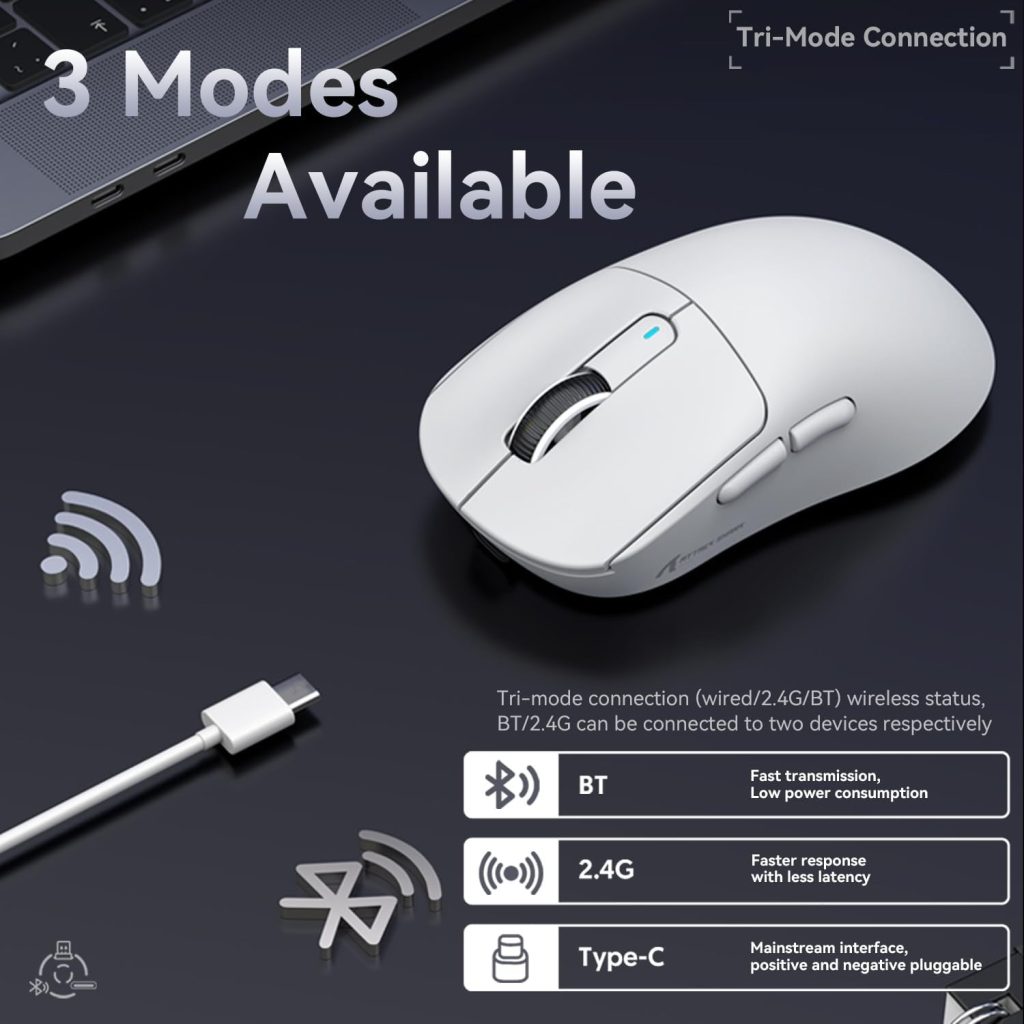
Tri-mode connectivity—combining wired USB, low-latency 2.4GHz wireless, and Bluetooth in a single device—has become essential to the ultralight programmable gaming mouse experience. Brands like ATTACK SHARK have embraced this tri-mode approach in their ultralight lineups, recognizing that each mode serves a distinct purpose: the 2.4GHz wireless connection delivers sub-one-millisecond response times virtually indistinguishable from wired play, Bluetooth extends battery life for casual browsing or travel use, and wired mode ensures uninterrupted performance during charging or tournament environments where wireless signals face interference. This flexibility means players never compromise based on their setup, whether competing on stage, practicing at home, or gaming on a laptop during travel.
For ultralight designs specifically, tri-mode connectivity solves a critical problem that plagued earlier lightweight mice. A cable, no matter how paracord-flexible, introduces drag that counteracts the benefits of a sub-60-gram chassis. Wireless freedom lets the mouse glide with its true weight, preserving the frictionless feel that makes ultralight designs so responsive. Meanwhile, the programmable features remain fully accessible across all three modes—stored onboard profiles, DPI stages, and button mappings function identically whether connected via dongle or cable, ensuring your customized setup follows you regardless of how you connect.
A Practical Guide to Choosing Your Programmable Gaming Mouse
Selecting the right ultralight programmable gaming mouse requires a systematic approach rather than chasing spec sheets alone. Start by honestly assessing your grip style and sensitivity preferences—claw grip players often benefit most from mice under 55 grams since their fingertip-driven micro-adjustments amplify every gram saved, while palm grip users may find slightly heavier builds around 60-65 grams offer better control during sweeping arm movements.
Next, evaluate the sensor specifications with your actual gaming habits in mind. If you play tactical shooters at low sensitivity, prioritize sensors with flawless tracking at slow speeds and zero spin-out risk during fast flicks. Check that DPI adjustment stages are programmable in fine increments so you can dial in exact sensitivities rather than settling for preset jumps. Verify the switch type beneath the primary buttons—Omron switches or equivalent mechanical microswitches ensure that your programmed macros and rapid-fire inputs register identically on click one and click ten million. For connectivity, confirm the mouse offers tri-mode connectivity with a dedicated 2.4GHz dongle, since Bluetooth alone introduces latency unsuitable for competitive play. Finally, test the software’s programmability depth: onboard memory for storing profiles independently of software, per-button remapping, and DPI-per-profile settings mean your configuration travels with you across any system without reinstalling drivers.
Ultralight Programmability as the Future of Competitive Gaming
The ultralight revolution has fundamentally redefined what a programmable gaming mouse can achieve. By stripping away unnecessary mass, manufacturers have created instruments that translate human intention into digital action with unprecedented fidelity—faster flicks, more precise tracking adjustments, and sustained accuracy across marathon sessions that would exhaust players wielding heavier alternatives. Yet weight reduction alone tells only part of the story. The convergence of reliable Omron switches ensuring every programmed input fires without hesitation, advanced optical sensors delivering flawless precision tracking at any speed, and tri-mode connectivity eliminating the cable drag that once undermined lightweight chassis designs creates a holistic performance package greater than the sum of its parts.
When selecting your next programmable gaming mouse, let these principles guide your decision: prioritize genuine weight savings that match your grip style, verify that internal components meet competitive-grade standards, and ensure connectivity options preserve the frictionless experience ultralight engineering promises. The trajectory of gaming peripheral design points toward even lighter, more capable devices as materials science advances and component miniaturization continues. Players who embrace this philosophy now position themselves at the leading edge of competitive performance—where the mouse disappears from awareness entirely, leaving only pure, unimpeded gameplay.
