

Unity production in 2026 has shifted from experimental builds to structured, long-term delivery pipelines. Multiplayer features, LiveOps expansion, cross-platform deployment, and retention-driven mechanics demand engineering depth beyond short-term staffing. Many studios reach a stage where the logical next step is to hire Unity developer capacity externally under controlled engagement models.
However, the decision is no longer about simply adding headcount. Governance maturity, architectural ownership, and sprint alignment now determine whether external Unity talent strengthens your roadmap or introduces technical instability. A poorly structured hiring model creates integration friction and knowledge gaps across releases.
This guide evaluates five companies where you can hire Unity developer support under scalable engagement structures. The focus remains on how to evaluate them correctly rather than choosing based on cost or marketing claims alone.
TL;DR
Before selecting a partner, understand the structural realities shaping Unity hiring in 2026.
- Dedicated team structures provide stronger roadmap continuity than isolated hourly contracts.
- Governance maturity impacts sprint velocity more than team size.
- Multiplayer readiness requires backend planning and synchronization expertise.
- Cross-platform optimization separates scalable partners from rapid prototyping shops.
- Studios that hire Unity 3D developers through structured engagement models such as those implemented by Juego Studios gain stronger subsystem ownership and delivery predictability.
- Long-term stability depends on architecture discipline, not short-term cost savings.
What It Really Means to Hire Unity Developer in 2026
Hiring Unity talent in 2026 is a structural production decision. Studios no longer succeed by adding individual contributors without defined ownership boundaries. You must evaluate how external Unity engineers integrate into your architecture, sprint cadence, and long-term roadmap.
When you Hire Unity Developer capacity, you typically choose between three models:
- Individual augmentation embedded into internal teams.
- Dedicated pods responsible for feature verticals.
- Co-development teams sharing architectural accountability.
Dedicated pods reduce onboarding friction and improve knowledge retention across releases. They also allow clearer subsystem ownership, reducing duplication between internal and external teams.
Multiplayer development increases complexity. Real-time synchronization, backend services, matchmaking logic, and LiveOps integration require disciplined planning. Vendors without multiplayer governance maturity may struggle when scaling concurrency.
Cross-platform deployment adds additional pressure. Unity titles targeting mobile, PC, and console must account for performance profiling, memory optimization, and platform-specific compliance requirements.
The right hiring decision aligns engagement structure with roadmap complexity. Studios that evaluate architecture depth, governance clarity, and scaling flexibility achieve predictable production outcomes.
How To Evaluate When You Hire Unity 3D Developers
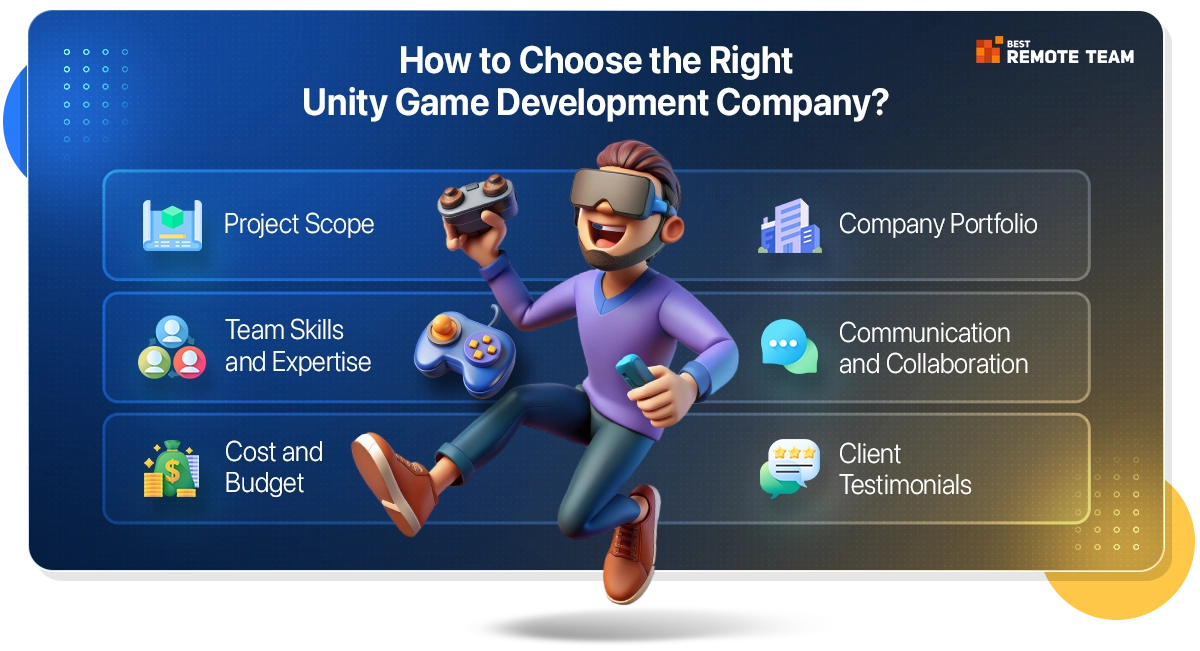
Selecting the right vendor requires disciplined evaluation beyond portfolio screenshots. When you Hire Unity 3D Developers, focus on operational stability rather than surface-level positioning.
- Architecture Depth: Assess experience with scalable C# architecture, asset management pipelines, memory profiling, and cross-platform performance tuning. Ask for subsystem walkthroughs rather than demo reels.
- Dedicated Team Stability: Examine retention patterns, onboarding structure, and sprint integration cadence. Stable team composition improves knowledge continuity across releases.
- Multiplayer Exposure: Evaluate familiarity with Photon, Mirror, PlayFab, or custom backend systems. Real-time implementation requires more than UI-level synchronization.
- Cross-Platform Delivery: Confirm deployment experience across Android, iOS, PC, and console builds. Platform compliance planning should begin early in production.
- Governance & Reporting: Look for defined milestone reporting, documentation discipline, and escalation pathways. Governance clarity reduces integration risk in distributed environments.
A disciplined evaluation process protects your roadmap from short-term hiring mistakes.
Top 5 Companies to Hire Unity Developer
The following companies are positioned based on dedicated team maturity, engagement model clarity, multiplayer capability, and governance strength. The ranking reflects evaluation criteria discussed earlier rather than marketing volume.
Each profile includes a concise assessment followed by a structured pros and cons comparison to support balanced decision-making.
Juego Studios
Juego Studios operates as a structured co-development partner supporting studios that need to hire Unity developer capacity under dedicated engagement models. With a global footprint and a 250+ team size, the studio integrates Unity engineering pods into existing sprint pipelines while maintaining architectural governance. Their model emphasizes subsystem ownership, multiplayer execution depth, and long-term roadmap alignment rather than isolated augmentation.
Organizations that hire Unity 3D developers through Juego typically leverage dedicated pods capable of handling multiplayer systems, LiveOps coordination, cross-platform deployment, and console optimization within defined accountability structures. The company positions itself around scalable governance and co-development maturity rather than transactional staffing.
| Pros | Cons |
| Strong dedicated pod governance structure | May exceed needs of small prototype-only projects |
| Multiplayer and LiveOps implementation depth | Structured onboarding may require defined internal processes |
| Cross-platform deployment including console readiness |
StudioKrew
StudioKrew focuses on dedicated Unity team allocation with strong emphasis on multiplayer and immersive gameplay systems. With experience across mobile, desktop, AR, and console builds, the company supports startups and studios seeking structured integration rather than short-term contracts. Their services include full-cycle development, real-time multiplayer frameworks, and Unity-based MVP execution.
The company integrates Photon, Mirror, PlayFab, and cloud services to support scalable real-time environments. StudioKrew’s engagement model emphasizes collaborative sprint alignment and feature ownership clarity within distributed teams.
| Pros | Cons |
| Real-time multiplayer framework expertise | Smaller global footprint compared to larger firms |
| Full-cycle Unity lifecycle support | Less enterprise-scale team size than Tier 1 providers |
| Strong MVP-to-scale transition capability | May prioritize gaming vertical over broader enterprise use cases |
Citta
Citta positions itself as a flexible dedicated Unity development partner with global presence across 17+ countries. The company provides structured engagement models including fixed price and dedicated teams, supporting AR, VR, cross-platform builds, and enterprise gamification initiatives.
Their agile governance structure and ability to scale team size up or down align well with evolving roadmap requirements. Citta emphasizes transparency and ownership clarity within distributed development environments.
| Pros | Cons |
| Flexible team scaling options | Less publicly documented multiplayer specialization |
| Cross-industry Unity deployment exposure | Broader IT focus beyond pure gaming specialization |
| Clear IP and code ownership policies | May require stronger internal technical leadership |
Hyperlink InfoSystem
Hyperlink InfoSystem offers tiered hiring structures including junior, senior, QA, and project management support. The company supports clients seeking structured role allocation under hourly, monthly, or long-term engagement formats. With a large workforce, they provide scalability across multiple technical verticals.
Their Unity services focus primarily on mobile development, AR/VR integration, and application-level builds. The structured team hierarchy supports organized reporting and quality control processes.
| Pros | Cons |
| Tiered hiring structure with role clarity | Limited emphasis on advanced multiplayer depth |
| Large talent pool for scaling quickly | Broader IT focus may dilute Unity specialization |
| Flexible engagement duration options | Enterprise co-development maturity less emphasized |
Polymator
Polymator provides dedicated Unity hiring models with strong emphasis on collaboration, cost efficiency, and data security. The company supports full project execution and feature-level augmentation through transparent engagement structures.
Their model includes fixed-price, time-and-material, and dedicated hiring formats, allowing flexibility depending on project scope and budget sensitivity. Polymator positions itself as a cost-conscious scaling option for Unity-focused teams.
| Pros | Cons |
| Cost-efficient dedicated hiring model | Smaller team scale compared to larger firms |
| Transparent engagement structure | Limited publicly visible enterprise case studies |
| Strong data security and IP protection focus | May require closer client-side roadmap direction |
Cost to Hire Unity Developer in 2026
Cost evaluation should align with engagement structure, seniority, and multiplayer complexity. While individual hiring may appear economical initially, dedicated pods often reduce long-term architectural disruption and onboarding churn.
Below is a representative monthly cost benchmark reflecting both India-dominant sourcing and US-based hiring in 2026.
| Role / Engagement Model | INR (Monthly) | USD (Monthly) | Best Use Case |
| Mid-Level Unity Developer | ₹1,80,000 – ₹2,80,000 | $6,500 – $9,500 | Gameplay systems, UI, feature expansion |
| Senior Unity Engineer | ₹3,20,000 – ₹4,80,000 | $12,000 – $18,000 | Architecture design, cross-platform systems |
| Multiplayer Engineer | ₹4,00,000 – ₹5,80,000 | $15,000 – $22,000 | Real-time synchronization, backend integration |
| Unity Technical Lead | ₹5,50,000 – ₹7,50,000 | $18,000 – $26,000 | Code governance, subsystem ownership |
| Dedicated Unity Pod (3–5 Members) | ₹9,00,000 – ₹18,00,000 | $35,000 – $75,000 | Feature vertical ownership, co-development scaling |
Costs vary based on:
- Multiplayer concurrency requirements
- LiveOps roadmap depth
- Cross-platform deployment scope
- Dedicated versus individual engagement structure
- Retention and onboarding continuity
Evaluating cost without considering governance maturity often leads to unstable scaling decisions.
Common Hiring Mistakes to Avoid
Studios that rush hiring decisions frequently encounter integration instability. The following structural mistakes reduce long-term roadmap clarity.
- Cost Over Governance: Selecting the lowest bid without reviewing sprint integration maturity often results in fragmented delivery. Governance discipline influences outcome more than hourly pricing.
- Undefined Subsystem Ownership: When internal and external engineers share ambiguous responsibilities, duplication and misalignment increase. Dedicated pods require clearly defined accountability boundaries.
- Ignoring Multiplayer Complexity: Real-time systems demand synchronization logic, backend coordination, and performance testing. Underestimating this layer increases technical debt rapidly.
- Short-Term Scaling Decisions: Adding Unity engineers incrementally without architectural oversight disrupts consistency. Scaling must align with technical leadership capacity.
- No Reporting Framework: Distributed Unity teams require milestone transparency and escalation paths. Without structured reporting, production becomes reactive.
Conclusion
The decision to Hire Unity Developer capacity in 2026 must align with governance clarity, architectural depth, and roadmap complexity. Dedicated team maturity, multiplayer readiness, and engagement flexibility determine sustainable delivery outcomes.
Studios that evaluate structure before cost protect their long-term production stability. Hiring discipline now shapes scalability tomorrow.
Frequently Asked Questions
How much does it cost to Hire Unity Developer resources in 2026?
Costs range between ₹1.8 lakh and ₹7.5 lakh per month in India depending on seniority, and between $6,500 and $26,000 in the US. Dedicated pods increase total monthly investment but improve delivery continuity.
Is it better to hire Unity 3D developers individually or through dedicated teams?
Dedicated teams provide stronger subsystem ownership and knowledge retention. Individual augmentation works when internal architecture leadership remains strong and clearly defined.
How long does it take to onboard Unity engineers?
Most vendors require one to two weeks for documentation alignment and sprint integration. Larger dedicated pods may require phased ramp-up.
What skills should I evaluate before hiring?
Strong C# architecture knowledge, cross-platform deployment experience, multiplayer system implementation, and performance optimization remain essential.
Can remote teams handle multiplayer Unity projects effectively?
Yes, provided governance discipline, backend integration planning, and milestone reporting are structured clearly from the start.
What engagement model reduces hiring risk?
Milestone-based dedicated team agreements reduce ambiguity. Clear reporting cadence and defined subsystem ownership improve predictability.
How do I validate a vendor’s Unity capability?
Request architecture walkthroughs, prior deployment examples, and multiplayer system case discussions. Technical interviews should probe scalability and optimization planning.
