

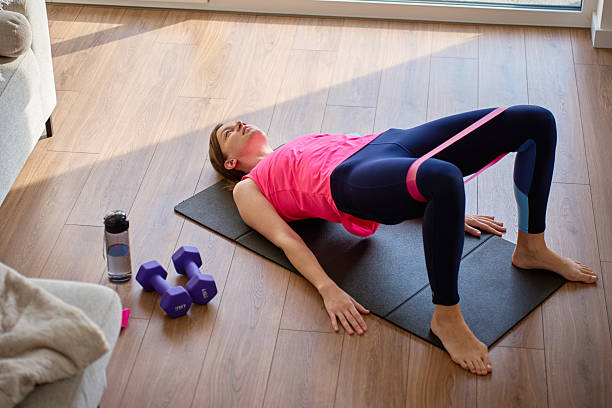
Working from home sounds like a fitness opportunity. No commute means extra time. No office means you can work out whenever. The kitchen is right there, so eating well should be easier. None of that turned out to be true for me, and I suspect it is not true for most people who have tried it. What actually happens is that the boundaries between work and everything else dissolve, the day stretches in strange directions, movement drops to nearly zero because you never have to walk anywhere, and by the time the laptop closes, you are more sedentary than you ever were in an office. That is the context in which I started looking seriously at a structured dumbbell glute workout routine, not from a place of having figured things out, but from a place of noticing that my body had quietly deteriorated over eighteen months of working from a spare bedroom with almost no deliberate movement.
My hips ached in the morning. My lower back was stiff by noon. Climbing stairs left me slightly breathless in a way that genuinely alarmed me. I was thirty-four years old. None of those things should have been happening yet. A friend who had been training at home for a couple of years told me the glutes were almost certainly the starting point; that everything I was describing was connected to those muscles switching off and that fixing that one thing would have knock-on effects across most of the other complaints. She was right, as it turned out. But getting there took longer and required more patience than I was initially prepared for.
Why Working From Home Makes This Harder Than Office Work
In an office, even a sedentary one, there is incidental movement built into the day. Walking to a meeting room. Going to someone else’s desk. Getting lunch from somewhere other than your own kitchen. None of it is exercise but it is movement, and movement keeps the glutes at least minimally engaged throughout the day. Working from home removes most of that. Some people go from bedroom to desk to couch and back with barely a hundred steps in between. Over months that baseline inactivity compounds into something that regular training sessions struggle to fully counteract.
There is also the psychological dimension of working from home that nobody really talks about in fitness contexts. When work and home are the same place, the mental switch-off that usually happens during a commute does not occur. You finish a meeting, and you are still at your desk, still in work mode, still surrounded by the visual cues of work. Carving out time and mental space for a training session requires more deliberate effort than it does when you have physically left one environment and arrived in another. This is a real barrier, and pretending it is not does not help anyone.
The Setup That Actually Got Me Moving Consistently
For the first few weeks I kept my dumbbells in a cupboard because I did not want them cluttering the room. I trained maybe once a week, sometimes less. Then I left them out on the floor next to the desk and trained four times the following week without doing anything differently except changing where the equipment lived. That genuinely annoyed me because it meant the problem had been this simple all along and I had just not done it.
Visible equipment is a cue. Every time you walk past it, you are reminded, and that reminder has a cumulative effect on whether the session actually happens. I also started keeping a small notebook next to the dumbbells with my last session written in it. Seeing the date of the last workout and the exercises I did was enough friction to make skipping feel more deliberate and less passive. You have to actively decide not to train rather than just drifting past it without thinking. That distinction matters more than it sounds.
The Exercises That Worked Best in a Small Space
My home office is not large. A desk, a chair, a bookshelf, and barely enough floor space for a yoga mat lengthways. That is it. So some exercises that are theoretically great for glutes were not practical in that context. Reverse lunges and lateral lunges both require more lateral space than I had consistently available. Walking lunges were out entirely. What worked was anything that could be done in a relatively fixed footprint.
Hip thrusts off the edge of the desk chair, surprisingly, worked fine. The chair height was almost perfect, and the exercise became one of my most reliable options. Romanian deadlifts require almost no lateral space; you just need to be able to hinge forward and back. Goblet squats take up essentially the same footprint as standing still. Bulgarian split squats needed the chair anyway for the elevated foot, and once the foot was on it the rest of the movement stayed within a manageable area. Small space glute training is genuinely doable once you stop trying to do exercises designed for an open gym floor.
What I Got Wrong About Rep Ranges Early On
I spent most of the first month doing sets of fifteen to twenty reps because I had read somewhere that higher reps were better for glute growth. I am not sure where that idea comes from originally, but it sent me down a slightly wrong path for a while. High rep sets with light weight kept me in a comfortable zone where the exercise felt like cardio rather than strength training: heart rate up, breathing harder, but the glutes never really reaching the kind of deep fatigue that produces growth.
Dropping to eight to twelve reps with a weight that made the last two or three genuinely hard changed things considerably. The sets were shorter, but the effort was higher. By the final rep of a set of ten Romanian deadlifts with a challenging weight, the hamstrings and glutes were fully loaded in a way that twenty reps at a lighter weight never produced. The soreness the following day was different too; deeper and more localized to the actual target muscles rather than the generalized fatigue of high-rep work.
Both rep ranges have a place. But if you are doing all your work above fifteen reps and wondering why progress is slow, trying a block of heavier, lower-rep training is worth experimenting with.
The Mid-Workout Feeling You Need to Learn to Recognise
There is a specific sensation in a well-executed glute exercise that took me weeks to identify and is now the thing I use to evaluate whether a set was worth doing. It is not the burning you feel in the quad during a squat. It is not the generalized fatigue of cardio. It is a deep, slightly uncomfortable muscular tension in the posterior hip that builds across the set and peaks somewhere around the last two reps. When I feel that during a set, I know the right muscles are working. When I do not feel it, something in the form or the loading is off.
Learning to notice this during training is the skill that everything else builds on. You cannot rely on soreness the next day as real-time feedback; it tells you something happened but not what. The sensation during the set is the signal that matters. Chase it. If a set finishes and you mostly felt things in your lower back or your quads, change something before the next one: your stance, foot position, tempo, or the cue you are using. Do not just repeat a set that did not produce the right feeling and hope the next one will be different.
How the Morning Routine Changed Everything
The training sessions were three times a week in the evening initially. Fine, they happened, but they felt like something bolted onto the end of an already long day. Around week six I shifted one session to the morning, before starting work, and the difference in energy and focus was significant enough that I eventually moved all three sessions to mornings. Not everyone can do this; some people genuinely cannot function well physically first thing. But if there is flexibility in the work schedule, morning sessions have an advantage that is hard to overstate; they happen before the day can interfere with them.
Working from home means the commute time that was previously lost is now available in the morning. A thirty-minute glute session replaces a thirty-minute drive and does considerably more for how the body feels for the rest of the day. That reframe helped me stop thinking of morning training as an additional commitment and start thinking of it as a better use of time that already existed.
Six Months In: What Has Actually Changed
The lower back stiffness is gone. Not reduced; gone. My hips move freely in a way they have not since my mid-twenties. Stairs are not a mild physical challenge anymore. The shape of my glutes has changed visibly enough that people who see me regularly have commented on it without me bringing it up, which is honestly the most satisfying kind of progress because it means it is obvious to someone looking rather than just detectable to me when I am specifically looking for it.
Strength numbers are places I did not expect to reach from home training alone. The combination of consistent sessions, progressive loading, and the exercise breakdowns from the 15 Best Glute Dumbbell Exercises guide on My Exercise Snacks gave me enough structure to keep improving past the beginner phase without needing a coach or a gym. That resource in particular helped when I hit the point where the basic exercises felt too easy and I needed to understand what to progress to next; it answers that question clearly and practically.
What I Would Change If Starting Again
I would address hip flexor tightness from day one instead of waiting until it became obviously limiting. I would leave the equipment out immediately rather than tidying it away. I would start with heavier weights sooner and spend less time in the high-rep comfort zone. And I would accept from the beginning that the first month is not really training in the meaningful sense; it is preparation for training, and being patient with that phase makes everything after it work considerably better.
None of these are dramatic revelations. But the gap between knowing something in theory and actually applying it from the start is where most people lose months of potential progress. If reading this saves someone even four weeks of spinning their wheels on the wrong approach, it was worth writing.
