

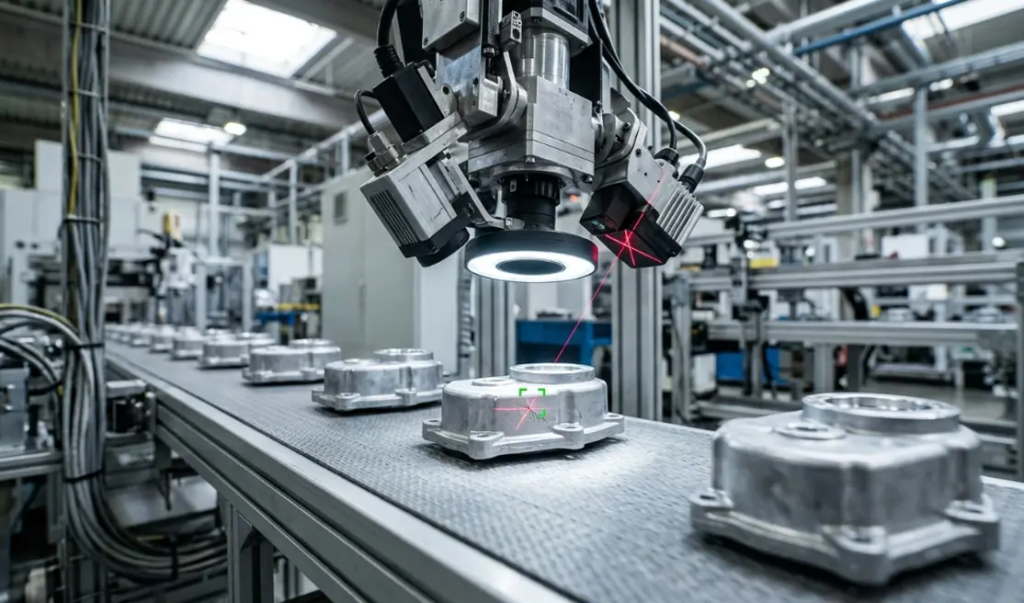
Recent research has concluded that human visual inspection misses roughly 20 to 30 percent of defects on average. It’s the natural ceiling of repetitive, high-precision work hour after hour, and it’s why factories are shifting hard toward AI-assisted inspection. Manual checks and rule-based optical systems weren’t built for the speed of modern production. Inspectors tire and rule-based vision faces issues when lighting or product variants change. Meanwhile, quality expectations keep climbing, and the cost of letting a defect slip has risen faster than the cost of catching one.
This article walks through the main techniques manufacturers use today, where each one shines, and where the technology’s heading next.
Why Surface Defect Detection Matters in Manufacturing
A flaw during surface defect detection creates obstacles further down the line. A flaw spotted at the source costs a part. A flaw spotted by the customer costs you the part, the rework, the shipping, the warranty handling, and sometimes the relationship itself.
Surface defects are harder to deal with since they’re often subtle and lighting-dependent, easy to miss even for a skilled inspector. As tolerances tighten and product surfaces grow more complex, the cost of letting them slip through has climbed while the cost of catching them has dropped. That’s the math driving the shift to modern inspection systems.
Optical Inspection Methods for Detecting Surface Defects
Machine vision is the cornerstone of modern industrial quality control, and most factories rely on it for the bulk of their inspection work. Three core techniques do most of the heavy lifting.
2D Vision and Edge Detection:
This technique uses pixel intensity variations to spot linear surface defects like scratches and micro-cracks. Fast, well understood, and reliable on flat or lightly textured surfaces.
Phase Shifting Deflectometry (PSD):
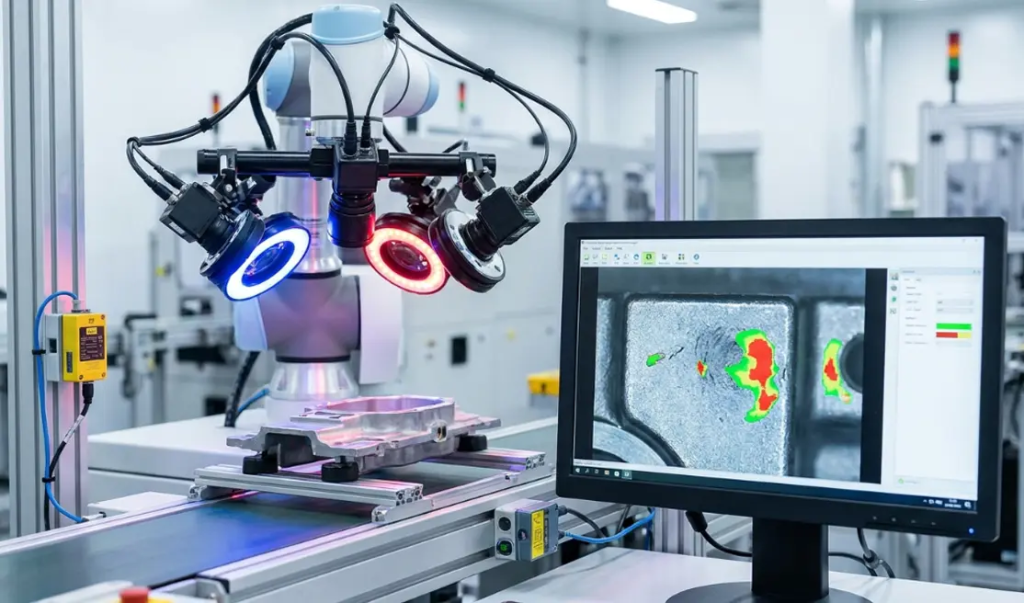
It projects structured light patterns onto reflective or flat surfaces and builds intensity, amplitude, and curvature maps from how those patterns deform. PSD is what finally made it possible to catch microscopic dents on shiny surfaces like painted car panels.
Laser Scanning and Profilometry:
When a 2D image can’t tell you how deep something is, lasers can. This approach captures detailed 3D geometry, letting manufacturers measure surface height irregularities and structural profiles with precision.
How AI Improves Surface Defect Detection
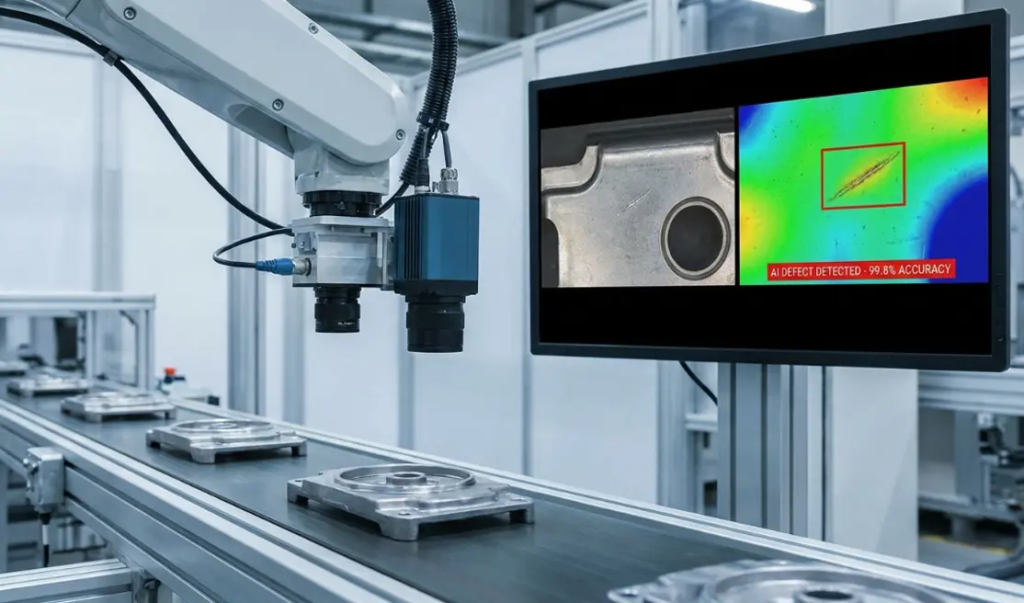
Traditional algorithms struggle when conditions change. That’s why AI defect detection has moved from research labs onto production lines so quickly. Deep learning models don’t follow hand-written rules. Instead, they learn from examples, which means they handle variation in ways traditional vision systems can’t match.
Convolutional Neural Networks (CNNs):
Specialized models like SqueezeNet are trained to classify and localize defect types. They’ve become the workhorse of modern visual inspection because they’re accurate and compact enough to run at full line speed.
Object Detection and Segmentation:
Architectures like YOLO, U-Net, and FPN draw bounding boxes around defects or separate them from the background pixel by pixel. Especially helpful with small-scale anomalies that earlier systems would have written off as noise.
Continuous Improvement:
AI models aggregate inspection data over time and flag recurring issues, which lets engineers run real root-cause analysis instead of treating each defect as a one-off. The system doesn’t just catch defects. It helps you understand why they happen.
How Non-Destructive Testing Supports Surface Inspection
Not every defect cooperates by sitting on the surface. Plenty hide just beneath, or inside the part entirely. And sometimes the surface itself is non-reflective or opaque, leaving optical methods unable to see what they need to.
That’s where non-destructive testing is used. NDT lets you inspect a part without damaging it, so anything that passes goes straight to the next station.
- Ultrasonic Testing: Uses high-frequency sound waves to probe for hidden flaws and voids beneath the surface. Common in aerospace, pressure vessels, and heavy industrial parts where structural integrity is non-negotiable.
- X-Ray and Radiographic Inspection: Gives operators a clear view of internal structures, pinpointing internal cracks or density variations. Widely used in electronics for solder joint inspection, and in castings where porosity is a make-or-break issue.
- Eddy Current Testing: Uses electromagnetic induction to detect surface and near-surface flaws in conductive materials. Fast, contact-free, and well suited to inline use on metal parts.
How to Choose the Right Surface Defect Detection Method
There’s no single best method. The right choice depends on what you’re working with: the material, the geometry of the part, the type of defect you’re chasing, the speed of your line, and your budget.
For flat, uniformly lit surfaces with scratches or simple defects, 2D machine vision is usually enough. For reflective or curved surfaces, deflectometry handles what 2D can’t. For deep structural defects in metals or composites, NDT is the best option. For high-mix lines where products and defect types keep shifting, AI defect detection layered on top keeps the system useful as conditions change.
In most modern factories, the answer is a thoughtful combination, with AI tying them together. This is the direction AI platforms have been building toward. AI Innovate, for example, develops deep-learning-based defect detection designed to layer onto existing production lines and adapt as products and conditions change.
Conclusion
Surface defect detection has come a long way. It’s no longer a single inspection step but a layered discipline drawing on optical, mechanical, and AI-driven techniques, each filling in where the others leave off. None of them are universal, but together they cover ground no single method ever could.
As models get smaller, cameras get faster, and AI defect detection becomes the default rather than the novelty, the bar for what counts as good quality is going to keep moving up. The manufacturers investing in it now are the ones who’ll set that bar for everyone else.
