

Modern manufacturers are under constant pressure to shorten lead times, reduce material waste, and improve assembly efficiency. Instead of relying solely on subtractive machining, many OEMs now combine aluminum extrusion, CNC machining, and finishing processes to create high-performance components at a competitive cost. This hybrid manufacturing approach delivers greater design flexibility while maintaining the precision required for automation, electronics, industrial equipment, and other demanding applications.
Why CNC Machining Is Only Part of the Manufacturing Process
Many engineers associate precision manufacturing with CNC machining alone. While machining delivers excellent dimensional accuracy, producing every part from a solid aluminum billet is not always the most economical solution—especially for long structural components or profiles with consistent cross-sections.
Today, manufacturers increasingly combine custom extruded aluminum profiles with CNC machining to optimize both cost and performance. The extrusion process creates the near-net shape, while machining adds the precision features required for assembly.
This approach offers several practical advantages:
- l Reduced raw material consumption
- l Shorter machining cycles
- l Improved production consistency
- l Lower overall manufacturing costs
- l Better scalability from prototype to mass production
For companies seeking a reliable precision manufacturing partner, working with a supplier capable of both extrusion support and CNC finishing helps simplify sourcing while improving quality control. Learn more about integrated manufacturing capabilities at Yueyi precision machining.
Why Custom Extruded Aluminum Profiles Continue to Replace Fully Machined Parts
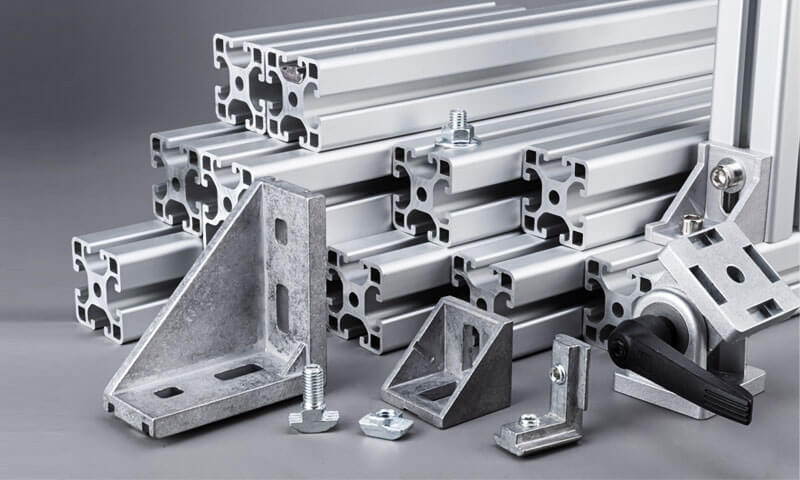
The growing adoption of precision aluminum components is largely driven by the increasing demand for lightweight structures, repeatable production, and cost efficiency.
Rather than removing large amounts of material from a solid block, engineers often begin with an aluminum profile that already contains much of the desired geometry. CNC machining is then used only where tight tolerances or functional features are required.
Typical CNC Operations After Extrusion
- Machining Process
- Purpose
- Milling
- Create precision pockets and mounting surfaces
- Drilling
- Produce accurate hole locations
- Tapping
- Add threaded fastening points
- Slot Machining
- Create assembly channels
- Face Milling
- Improve flatness for sealing or mounting
- Chamfering
- Remove sharp edges and improve assembly
Because only critical areas require machining, manufacturers can significantly reduce machining hours while maintaining high dimensional accuracy.
This manufacturing strategy is commonly used in:
- l Industrial automation systems
- l Electronic equipment housings
- l Medical equipment frames
- l LED lighting structures
- l Communication equipment
- l Inspection devices
- l Conveyor systems
- l Robotics components
For these applications, combining extrusion and machining often delivers better value than machining every feature from solid stock.
How Aluminum Extrusion and CNC Machining Work Together
A successful production process should not treat extrusion and machining as separate operations. Instead, both should be considered during the early design stage.
A typical workflow looks like this:
Stage
Manufacturing Objective
- Profile Design
- Optimize cross-sectional geometry
- Extrusion
- Produce consistent aluminum profiles
- Straightening
- Improve profile stability
- CNC Machining
- Add precision functional features
- Surface Finishing
- Enhance appearance and corrosion resistance
- Final Inspection
- Verify dimensions and quality
- Planning the manufacturing route early offers several benefits:
- l Less secondary machining
- l Improved dimensional repeatability
- l Lower tooling costs
- l Reduced production risk
- l Faster delivery schedules
This collaborative approach is particularly valuable for products that require both structural strength and precise assembly features.
Why Material Selection Matters
Choosing the correct alloy has a direct impact on machining performance, strength, corrosion resistance, and finishing quality. Engineers should evaluate material properties based on the actual application rather than selecting an alloy solely because it is widely available.
Some of the most common choices include:
- Alloy
- Typical Advantages
- Common Applications
- 6061
- High strength and excellent machinability
- Automation equipment, machine frames
- 6063
- Excellent surface finish and extrudability
- Decorative and structural profiles
- 6082
- Higher structural strength
- Heavy-duty industrial components
- 6005A
- Good balance of strength and extrusion performance
- Mechanical structures
After selecting the appropriate alloy, manufacturers can further improve product quality through aluminum CNC machining to achieve tighter tolerances, threaded features, precision holes, and critical mounting surfaces.
A manufacturer capable of supporting both material selection and precision machining can often reduce design revisions while improving overall production efficiency.
How to Choose Between Solid CNC Machining and Aluminum Extrusion + CNC Machining
Selecting the right manufacturing route begins with understanding the part’s geometry, functional requirements, and expected production volume. Instead of asking which process is “better,” engineers should determine which combination delivers the best balance of cost, manufacturability, and long-term production efficiency.
The following comparison highlights the key engineering considerations.
- Engineering Factor
- Solid CNC Machining
- Aluminum Extrusion + CNC Machining
- Material utilization
- Lower due to significant material removal
- High, as the profile is produced close to the final shape
- Best part geometry
- Complex 3D parts with changing cross-sections
- Long parts with a consistent cross-section
- Secondary machining
- Most features require machining
- Only functional features are machined
- Production efficiency
- Better for prototypes and small batches
- Excellent for medium- and high-volume production
- Cost per part
- Higher as production volume increases
- Lower after extrusion tooling is amortized
- Dimensional consistency
- High, depending on machining setup
- High when extrusion is combined with precision CNC finishing
- Typical applications
- Precision fixtures, custom components, low-volume parts
- Machine frames, automation equipment, heat sinks, electronic enclosures, structural supports
Rather than viewing the two processes as competitors, many manufacturers use them together. Aluminum extrusion provides an efficient structural foundation, while CNC machining adds the precision features needed for assembly, fastening, sealing, and functional performance.
A Practical Selection Guide
Use solid CNC machining when:
l The component has a highly complex 3D geometry.
l Design revisions are expected during development.
l Production quantities are relatively low.
l Most surfaces require precision machining.
Choose aluminum extrusion followed by CNC machining when:
l The part has a constant cross-sectional profile.
l Material utilization is an important cost factor.
l Only selected areas require tight tolerances.
l Production will eventually scale from prototypes to repeat manufacturing.
l Consistent dimensional repeatability is required across large production runs.
Design Considerations Before Extrusion and CNC Finishing
A well-designed profile simplifies downstream machining, improves production stability, and minimizes unnecessary material removal. Engineers who consider manufacturing constraints during the design stage typically achieve shorter lead times and fewer engineering revisions.
Important design recommendations include:
Maintain Uniform Wall Thickness
Large wall-thickness variations can affect metal flow during extrusion and may increase the likelihood of profile distortion.
Reserve Machining Allowance
Critical surfaces, threaded holes, and precision mounting features should include sufficient stock for CNC finishing instead of relying solely on extrusion tolerances.
Optimize Corner Radii
Appropriate internal and external radii improve material flow while reducing stress concentrations and unnecessary tool wear.
Reduce Secondary Operations
Whenever possible, incorporate structural features directly into the extrusion profile instead of machining them later. This approach shortens production time and improves repeatability.
For engineers developing new products, understanding profile geometry, tolerance planning, and manufacturability before tooling begins can eliminate costly redesigns. A comprehensive aluminum extrusion design strategy is equally important as precision machining.
Selecting a Manufacturing Partner with Integrated Capabilities
Manufacturing efficiency is influenced not only by equipment but also by the supplier’s ability to coordinate every production stage. Working with separate extrusion and machining vendors often introduces additional logistics, dimensional variation, and longer delivery schedules.
A capable manufacturing partner should provide:
- l Extrusion profile design support
- l CNC milling and turning services
- l Precision drilling, tapping, and slot machining
- l Surface finishing coordination
- l Material traceability
- l In-process quality inspection
- l Scalable production from prototypes to volume orders
For companies requiring both profile manufacturing and secondary machining, integrated production can simplify communication while improving consistency throughout the entire manufacturing process. Learn more about custom extruded aluminum profiles and integrated production capabilities at Yueyi Precision’s Custom Aluminum Extrusion Profiles.
Frequently Asked Questions (PAA)
Is aluminum extrusion more cost-effective than machining from solid aluminum?
For components with consistent cross-sections, aluminum extrusion typically reduces material waste and machining time. CNC machining is then used only for precision features, resulting in a more economical manufacturing process.
What aluminum alloy is commonly used for extruded precision components?
6061 and 6063 are among the most widely used alloys. 6061 offers excellent strength and machinability, while 6063 provides superior surface finish and extrusion performance.
Can extruded aluminum profiles achieve tight tolerances?
Yes. Although extrusion provides the base geometry, critical dimensions are commonly finished through CNC machining to meet demanding tolerance requirements.
Which industries commonly use custom extruded aluminum profiles?
Industrial automation, consumer electronics, medical equipment, communication devices, transportation equipment, LED lighting systems, and machinery manufacturers frequently use custom aluminum extrusions.
When should CNC machining be combined with aluminum extrusion?
The combination is ideal when a component has a uniform cross-section but also requires precision holes, threaded features, slots, or machined mounting surfaces.
How can manufacturers reduce production costs without compromising quality?
Designing components for extrusion first and applying CNC machining only to functional features can reduce machining hours, improve material utilization, and maintain consistent product quality.
Final Thoughts
Modern manufacturing is no longer about choosing between aluminum extrusion and CNC machining. Instead, successful products are created by combining both technologies in a way that balances structural efficiency, precision, cost, and production scalability.
Starting with an optimized extrusion profile minimizes raw material waste and machining time, while CNC finishing delivers the accuracy needed for assembly-ready components. This hybrid approach enables manufacturers to improve production efficiency without sacrificing quality.
For engineers and procurement teams developing industrial equipment, automation systems, electronic enclosures, or structural assemblies, integrating aluminum extrusion, custom extruded aluminum profiles, and aluminum CNC machining into a unified manufacturing strategy can provide measurable advantages throughout the product lifecycle.
Additional information about machining aluminum alloys, tolerances, and secondary processing can be found through Yueyi Precision’s aluminum CNC machining resource.
