

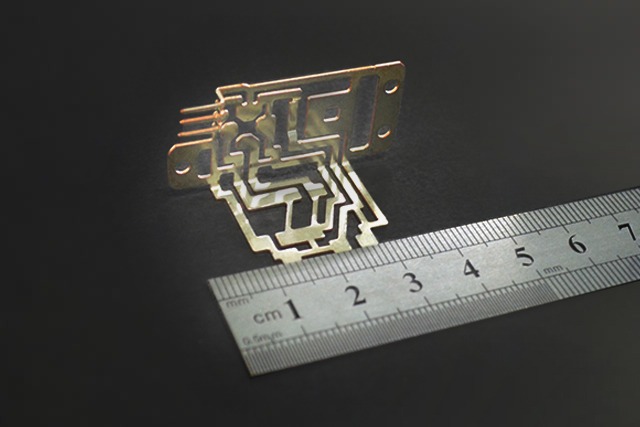
Electrical and electronic devices depend on thousands of small components working together accurately. A terminal that is slightly out of position or a connector that does not maintain the required dimensions can affect the performance of an entire assembly.
For manufacturers producing components for sensitive applications, material selection is equally important. Magnetic characteristics may need to be controlled when components operate near sensors, coils, or other sensitive systems.
Non-magnetic stamping can provide a combination of material control, production efficiency, and dimensional precision.
Why Stamping Is Used for Electronic Components
Stamping is particularly useful for producing high volumes of small metal components.
Once the appropriate tooling has been developed, the same die can produce repeated shapes with consistent dimensions.
This makes stamping suitable for terminals, contacts, clips, brackets, shields, and other components commonly found in electrical assemblies.
Material Selection Comes First
The choice of metal depends on what the component needs to accomplish.
Copper is often selected when electrical conductivity is important. Brass can provide a useful balance of conductivity and mechanical properties.
Aluminum can be useful when low weight and corrosion resistance are priorities.
The specific alloy should be selected according to conductivity, hardness, strength, forming characteristics, corrosion resistance, and magnetic behavior.
Controlling Magnetic Interference
Certain electronic and electrical applications are sensitive to magnetic fields.
In such environments, engineers may need components with controlled magnetic properties.
Selecting an appropriate non-magnetic stamping material can help reduce unwanted magnetic interaction.
However, the term “non-magnetic” should always be evaluated in relation to the actual alloy and application. Some materials may have weak magnetic responses under particular conditions.
Precision and Tolerances
Electronic components often have tight dimensional requirements.
A stamped terminal may need to fit into a connector housing, while a contact must maintain a specific position to establish reliable electrical contact.
Tooling design, press accuracy, material thickness, and process control all influence final dimensions.
Miniaturization
Modern electronics continue to become smaller.
This trend creates demand for smaller and more precise stamped components.
Manufacturers may need to produce narrow features, small holes, bends, tabs, and contact points while maintaining consistency across high production volumes.
Precision tooling becomes particularly important as component dimensions decrease.
Electrical Conductivity
For conductive components, mechanical shape is only one consideration.
The metal also needs appropriate electrical properties.
Copper and certain copper alloys are commonly considered for conductive stamped parts because of their combination of conductivity and formability.
Surface treatments may also be used when specific contact or corrosion requirements exist.
Surface Finish
Electronic components may require controlled surface finishes depending on their application.
A suitable finish can influence electrical contact, corrosion resistance, appearance, and solderability.
Manufacturers should determine whether plating or another surface treatment is required before finalizing the stamping process.
Applications
Non-magnetic stamped components can be used in various areas, including:
- Electrical connectors
- Electronic terminals
- Sensor components
- Switch components
- Precision brackets
- Shielding structures
- Medical electronics
- Specialized instrumentation
Each application has its own material and dimensional requirements.
Quality Control
High-volume electronic component manufacturing requires consistent quality.
Inspection may include dimensional measurements, visual checks, material verification, and electrical testing where appropriate.
Automated inspection can also be integrated into production when large quantities of small components need to be checked.
Choosing a Manufacturing Partner
When sourcing precision stamped components, manufacturers should evaluate more than production capacity.
Important considerations include tooling capabilities, material expertise, tolerance control, quality systems, surface treatment options, and experience with specialized alloys.
Clear communication of drawings, tolerances, material specifications, and magnetic requirements can prevent problems during production.
Conclusion
Non-magnetic stamping can support the production of precise electrical and electronic components where controlled magnetic properties are important.
The combination of suitable materials, accurate tooling, and controlled manufacturing processes can help produce consistent components at commercial volumes.
For the best results, engineers should define magnetic, mechanical, electrical, dimensional, and environmental requirements before selecting the material and stamping process.
