

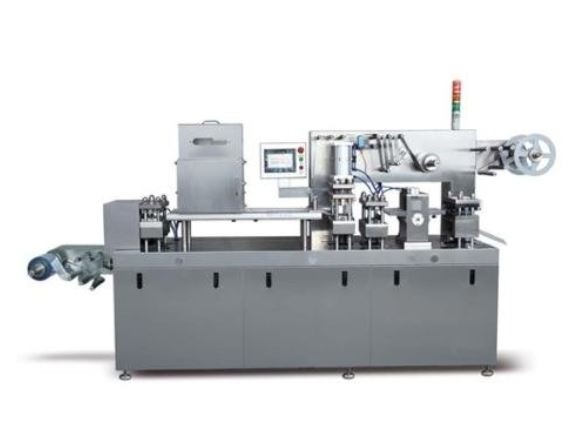
Selecting packaging equipment is an important decision for manufacturers. A machine needs to meet current production requirements while also providing enough flexibility to accommodate future changes.
A blister packing machine can automate the forming, filling, sealing, and cutting stages of blister production, but different machines are designed for different applications.
Choosing the right system therefore requires consideration of production capacity, product characteristics, materials, tooling, automation, and maintenance.
Start With Production Requirements
The first step is determining how much product needs to be packaged.
Small manufacturers, laboratories, and companies producing multiple short runs may prioritize flexibility and easy changeovers. High-volume pharmaceutical manufacturers may place greater emphasis on continuous operation and maximum throughput.
The machine’s actual production capacity should be evaluated rather than relying only on a maximum theoretical speed.
Consider the Product
The characteristics of the product influence the filling system.
Tablets and capsules may require different feeding arrangements, particularly when products vary in size, shape, weight, or fragility.
If the machine will package multiple products, the feeding system and tooling should be capable of accommodating the required range.
Select the Appropriate Forming Technology
One of the most important decisions is whether the application requires thermoforming or cold forming.
Thermoforming heats a plastic film before creating the cavities. It can offer transparency and flexibility in blister shapes.
Cold forming mechanically creates cavities in an aluminum-based structure and is often selected for products requiring stronger barrier protection.
The correct choice depends on the product’s protection requirements and packaging specifications.
Evaluate Machine Configuration
Flat-plate and rotary machines have different operating characteristics.
Flat-plate systems use indexed movement and can provide useful flexibility for various formats. Rotary systems use continuous movement and can be advantageous for high-volume production.
Manufacturers should compare these configurations based on production volume, format requirements, tooling costs, and changeover expectations.
Check Automation Level
Blister machines can range from semi-automatic systems to fully automated production lines.
A semi-automatic machine may be appropriate for smaller production volumes or applications requiring frequent operator intervention.
Fully automatic systems can integrate forming, filling, sealing, cutting, inspection, and other operations, reducing manual handling and improving production consistency.
Changeover Time
Manufacturers producing several products should pay close attention to changeover requirements.
Frequent changes in cavity dimensions, pack sizes, or products can create significant downtime if tooling is difficult to replace.
Easy-to-change tooling and accessible machine components can improve overall production efficiency.
Sealing Quality
The quality of the seal is critical because the sealed package needs to protect its contents.
Temperature, pressure, material compatibility, and dwell time all influence sealing performance.
A machine should provide appropriate control over these parameters and allow operators to monitor them during production.
Inspection Features
Quality control becomes increasingly important as production volumes increase.
Modern blister lines may include sensors and automated vision inspection to detect missing products, damaged cavities, incorrect filling, or sealing defects.
Rejected packs can then be automatically separated from acceptable products.
Maintenance and Cleaning
Packaging equipment requires regular maintenance to operate reliably.
Before purchasing, consider how easily operators can access forming, filling, sealing, and cutting areas for inspection and cleaning.
Accessible components can reduce maintenance downtime and make routine servicing easier.
For pharmaceutical applications, cleaning and validation requirements should also be considered during equipment selection.
Material Compatibility
The machine should be compatible with the materials required for the intended packaging format.
Depending on the design, this may include plastic forming films, aluminum laminates, lidding foil, and other packaging materials.
Material selection should be based on product protection, sealing requirements, appearance, and applicable regulations.
Consider Future Production
A machine should ideally support more than the manufacturer’s immediate requirements.
If production volumes are expected to increase, consider whether the equipment can accommodate higher output or integration with upstream and downstream systems.
The ability to add inspection, coding, cartoning, or other modules can also provide greater flexibility.
Final Thoughts
Choosing a blister packing machine requires a complete assessment of the production process rather than focusing on speed alone.
Manufacturers should consider product characteristics, forming technology, production volume, automation, changeover time, sealing control, inspection, maintenance, and material compatibility.
A machine that matches the actual production environment can improve packaging consistency, reduce unnecessary downtime, and provide a stronger foundation for long-term manufacturing efficiency.
