

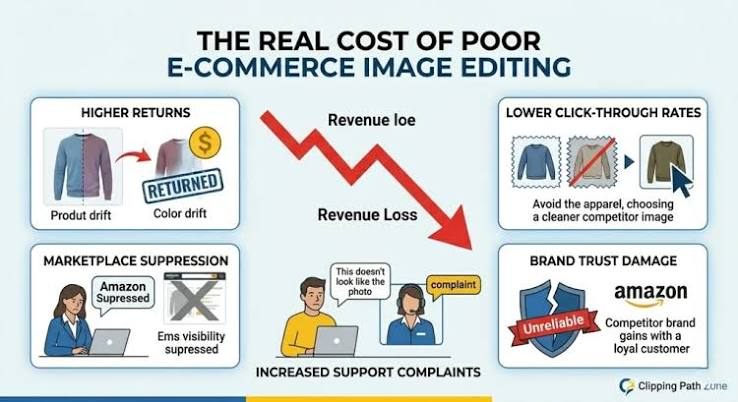
Online retail has a visibility problem that most operators underestimate until the revenue data makes it undeniable. A product can be well-made, competitively priced, and correctly categorized, yet still fail to convert because the images representing it do not meet the visual expectations buyers have developed from years of shopping on polished, professionally managed platforms. The image is not decoration. In the absence of physical interaction, it is the primary sensory experience a buyer has with a product before committing to a purchase decision.
This is not a new observation, but it remains one that many ecommerce operators treat as a secondary concern — something to address later, after other operational priorities are resolved. The problem is that image quality does not sit quietly in the background while you optimize other parts of your business. It works against you actively, eroding trust and suppressing conversion on every page where it appears. Understanding how this happens, and what it costs, requires looking at the mechanics of buyer behavior rather than surface-level aesthetics.
Why Image Quality Is an Operational Problem, Not a Creative One
Most ecommerce operators treat product photography as a creative or marketing function — something handled once during a launch phase and revisited only when a product is redesigned or rebranded. This framing misses the operational weight that image quality carries across the entire transaction lifecycle. When buyers encounter inconsistent lighting, visible noise, poorly cut backgrounds, or color that does not match the actual product, the problem does not stop at aesthetics. It introduces friction at the decision point, increases return rates due to mismatched expectations, and damages platform performance metrics over time.
Investing in ecommerce photo retouching services is not a creative upgrade — it is a process control decision that affects how consistently your product catalog performs across different devices, screen calibrations, and marketplace environments. A browser viewing your product on a calibrated monitor in a well-lit room will see different things than someone on a mobile device with automatic brightness engaged. Professional retouching accounts for these variables by standardizing color rendering, contrast balance, and background neutrality in ways that raw photography cannot consistently achieve on its own.
The Compounding Effect of Inconsistent Visuals Across a Catalog
When a product catalog contains images that were processed at different times, by different people, or with different standards applied, the inconsistency accumulates into something buyers notice without being able to articulate. They register it as a general sense of unreliability — a feeling that the brand is not fully put together. This impression forms in seconds and shapes how much trust a buyer extends to the product listing, the pricing, and the brand overall.
The challenge compounds as catalogs grow. A small inconsistency in a ten-product store is manageable. The same inconsistency applied across hundreds or thousands of SKUs becomes a systemic credibility problem. Buyers navigating between product pages notice when shadow direction changes, when white backgrounds vary between off-white and bright white, or when the color saturation in one image contradicts the tones shown in another. These are signals that something in the production process is not controlled, and they transfer, consciously or not, into doubt about the product itself.
Marketplace Algorithms Respond to Engagement, Not Intent
On major selling platforms, product listings are not treated equally regardless of how accurate or well-described they are. Algorithms that govern visibility and ranking weigh engagement signals heavily — click-through rates, time spent on listing pages, and conversion rates all factor into how frequently a product is surfaced to prospective buyers. Poor image quality suppresses click-through rates directly. When thumbnail images fail to communicate product quality at small sizes, buyers scroll past without engaging, and the algorithm registers the product as low-interest regardless of its actual merits.
This creates a structural disadvantage that is difficult to recover from without addressing the root cause. A product that underperforms in its first weeks on a marketplace accumulates negative signal data that affects its ranking position over time. Correcting image quality later helps, but it means reclaiming ground that should not have been lost in the first place. The cost of the initial decision to skip professional processing does not stay fixed — it grows as visibility shrinks.
Return Rates and the Hidden Cost of Visual Misrepresentation
One of the most direct financial consequences of inadequate product photography is the elevation of return rates. According to research documented by the Nielsen Norman Group, product misrepresentation — including inaccurate color and unclear product detail — is among the leading drivers of ecommerce returns. When buyers receive a product that does not match what they believed they were purchasing based on the listing images, they return it. The return itself costs money in logistics and restocking, but the downstream effects are equally damaging: negative reviews, platform penalties, and lost repeat business from customers who do not bother to complain and simply never return.
Color Accuracy as a Functional Requirement
Color is among the most common sources of expectation mismatch between what buyers see in product images and what arrives at their door. Raw photography introduces color variables at multiple stages — lighting temperature during the shoot, white balance settings on the camera, and the color profile of the editing software used in post-processing. Without a controlled retouching workflow designed to standardize output, color rendering across a catalog becomes unpredictable.
For product categories where color is a primary purchase driver — apparel, home goods, cosmetics, furniture — this unpredictability has a direct return-rate consequence. A buyer choosing between two shades of a product needs the image to accurately represent which shade they are selecting. When the image misrepresents the color even slightly, the purchase decision is based on incorrect information, and the return that follows is a predictable outcome rather than an exception.
Detail Clarity and the Role of Retouching in Communicating Product Value
Beyond color, the clarity of product detail in an image communicates quality before a buyer has read a single line of copy. Texture, stitching, material finish, hardware, and surface quality are all elements that buyers assess visually to determine whether a product justifies its price point. When images are underexposed, overly compressed, or poorly processed, these details become ambiguous or invisible. The buyer cannot confirm the quality they are being asked to pay for, and in that uncertainty, many choose not to proceed.
Professional retouching recovers and enhances this visual information without misrepresenting the product. The goal is not to make a product look better than it is — it is to ensure that the quality already present in the product is communicated clearly and accurately through the image. When this step is skipped, the image consistently undersells the product, regardless of how good the product actually is.
The Workflow Implications of Treating Photography as a One-Time Task
Many ecommerce operations treat product photography as a periodic task rather than an ongoing process. Images are captured during a product launch, processed once, and published without a structured review or update cycle. This approach works in a static catalog environment, but most active ecommerce businesses are not static. New products are added, existing products are updated, seasonal context changes, and platforms periodically revise their image requirements and display formats.
When photography and retouching are not integrated into the ongoing product management workflow, inconsistencies accumulate over time. Older images fall below current platform standards. New products are added with images processed by different vendors or to different specifications. The catalog fragments visually, and the cumulative effect on brand perception is more damaging than any single poorly processed image would be in isolation.
Scaling Without a Standardized Retouching Process
Growth in ecommerce volume creates a corresponding need for image processing capacity. Businesses that handle retouching informally — through internal staff without specialized training, through inconsistent vendor relationships, or through ad hoc decisions made product by product — find that this approach does not scale. What functions adequately at low volume becomes an operational bottleneck or a quality control failure as catalog size increases.
Establishing a standardized retouching process early creates a repeatable workflow that maintains consistency regardless of catalog volume. It also creates clear specifications that photographers can shoot to, reducing the amount of correction required in post-processing. The downstream effect is a catalog that grows in size without degrading in visual consistency — a condition that directly supports sustained conversion performance over time.
What Professional Retouching Actually Addresses
The scope of professional ecommerce photo retouching services extends beyond removing blemishes or adjusting brightness. A structured retouching process addresses the full range of variables that affect how a product image performs in a commercial context:
• Background removal and replacement ensures that products appear on clean, neutral surfaces that meet marketplace specifications and do not compete visually with the product itself.
• Color correction standardizes the rendering of product color across different lighting conditions captured during the shoot, ensuring that what appears in the image reflects the actual product as accurately as possible.
• Shadow and reflection work adds dimensional grounding to product images, preventing the flat, disconnected appearance that unprocessed cutout images often produce.
• Exposure and contrast balancing ensures that product detail is visible across the range of devices and screen calibrations buyers use, from high-end monitors to low-brightness mobile screens.
• Consistency normalization across a catalog brings all images to a common visual standard, preventing the fragmentation that occurs when images are processed at different times or by different parties without a shared specification.
Each of these functions addresses a specific failure mode that occurs when retouching is skipped or handled without a controlled process. The result is not a more attractive catalog — it is a more reliable one, and reliability in how products are represented is what buyers are actually responding to when they convert.
Closing: The Decision Behind the Image
Product image quality is a decision made upstream of the sale, with consequences that play out across every buyer interaction downstream. The cost of inadequate retouching is not always visible in a single transaction, but it accumulates steadily in suppressed click-through rates, elevated return rates, weakened platform rankings, and a brand perception that consistently underperforms relative to the actual quality of the products being sold.
For ecommerce operators managing growing catalogs, the question is not whether professional image processing is worth the cost. The question is how much the absence of it is already costing, and how long that cost will continue to compound before it becomes impossible to ignore. Addressing image quality as an operational standard rather than a creative afterthought is not a refinement — it is a structural correction that affects how every product in a catalog performs from the moment it is published.
