

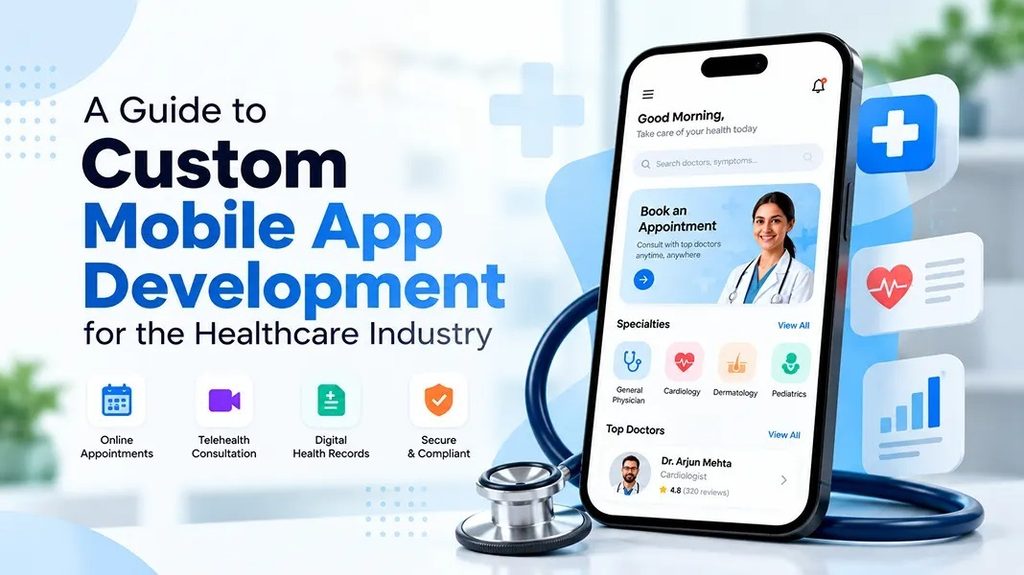
Smartphones now sit at the center of how patients, doctors, caregivers, and hospitals communicate. Healthcare mobile app development has grown because generic apps rarely fit clinical workflows, privacy duties, or existing systems. This practical guide covers app types, features, security, integrations, development stages, costs, and future trends.
Why Custom Mobile Apps Are Transforming the Healthcare Industry
Healthcare organizations invest in custom apps to reduce administrative friction, improve access to care, support remote follow-up, and give clinicians timely information. Custom development lets teams design around their own referral paths, scheduling rules, patient populations, and staffing models instead of bending operations to fit someone else’s product.
Common goals include:
- Better Access: Remote visits, reminders, and mobile-friendly intake.
- Operational Efficiency: Less paperwork and fewer phone-based handoffs.
- Continuity of Care: Follow-up, medication support, and care-plan tracking.
- Clearer Visibility: Relevant information reaches clinicians when they need it.
What Is Custom Healthcare Mobile App Development?
Custom healthcare app development means designing an app around a specific organization’s clinical, operational, and regulatory needs, unlike off-the-shelf products built for broad audiences. In medical app development, errors can affect patient care, so discovery and domain expertise matter early, when workflows, users, data flows, and risks are defined.
- Off-the-Shelf Apps: Faster to launch and cheaper initially, but limited in customization, with a roadmap controlled by the vendor.
- Custom Apps: Built around your workflows, integrations, branding, and security requirements, with higher upfront investment and long-term ownership responsibilities.
Types of Healthcare Mobile Apps You Can Build
Healthcare apps vary by purpose, users, and regulatory exposure. A telehealth app for patients has different needs than a monitoring tool for nurses. Choosing the right category first shapes features, integrations, and budget, and it is the foundation of sound mobile healthcare application development.
1. Telemedicine & Virtual Care Apps
These apps let patients consult clinicians remotely through video, audio, or chat. Core needs include scheduling, secure messaging, e-prescription workflows, and payments, serving rural patients, busy professionals, and follow-up visits.
2. Remote Patient Monitoring Apps
These apps collect readings such as blood pressure or glucose from connected devices for care teams. Alerts, trend dashboards, and clear escalation rules help clinicians act on meaningful changes.
3. Mental Health Apps
These apps support therapy sessions, mood tracking, guided exercises, and crisis resources. Privacy, tone, and safe escalation paths matter greatly, since users may share deeply personal information.
4. Chronic Disease Management Apps
Built for conditions like diabetes, hypertension, or asthma, these apps combine symptom logs, medication reminders, education, and care plans so patients and clinicians can track progress between visits.
5. Patient Engagement Apps
These apps give patients one place for appointments, test results, billing, reminders, and questions. Well-designed tools can help reduce missed appointments and keep patients informed about their care.
Many organizations start with one category and expand later. A phased approach to health mobile app development lets teams validate a core use case before adding modules.
Essential Features of a Custom Healthcare Mobile App
The right features depend on the app’s purpose, users, and clinical setting. Adding every possible function increases cost, risk, and complexity. Start with the features that support core workflows, then expand based on usage data and feedback. These are the features most healthcare apps need to consider.
1. Secure User Registration & Authentication
Registration should verify identity appropriately, support strong passwords or biometrics, and manage sessions safely. Patients, clinicians, and administrators often need different onboarding flows and permissions from the first login.
2. Appointment Scheduling
Scheduling should reflect real clinic rules, including provider availability, visit types, reminders, cancellations, and waitlists. Syncing with existing scheduling systems helps prevent double bookings and manual rework.
3. Video/Audio Consultations
Consultations need reliable, low-latency video and audio, graceful behavior on weak networks, waiting rooms, and optional screen sharing. Clinicians need documentation tools and consent handling where local rules require it.
4. Health Records Access
Patients and authorized clinicians may need to view histories, lab results, medications, and visit summaries. Access must be permission-based, accurate, and clearly presented so results are easy to understand.
5. Wearable/Device Integration
Apps can pull data from smartwatches, glucose monitors, and blood pressure cuffs. Teams must decide which data is clinically useful, how often it syncs, and how errors are handled.
Features should earn their place. A capable healthcare mobile app developer will ask which user problem each feature solves and may recommend postponing those without a clear answer.
Healthcare App Security & Data Privacy
Healthcare apps handle sensitive information, so three ideas must be kept separate. Security protects data from unauthorized access, privacy governs how data is collected and used, and regulatory compliance means meeting legal obligations. Strong security supports the other two but does not replace them.
1. Data Encryption in Transit & at Rest
Use TLS for data moving between the app and servers, and strong encryption for stored data, including backups. Manage keys carefully and avoid leaving sensitive data unprotected on devices.
2. Multi-Factor Authentication
MFA adds a second proof of identity, such as a one-time code or biometric check. It is especially valuable for clinicians, administrators, and anyone accessing records with broad permissions.
3. Role-Based Access Control
RBAC limits what each user can see or do based on role. A receptionist, nurse, physician, and patient should not share the same permissions, following least privilege.
4. Audit Logs
Audit logs record who accessed or changed data, when, and from where. They support investigations, accountability, and compliance reviews, and they should be protected from tampering.
5. Data Minimization
Collect only the data the app needs, keep it only as long as necessary, and avoid exposing it in logs, notifications, or analytics. Less stored data means less risk.
Regulatory and Privacy Frameworks
- HIPAA: U.S. rules for covered entities and their business associates. Whether an app is covered depends on who builds it, who uses it, and what data it handles.
- GDPR: Can apply when an app targets or monitors people in the EU, even if the company is based elsewhere. Health data is a special category with stricter conditions.
- Local laws: Many markets have their own rules, such as India’s Digital Personal Data Protection Act, 2023, or Canada’s PIPEDA. Some also regulate data residency, and apps with diagnostic or treatment functions may fall under medical device rules.
EHR, EMR, FHIR, and HL7 Integration in Healthcare Apps
Many healthcare apps need to read or write clinical data held in other systems. Understanding EHR, EMR, HL7, and FHIR helps non-technical leaders ask better questions, plan integrations realistically, and avoid building an app that cannot connect to the systems clinicians already use.
1. What EHR Means
An electronic health record (EHR) is a digital patient record designed to be shared across organizations, containing history, diagnoses, medications, allergies, test results, and care plans accessible to authorized providers.
2. What EMR Means
An electronic medical record (EMR) is the digital version of a patient’s chart within a single practice or facility, used mainly for diagnosis and treatment inside that organization.
3. EHR vs. EMR at a Glance
| EHR | EMR | |
| Scope | Across care settings | Single practice or facility |
| Sharing | Designed for sharing with providers | Mainly internal |
| Typical use | Coordinated care across providers | In-clinic diagnosis and treatment |
| Example | A hospital network’s shared patient record | A clinic’s patient chart system |
In everyday use, the terms often overlap, and many vendors use them interchangeably.
4. What HL7 Is
Health Level Seven (HL7) is a set of international standards for exchanging healthcare information. HL7 v2 messaging, widely used in hospitals, carries admissions, orders, and lab results between systems.
5. What FHIR Is
Fast Healthcare Interoperability Resources (FHIR) is an HL7 standard using web APIs, making it easier for mobile apps to request specific data such as patients or medications.
The Custom Healthcare Mobile App Development Process
A structured process reduces risk. Healthcare apps generally need stronger attention to security, reliability, testing, interoperability, and data handling than many consumer apps, because failures can affect patient safety and trust. The early stages set direction, and the later stages protect quality over time.
The early stages typically include:
1. Discovery & Requirements: Define users, workflows, integrations, and regulatory scope.
2. UX/UI Design: Prototype patient and clinician flows with accessibility in mind.
3. Architecture: Choose platforms, cloud services, APIs, and data models.
4. Development: Build in iterations, with code review and regular demos.
5. Testing & Quality Assurance
QA covers functional, usability, performance, device, and network testing, plus integration checks with test data. Healthcare apps should be tested against realistic clinical workflows using synthetic data.
6. Compliance & Security Validation
Before launch, teams review architecture, run vulnerability scans and penetration tests, check access controls, and prepare documentation with compliance advisers. This step confirms safeguards work as intended.
7. Deployment
Release usually involves app store submission, production environment setup, data migration, and staff training. A phased rollout to a pilot group can surface problems before wider launch.
8. Monitoring & Maintenance
After launch, teams track uptime, crashes, performance, and security alerts. They also apply operating system updates, patch vulnerabilities, and maintain integrations when connected systems change their APIs.
9. Continuous Improvements
User feedback, analytics, and clinical input should guide regular updates. Small, tested improvements to usability, workflows, and features keep the app useful as care models and patient expectations change.
How Much Does It Cost to Develop a Custom Healthcare Mobile App?
Healthcare mobile app development costs vary widely. As a broad estimate, projects range from about $20,000 for a focused MVP to over $250,000 for complex, integrated platforms. These are indicative figures, not quotes, and a discovery phase is needed to define scope before an accurate estimate is possible.
| Scope | Typical Characteristics | Indicative Estimate |
| Focused MVP | One user type, core features, little or no EHR integration | $20,000 to $50,000 |
| Mid-complexity app | Multiple roles, telehealth or monitoring, some integrations | $50,000 to $120,000 |
| Advanced platform | Several integrations, device data, analytics, high security needs | $120,000 to over $250,000 |
Choosing a delivery partner matters as much as choosing features. When evaluating a healthcare mobile app development company or any provider of medical app development services, ask about:
- Experience with healthcare workflows and integrations
- Approach to security, testing, and documentation
- Discovery and estimation process
- Post-launch support
- Verifiable references and past work
Companies such as Mobulous, a provider of custom app development, can be assessed against these criteria alongside other options.
Future Trends in Custom Healthcare Mobile App Development
Healthcare apps will keep changing as AI, connected devices, and interoperability standards mature. None of these trends removes the need for responsible implementation. Privacy, security, clinical safety, regulatory requirements, and human oversight should shape every decision, especially when technology influences patient care.
1. Generative AI & Healthcare Assistants
Generative AI may help with appointment guidance, visit summaries, and administrative drafting. It can produce errors, so outputs need clinical review, clear limits, and privacy controls. Human oversight remains essential.
2. Remote Patient Monitoring
Remote monitoring is extending beyond chronic care into post-discharge follow-up and home-based care. Success depends on clear thresholds, manageable alert volumes, and workflows that clinicians can realistically follow.
3. Wearable Integrations
Consumer and medical-grade wearables are producing richer data. Apps must distinguish wellness data from clinically validated readings, manage patient consent, and avoid overwhelming clinicians with information they cannot act on.
4. Interoperability & API-First Healthcare Platforms
API-first design builds the app on well-documented interfaces, often using FHIR, so new services and partners can connect more easily. It supports scalability and reduces dependence on one system.
5. Privacy-Enhancing Technologies
Techniques such as de-identification, federated learning, and differential privacy can reduce exposure of personal data during analytics and model training. They complement, not replace, sound security and legal governance.
Conclusion
Successful healthcare apps need more than an attractive interface: thoughtful UX, secure architecture, reliable integrations, interoperability, privacy, scalability, and ongoing maintenance all matter. Organizations exploring custom healthcare app development services may consider an experienced partner such as Mobulous to turn requirements into dependable products.
