

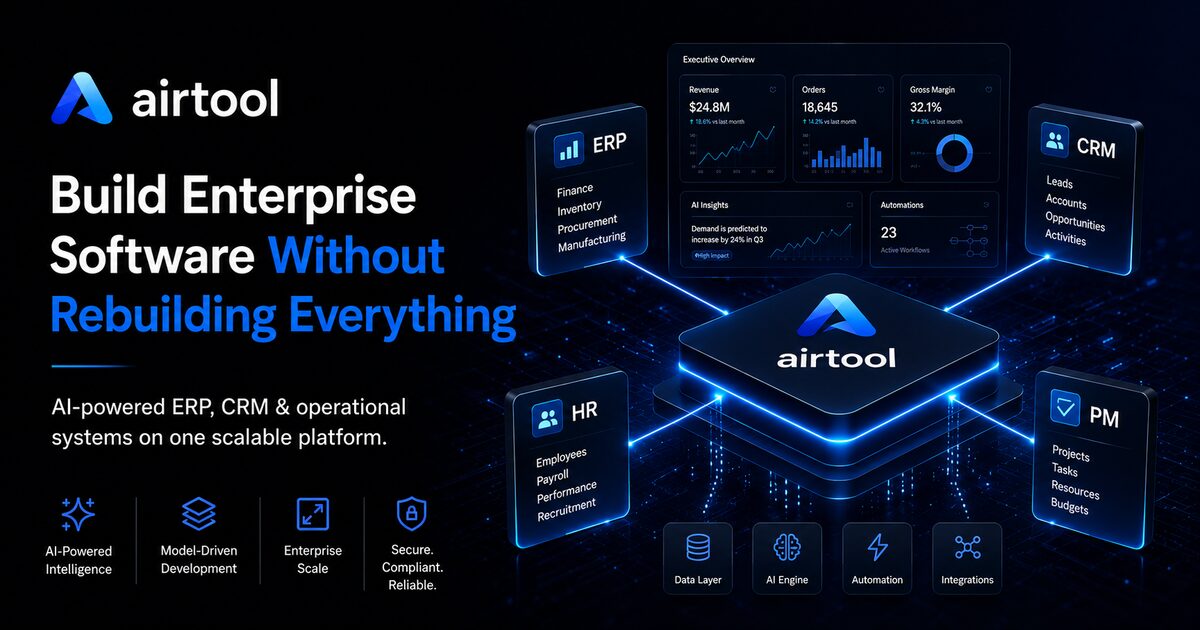
Most enterprise organisations do not need another isolated business tool. They need integrated enterprise applications that work together.
Finance needs accurate sales and procurement data. HR changes affect payroll, accounting and project costs. Project managers need real-time visibility into budgets, time and margins. Sales teams need customer records connected directly to orders, invoices and support activity.
Yet many organisations still operate these functions through separate applications connected by integrations, spreadsheets and reconciliation jobs.
Airtool takes a different approach. It is an enterprise application platform for building and operating business applications, analytics and AI on existing databases. It brings application development, data access, security, operations and AI governance into one runtime.
The platform can support ready-to-use business applications as well as custom enterprise applications designed around an organisation’s own processes. Teams can extend these applications through metadata-driven development and low-code tools, without making low-code the limit of what the platform can do.
ERP: the operational backbone
Airtool ERP connects the financial and operational processes that run the business.
Its main areas include:
• Financial management.
• Procurement and supplier management.
• Manufacturing and operations.
• Sales and customer management.
• Inventory and supply chain.
• Reporting, BI and analytics.
The important distinction is that these modules do not operate as disconnected products. Finance, sales, procurement, inventory and manufacturing work with shared operational records through one enterprise ERP platform.
For example, a purchase order can be connected to the goods receipt, supplier invoice and payment. A sales order can flow into delivery, invoicing and settlement without requiring teams to re-enter the same information in multiple systems.
Financial management supports multi-entity and multi-currency operations, including general ledger, payables, receivables, cash-flow planning, consolidation and statutory reporting. Group consolidation can include intercompany elimination, while currency revaluation can run on a configurable schedule.
Airtool | airtool.io Page 1
Procurement teams can manage suppliers, contracts, certifications, payment terms and performance history in one governed record. Supplier scorecards can use live operational data such as delivery performance, quality acceptance, invoice accuracy and disputes.
For manufacturing and operations, Airtool supports work centres, routings, capacities, manufacturing orders, bills of materials, disassembly and rolled-up costing. Inventory can be tracked across multiple warehouses and locations, including lot, serial and batch information.
This gives operations teams a live view of stock, production, purchasing and fulfilment rather than relying on separate spreadsheets and delayed reconciliation. It also supports business process automation across finance, procurement, inventory and manufacturing without forcing each department to adopt a separate workflow tool.
CRM: from lead to payment
Airtool CRM connects customer-facing activity to the operational and financial processes behind it.
The process can cover:
• Lead qualification.
• Opportunities and pipeline.
• Quotes.
• Sales orders.
• Delivery.
• Invoicing.
• Payments.
• Support cases.
These are not isolated CRM records that must later be synchronised with ERP. The customer, quote,
order, invoice and payment remain connected through the same metadata repository.
That removes a common source of enterprise friction: the CRM says one thing, while finance or operations maintains another version of the customer relationship.
Sales teams can view pipeline health, conversion rates, sales by territory and forecast accuracy using live business data. Finance can see the commercial impact of customer activity without waiting for a separate integration cycle.
Support cases can also remain connected to the same customer and account record. This creates a more complete operational view: sales understands service history, support sees commercial context and finance can follow the complete quote-to-cash process.
The value is not simply having CRM and ERP on the same product menu. The value is that the processes are connected at the record level through an integrated enterprise application platform.
HR: one governed employee lifecycle
Airtool HR manages the employee lifecycle from recruitment through payroll and performance management.
Airtool | airtool.io Page 2
The system can cover:
• Recruitment.
• Onboarding.
• Personal information.
• Employment history.
• Contracts.
• Benefits.
• Certifications.
• Payroll.
• Performance reviews.
• Employee records.
• Disciplinary records.
• Time off.
Employee information is held in a governed record with role-based access and change audit. Sensitive HR data can be restricted by role, tenant, row and column, rather than being exposed through a broad application-level permission.
HR changes can also affect other parts of the business in real time. A payroll entry can post to the ERP general ledger. Employee costs can flow into project costing. A leave request can be linked to the project plan it affects.
This removes the need to export HR data into spreadsheets or wait for separate reconciliation processes. The same employee and financial records remain connected across the business.
The result is a more useful enterprise HR platform: not only a place to store employee information, but part of the organisation’s operational fabric.
Project management connected to finance
Project management is also included in the Airtool application suite.
Teams can manage:
• Projects.
• Tasks.
• Boards and lists.
• Timelines.
• Dependencies.
• Resources.
• Budgets.
• Time and effort.
• Billing.
The key advantage is the connection between project work and financial outcomes. Projects, tasks, time entries, budgets, revenue and margins use the same operational records as the ERP.
Airtool | airtool.io Page 3
A task can become a time entry, then a billable line, invoice and payment without passing through a separate billing system. Project managers can see whether work is slipping, while finance can see the effect on cost and revenue.
AI can summarise project status, identify delayed work and estimate effort using the data the user is already authorised to access. This makes Airtool suitable for enterprise project management where operational activity and financial control need to remain connected.
One runtime for all applications
ERP, CRM, HR and project management are valuable individually, but Airtool’s larger differentiator is that they share one runtime.
The same platform provides:
• One metadata repository.
• One security perimeter.
• One audit model.
• One tenant model.
• One AI and MCP layer.
• One operational and observability surface.
This avoids the common situation where each business application has its own authentication, permissions, integrations, reporting model and audit trail.
Airtool applications are defined as metadata rather than isolated frontend and backend codebases.
Forms, dashboards, reports, roles, APIs, server-side logic and scheduled jobs are represented in the platform model and executed by the runtime.
That allows a team to build or extend applications without maintaining a separate technology pattern for every department. The platform functions as an enterprise application development platform, while its low-code capabilities help teams create forms, workflows and business interfaces more efficiently.
Low-code is therefore an accelerator inside the broader platform — not a restriction on engineering teams. Developers can use visual and metadata-driven tools for common application work while retaining server-side logic, native SQL, APIs and database-specific capabilities where deeper control is required.
Existing databases, not forced migration
Airtool is designed for organisations that already have important database investments.
The platform supports seven OLTP engines:
• PostgreSQL.
• Informix.
• Oracle.
• DB2.
• SQL Server.
Airtool | airtool.io Page 4
• MySQL.
• SAP HANA.
It also supports three OLAP engines:
• Vertica.
• ClickHouse.
• BigQuery.
Airtool generates engine-native SQL and uses XDBL as a database-independent grammar for schema, data manipulation, access control and stored-procedure logic.
This gives organisations a practical database modernisation platform. They can build new applications on an existing database, modernise a legacy system incrementally or support different customers on different database engines without rewriting the entire application.
Operational applications and analytics can also remain connected through the same platform model. Dashboards, reports and analytical objects can use governed data rather than relying on disconnected copies with separate permissions.
For organisations evaluating an enterprise application modernisation strategy, this approach reduces the need for a risky “replace everything at once” project.
Security and audit by construction
Airtool provides centralised security instead of requiring every application team to rebuild the same controls.
Authentication options include SAML, OpenID Connect, OAuth 2.0, JWT, mutual TLS, TOTP, email OTP and SMS OTP.
The platform also supports:
• Multi-tenancy.
• Row-level security.
• Column-level security.
• Role-based access.
• Session controls.
• Full audit trails.
These controls apply across the application suite, analytics and AI features. A user’s access to an HR record, financial field, project cost or customer account is governed by the same platform-level model.
Audit information can cover logins, REST calls, data changes, sessions and AI activity. This gives organisations a clearer record of what happened, who initiated it and which system action followed.
The same controls also support secure enterprise application integration. When applications, APIs and external services exchange data, access can be managed through the platform instead of adding an unrelated permission layer to every integration.
Airtool | airtool.io Page 5
Governed AI agents and native MCP
Airtool brings AI into the same permission boundary as the rest of the application platform.
AI agents can operate under the requesting user’s identity rather than receiving unrestricted database access. When an agent generates a data request, Airtool applies the user’s row- and column-level permissions during compilation and execution.
This means an employee cannot use an AI assistant to access data they could not access directly through the application.
Airtool also includes a native MCP server. External assistants can connect through OAuth or personal tokens, while tool visibility can be filtered by role, explicit grants and tenant context.
AI usage can be governed through model allowlists, quotas, token limits, budgets and usage reporting. Organisations can track provider, model, user, tenant, tokens, cost and execution time.
For RAG use cases, Airtool supports vector infrastructure including PostgreSQL with pgvector, Qdrant, Milvus and Redis. This allows organisations to build knowledge assistants and document
search experiences while retaining control of where embeddings and retrieved content are stored.
Together, these capabilities make Airtool an AI application development platform for organisations that want to introduce AI without creating a separate, uncontrolled data perimeter.
A platform for building and operating
Airtool Studio provides a central console for users, roles, databases, cluster topology, certificates, AI providers, model policies, scheduled automation, integrations and audit review.
The platform also exposes operational state through SQL, including runtime telemetry, JDBC activity, caches, JVM information and statistics.
Deployment can be cloud-based or customer-controlled, including on-premises environments. This gives organisations flexibility around data residency, infrastructure ownership and long-term operational control.
Airtool can also support enterprise workflow automation through server-side logic, scheduled jobs, APIs and metadata-defined processes. Teams can automate business operations while keeping the resulting activity inside the same security, audit and tenant model.
Why Airtool matters
Airtool is not simply an ERP, CRM or AI connector. It is an enterprise application platform that connects business applications to the runtime underneath them.
ERP provides the financial and operational backbone. CRM connects customer activity to revenue. HR connects employee data to payroll, accounting and projects. Project management connects work, time, budgets and margins.
All of these applications share the same data foundation, security model, audit trail, analytics capabilities and AI perimeter.
Airtool | airtool.io Page 6
For organisations trying to reduce application fragmentation, modernise legacy systems and introduce AI without losing control, Airtool offers a practical alternative: one platform for building, operating and evolving enterprise applications.
It supports custom enterprise applications, integrated workflows, enterprise application integration and low-code development where useful, while still providing the deeper database, runtime and engineering controls expected from a serious enterprise application platform.
Visite Airtool website : https://www.airtool.io/
Airtool | airtool.io Page 7
