

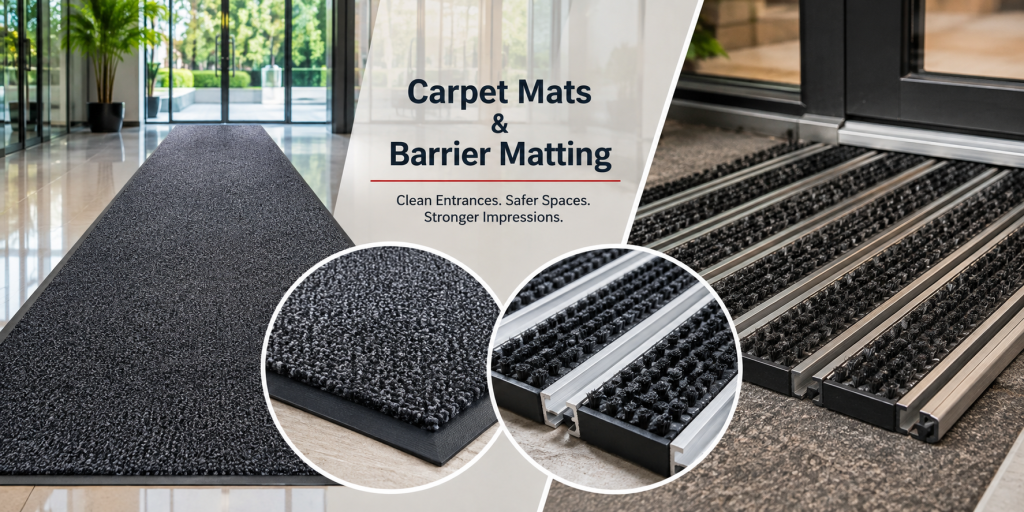
Most facility managers only think about entrance matting after something goes wrong. A slip near the front desk. A client complaint about muddy floors. A maintenance bill that keeps creeping up every quarter.
By then, the matting decision has usually already been made poorly, often because barrier matting and carpet matting were treated as the same product.
They’re not. The barrier matting vs carpet matting difference comes down to where each one sits in the entrance and what job it’s actually designed to do.
Getting this right at the specification stage saves far more in cleaning costs and floor repairs than most buyers expect. This guide breaks down what separates the two, where each performs best, and how to decide which one, or which combination, fits your space.
What Barrier Matting Actually Does
Barrier matting is the workhorse at the door. It’s usually ribbed or channeled, made from aluminium, rubber, or heavy PVC.
Its whole purpose is to scrape shoes clean and pull water away before it spreads further into the building.
In a warehouse or a hospital corridor, this is the mat that’s earning its keep during monsoon season or a shift change, when hundreds of feet pass through in an hour.
It’s not a comfortable mat to stand on for long, and it’s not meant to be. Think of it as infrastructure rather than decor.
Where You’ll Typically Find It
- Warehouse and factory entrances
- Hospital and clinic doorways, where hygiene control matters
- Retail store fronts with high daily footfall
- Office building main entrances
- Hotel porte-cocheres and lobby thresholds
And Carpet Matting?
A few steps past the barrier zone is usually where carpet matting takes over.
It’s softer underfoot, made from tufted or needle-punch fiber on a rubber backing. Its job is finishing what the barrier mat started.
That means soaking up whatever moisture is left, trapping fine dust, and doing it while still looking presentable in a lobby or reception area.
You’ll find this type in hotel corridors, office interiors, boutique retail changing rooms, even home hallways.
It won’t survive standing water or heavy grit the way barrier matting does. It isn’t supposed to. That’s a different mat’s job.
Barrier Matting vs Carpet Matting: The Core Differences
Here’s how the two stack up side by side.
| Factor | Barrier Matting | Carpet Matting |
| Primary function | Scrapes dirt, channels water | Absorbs moisture, traps fine dust |
| Best location | Entry point, first 1-2 meters | Just beyond entry, interior zones |
| Material | Aluminium, rubber, heavy PVC | Tufted or needle-punch carpet fiber |
| Durability | Very high, built for harsh wear | Moderate, needs regular cleaning |
| Appearance | Functional, industrial look | Softer, more finished aesthetic |
| Ideal setting | Warehouses, factories, outdoor entries | Lobbies, offices, hotels, homes |
So Which One Do You Need?
If the real problem at your entrance is safety and heavy debris, a loading dock, a hospital doorway in the rains, a retail front that never stops seeing foot traffic, start with barrier matting.
Slip injuries are one of the most common workplace incidents. A lot of that risk traces back to what’s tracked in through the door.
If the space is more about how it feels and looks, a hotel lobby, a corporate reception, the hallway of someone’s home, carpet matting is the better fit.
It’s not solving a drainage problem. It’s solving a comfort and finish problem.
Most commercial buildings honestly need both. Barrier matting takes the first, dirtiest hit at the door, and carpet matting cleans up what’s left as people walk further in.
It’s a two-stage system, not an either-or choice. That’s why you’ll see both used together in almost every well-designed commercial entrance.
Mistakes Worth Avoiding
- Skipping barrier matting outdoors and relying on carpet alone. The carpet saturates fast and wears out faster.
- Undersizing the mat. Anything shorter than about 1.5 to 2 meters won’t capture enough footsteps to actually clean shoes before someone’s inside.
- Assuming standard sizing works everywhere. It rarely does for irregular entryways or recessed wells, which is where made-to-measure options, like the custom floor mat solutions Ultimats builds, tend to solve the problem more cleanly than an off-the-shelf mat.
- Treating matting as a one-time purchase. Heavy-use entrances need mats replaced or rotated well before they look visibly worn, since performance drops before appearance does.
A Few Questions People Usually Ask
Can carpet matting handle an outdoor entrance on its own?
Not really. It’ll absorb moisture for a while, but it isn’t built for standing water or heavy grit.
It’ll wear out well before a barrier mat would in the same spot.
How long does an entrance mat actually need to be?
Somewhere around 1.5 to 2 meters is the general rule. That’s enough to catch two or three footsteps before someone’s fully inside.
Do most buildings need both types?
Yes, especially anywhere with real foot traffic. Barrier matting at the door, carpet matting a bit further in, is the standard approach for a reason.
How often does entrance matting need cleaning?
Barrier mats need debris cleared out daily in busy spaces.
Carpet mats can go longer between deep cleans but still need regular vacuuming to stay effective rather than just soaked.
Is a custom-sized mat worth the extra cost?
For anything other than a standard rectangular doorway, usually yes.
A mat that doesn’t fully cover the entry leaves gaps for dirt and water to slip past entirely.
Final Thoughts
Getting the barrier-versus-carpet decision right isn’t complicated once you know what each one is actually for.
It just takes matching the mat to the problem instead of assuming one type covers every entrance.
