

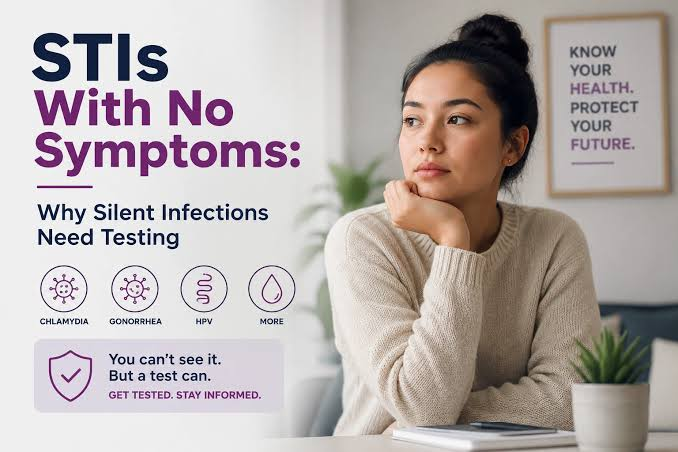
Yes. You can have a sexually transmitted infection (STI) without experiencing any noticeable symptoms.
In fact, many STIs are often asymptomatic, meaning a person has the infection but does not develop obvious signs that something is wrong. Some infections may also cause symptoms that are so mild that they are mistaken for another condition or simply overlooked.
This means someone can:
- Have an STI and feel completely well
- Have no visible sores or discharge
- Unknowingly pass the infection to a sexual partner
- Develop complications if the infection remains untreated
The absence of symptoms therefore does not necessarily mean that an STI is absent.
Testing is the only way to identify many asymptomatic infections, particularly when there has been a potential exposure or other reason for screening.
What Is an Asymptomatic STI?
An asymptomatic STI is an infection that does not cause noticeable symptoms.
A person may have an infection without experiencing:
- Pain
- Itching
- Genital discharge
- Sores
- Rash
- Pain when urinating
- Pelvic or abdominal discomfort
Some infections may remain asymptomatic throughout part or all of their course.
Others may alternate between periods with and without symptoms.
An infection may also affect a particular body site without causing noticeable symptoms. For example, chlamydia and gonorrhoea infections affecting the throat or rectum can be asymptomatic.
Why Do Some STIs Cause No Symptoms?
Different STIs affect the body in different ways.
Symptoms may depend on:
- The type of infection
- The site of infection
- The person’s immune response
- How long the infection has been present
- Whether the infection is in its early, latent or later stage
Some infections can cause only mild symptoms, while others may remain completely unnoticed.
This is one reason why symptoms alone cannot reliably determine whether someone has an STI.
Which STIs Can Be Asymptomatic?
Several common STIs can occur without noticeable symptoms.
Chlamydia
Chlamydia is frequently asymptomatic.
This is particularly relevant because untreated chlamydia can persist and potentially cause complications.
Genital chlamydia may cause no symptoms, especially in women. Pharyngeal and rectal infections are also often asymptomatic.
When symptoms do occur, they may include:
- Unusual genital discharge
- Burning when urinating
- Pelvic pain
- Bleeding between periods or after sex
- Testicular discomfort
- Rectal pain or discharge
The absence of these symptoms does not rule out chlamydia.
Gonorrhoea
Gonorrhoea can also occur without noticeable symptoms.
This can be particularly important for infections affecting the throat or rectum.
When symptoms do occur, they may include:
- Discharge from the penis or vagina
- Painful urination
- Pelvic discomfort
- Rectal discharge
- Rectal pain
- Sore throat
Because symptoms may be absent, people can potentially transmit gonorrhoea without knowing that they have it.
Syphilis
Syphilis develops through different stages.
Some people may not notice the initial painless sore, while later latent syphilis is specifically an asymptomatic stage of infection.
This means a person can have syphilis without obvious signs while the infection remains present.
Without appropriate treatment, syphilis can eventually affect multiple organs and cause serious complications.
Genital Herpes
Many people with genital herpes have no symptoms or only mild symptoms.
Some people may never recognise that they have herpes because they do not develop obvious blisters or ulcers.
The virus can still be transmitted when symptoms are absent because viral shedding can occur from apparently normal skin.
Human Papillomavirus (HPV)
HPV infections frequently do not cause noticeable symptoms.
Some HPV types can cause genital warts, while others can cause cellular changes that are not visible or immediately noticeable.
Certain high-risk HPV infections can contribute to cancers, including cervical cancer, which is why appropriate HPV vaccination and cervical screening are important where applicable.
Trichomoniasis
Trichomoniasis can also be asymptomatic, particularly in men.
When symptoms occur, they may include genital irritation, discharge, discomfort during urination or discomfort during sex.
Because symptoms are not always present, a person may have the infection without realising it.
HIV
HIV can also be asymptomatic.
Some people develop flu-like symptoms during acute infection, but others do not notice any symptoms.
HIV can then enter a prolonged asymptomatic stage during which the virus continues to replicate and affect the immune system.
This is why an HIV test is needed to determine infection status rather than relying on symptoms.
Can You Have an STI and Feel Completely Healthy?
Yes.
A person can have an STI while:
- Feeling healthy
- Having no pain
- Having no discharge
- Having no visible sores
- Having no unusual symptoms
This is one of the main reasons STI screening can be important.
A person who does not know they have an infection may continue having sexual contact and unknowingly pass the infection to another person.
Can an Asymptomatic STI Still Be Transmitted?
Yes.
The absence of symptoms does not necessarily mean that an infection is no longer infectious.
Some STIs can be transmitted while a person has no noticeable symptoms.
For example, herpes can be transmitted through viral shedding without visible sores, while infections such as chlamydia and gonorrhoea can be present without symptoms.
This means that relying on how a partner looks or feels is not a reliable way to assess STI risk.
Can You Get an STI From Someone Who Looks Healthy?
Yes.
A partner can appear completely healthy while having an STI.
They may:
- Have never been tested
- Have an infection that causes no symptoms
- Have symptoms that are too mild to notice
- Have symptoms affecting a part of the body they cannot easily see
- Be in an asymptomatic stage of infection
For this reason, sexual health status cannot be determined from appearance.
Testing provides more useful information than assumptions based on symptoms or appearance.
Can an STI Be Asymptomatic in One Person but Cause Symptoms in Another?
Yes.
The same infection can produce different symptoms in different people.
For example, one person may experience obvious genital symptoms while another has no noticeable signs.
Symptoms can also differ according to the site of infection.
A person with a throat infection may have no symptoms even if the same infection produces noticeable genital symptoms in another person.
This variation makes symptom-based diagnosis unreliable.
Can an STI Affect the Throat Without Symptoms?
Yes.
Some STIs can infect the throat after oral sex.
These include:
- Gonorrhoea
- Chlamydia
- Syphilis
- Herpes
- HPV
Throat infections may cause:
- Sore throat
- Swollen glands
- Redness
- Discomfort
But many can also occur without symptoms.
If you have had oral sex and are concerned about STI exposure, tell your healthcare provider. A throat swab may be appropriate depending on the exposure.
Can an STI Affect the Rectum Without Symptoms?
Yes.
Rectal infections can occur following anal sex or other forms of exposure.
Chlamydia and gonorrhoea can infect the rectum and may cause:
- Rectal pain
- Discharge
- Bleeding
- Itching
- Pain during bowel movements
However, rectal infections can also be asymptomatic.
This is why the type of sexual activity is relevant when deciding which STI tests may be appropriate.
Can You Have an STI Without Visible Sores?
Yes.
Not all STIs cause sores.
Even infections that can cause visible lesions may sometimes be present without them.
For example:
- Herpes may be asymptomatic
- Syphilis sores may be painless and go unnoticed
- HPV may be present without visible genital warts
A lack of visible lesions therefore does not rule out infection.
Can an STI Go Away Without Treatment?
It depends on the infection.
Some symptoms may disappear even though the infection remains.
For example, syphilis can progress from stages with symptoms to an asymptomatic latent stage without the infection being eliminated.
Some bacterial STIs can be cured with appropriate treatment, while viral infections such as HIV and herpes are managed rather than cured.
Therefore, feeling better does not necessarily mean the infection has gone away.
If you have been diagnosed with an STI, follow the recommended treatment and follow-up plan even if your symptoms disappear.
Why Can an Asymptomatic STI Be a Problem?
An STI does not necessarily need to cause symptoms to affect your health.
Untreated infections can sometimes lead to complications.
Fertility Problems
Some untreated infections, particularly chlamydia and gonorrhoea, can cause reproductive complications.
In women, infection can contribute to pelvic inflammatory disease, which may affect fertility.
In men, some infections can contribute to complications involving the reproductive tract.
Pregnancy Complications
Certain untreated STIs can affect pregnancy or be transmitted to a baby during pregnancy or childbirth.
Syphilis, for example, can cross the placenta and cause congenital infection.
Increased HIV Risk
Some STIs can increase the likelihood of acquiring HIV if exposed to the virus.
Inflammation or breaks in the skin and mucous membranes can make it easier for HIV to enter the body.
Long-Term Organ Complications
Certain untreated infections can eventually affect organs beyond the initial site of infection.
Syphilis is one example because untreated infection can eventually involve the cardiovascular or nervous system.
Ongoing Transmission
An asymptomatic infection can continue to spread to sexual partners because the person may not know that they need treatment or to take additional precautions.
How Do You Know If You Have an Asymptomatic STI?
You cannot reliably determine this based on how you feel.
Testing is the most reliable way to identify an asymptomatic STI.
The tests required depend on:
- Your sexual history
- Type of sexual contact
- Symptoms, if any
- Potential exposure
- Previous STI history
- Your partner’s diagnosis
- The infection being investigated
A healthcare provider can determine which tests are appropriate.
What Tests Can Detect an Asymptomatic STI?
There is no single test that detects every STI.
Different infections require different testing methods.
Urine Tests
Urine testing can be used to detect certain infections, including chlamydia and gonorrhoea in appropriate circumstances.
Swab Tests
Swabs may be taken from sites such as:
- Vagina
- Cervix
- Penis or urethra
- Throat
- Rectum
- An ulcer or sore
The testing site matters.
For example, if an infection was potentially acquired through oral sex, a genital test alone may not identify an infection in the throat.
Blood Tests
Blood tests can be used for infections such as:
- HIV
- Syphilis
- Hepatitis B
- Hepatitis C
The exact tests depend on the individual’s circumstances.
Singapore’s STI testing services use blood tests, urine tests and swabs from areas such as the vagina, cervix, rectum, penis, mouth or throat depending on the suspected infection and exposure.
Who Should Get Tested for an STI Even Without Symptoms?
STI screening may be appropriate if you:
- Have had condomless sex
- Have a new sexual partner
- Have multiple sexual partners
- Have had a partner diagnosed with an STI
- Are unsure of your partner’s sexual history
- Have previously had an STI
- Have had oral or anal sex
- Are concerned about a recent sexual exposure
- Are pregnant and require recommended antenatal screening
People with ongoing exposure risks may need regular screening rather than testing only once.
Current Singapore guidance encourages sexual health screening for people who believe they may be at risk, including those with multiple or casual sexual partners or inconsistent condom use.
Should You Get Tested If Your Partner Has No Symptoms?
You may still need testing if there has been potential exposure.
Your partner’s lack of symptoms does not establish that they are free from an STI.
The same applies if both partners feel completely healthy.
If you are entering a new relationship or have concerns about previous exposure, testing can provide more reliable information than relying on symptoms.
Should You Get Tested If You Have Only Had One Sexual Partner?
Having one sexual partner does not automatically mean that STI testing is unnecessary.
The need for testing depends on factors such as:
- Whether either partner was tested previously
- Whether either partner had previous sexual exposure
- Whether the relationship is mutually monogamous
- Whether there have been other potential exposures
- Whether either person has symptoms
Some infections can remain undiagnosed for a long time.
If you are unsure of your status, a healthcare professional can advise whether screening would be appropriate.
Should You Get Tested After Unprotected Sex?
Yes, testing may be appropriate after condomless sex, even if you feel completely well.
The timing of testing depends on the infection because different STIs have different incubation and detection periods.
Testing immediately after exposure may not detect every newly acquired infection.
A healthcare provider can advise when testing should be performed and whether repeat testing is needed.
If the exposure was recent, provide the date and type of sexual contact so the appropriate testing schedule can be considered.
Can You Test for an STI Too Soon After Exposure?
Yes.
Testing too soon can produce a negative result even when an infection has been acquired.
Different infections become detectable at different times.
For example, Singapore’s current STI guidance provides different testing timeframes for infections such as chlamydia, gonorrhoea, syphilis, herpes and HIV.
If you have been tested shortly after exposure, ask whether repeat testing is necessary.
Does a Negative STI Test Mean You Do Not Have an STI?
It depends on:
- Which infection was tested
- Which body site was tested
- When the test was performed
- Whether the correct specimen was collected
- Whether there have been additional exposures
A negative result can be reassuring, but testing during an early window period may not rule out a recent infection.
Similarly, testing the wrong body site may fail to identify an infection elsewhere.
For example, a urine test may not detect a throat infection.
Can You Have More Than One Asymptomatic STI?
Yes.
It is possible to have more than one STI at the same time.
For example, a person may have:
- Chlamydia and gonorrhoea
- Syphilis and HIV
- An STI affecting more than one body site
This is why a healthcare provider may recommend several tests rather than testing for only the infection that seems most likely.
Treating one infection does not automatically treat another.
Can an Asymptomatic STI Affect Fertility?
Yes, some untreated STIs can contribute to reproductive complications.
Chlamydia and gonorrhoea are particularly important because infections can sometimes spread to the upper reproductive tract.
In women, this can contribute to pelvic inflammatory disease and associated complications such as infertility or ectopic pregnancy.
Men can also develop complications affecting the reproductive tract.
Because these infections may be asymptomatic, complications can develop without an obvious warning.
Can an Asymptomatic STI Affect Pregnancy?
Yes.
Certain infections can be transmitted from a pregnant person to their baby or affect pregnancy outcomes.
Syphilis can cross the placenta and cause congenital infection, while infections such as chlamydia and gonorrhoea can be transmitted to newborns during delivery.
This is why recommended STI screening during pregnancy is important.
If you are pregnant and concerned about a previous sexual exposure, discuss testing with your obstetric or healthcare provider.
Can You Pass an STI to Your Partner Without Knowing?
Yes.
If you have an asymptomatic infection, you may not know that you are infectious.
This can allow transmission to occur before diagnosis and treatment.
Regular testing can therefore benefit both individuals and their sexual partners.
If an STI is diagnosed, follow the healthcare provider’s advice about treatment, sexual activity and partner notification.
What Should You Do If Your Partner Tests Positive for an STI?
If a sexual partner tells you that they have been diagnosed with an STI, seek medical advice even if you have no symptoms.
Depending on the infection and timing of exposure, you may need:
- STI testing
- Preventive treatment
- Repeat testing
- Temporary avoidance of sexual contact
- Treatment at the same time as your partner
Do not wait for symptoms to appear before seeking advice.
Some infections can be treated or managed more effectively when identified early.
Can You Prevent Asymptomatic STIs?
No prevention method eliminates every STI risk, but several measures can reduce the likelihood of infection.
Use Condoms Correctly
Using condoms consistently and correctly during vaginal, anal and oral sex can reduce the risk of many STIs.
However, condoms do not cover every area of skin, so they provide less complete protection against infections that can spread through skin-to-skin contact.
Consider Vaccination
Vaccines can help prevent certain infections.
Vaccination is available for:
- HPV
- Hepatitis B
Vaccination does not prevent all STIs, so screening and safer-sex practices remain important.
Get Regular STI Screening
Regular screening can identify infections that do not cause symptoms.
The appropriate testing frequency depends on your individual exposure risk.
Discuss Sexual Health With Partners
Discussing previous testing, recent results and safer-sex practices can help both partners make informed decisions.
Avoid Sexual Contact When Symptoms Are Present
If you or your partner develops genital sores, unusual discharge, painful urination or another possible STI symptom, seek medical advice and follow recommendations about sexual activity until the cause is established.
Is There a Difference Between an Asymptomatic STI and an Incubating STI?
Yes.
These terms describe different situations.
An incubating STI refers to an infection during the period between exposure and the development of symptoms, if symptoms are going to occur.
An asymptomatic STI refers to an infection where noticeable symptoms are absent.
A person may therefore be infected but have no symptoms because:
- The infection has not yet reached the stage when symptoms may appear
- The infection commonly causes few or no symptoms
- Symptoms are too mild to notice
- The infection is in a latent or otherwise asymptomatic stage
The timing and characteristics vary considerably between infections.
How Long Can an STI Be Asymptomatic?
There is no single timeframe.
Some infections may remain unnoticed for weeks, months or longer.
For example, syphilis has an asymptomatic latent stage, while HIV can have a prolonged period without specific symptoms.
Other infections may produce symptoms relatively soon after exposure but can still be asymptomatic in some people.
The length of time an infection can remain unnoticed therefore depends on the specific STI.
Can Symptoms Appear Later After Having No Symptoms?
Yes.
Some STIs can cause symptoms intermittently or progress through different stages.
Genital herpes, for example, can have recurrent outbreaks separated by periods without symptoms.
Syphilis can progress from an early stage with symptoms to an asymptomatic latent stage.
HIV can also have an early symptomatic phase followed by a prolonged asymptomatic stage.
A person should therefore not assume that an infection has disappeared simply because symptoms have stopped.
When Should You See a Doctor for a Possible Asymptomatic STI?
Consider seeking medical advice if:
- You have had condomless sex
- You have a new sexual partner
- A partner has been diagnosed with an STI
- You have multiple sexual partners
- You have had oral or anal sex and are concerned about exposure
- You have never had an STI screening
- You are pregnant and require recommended screening
- You have previously had an STI
- You are unsure whether your previous test covered the relevant infection or body site
You should also seek medical advice if symptoms develop, including:
- Genital discharge
- Painful urination
- Genital sores
- Blisters
- Genital rash
- Pelvic pain
- Testicular pain
- Rectal pain or discharge
- Unusual bleeding
Singapore’s public health guidance recommends STI screening for people who believe they may have been exposed, including people with multiple or casual sexual partners or inconsistent condom use.
What Happens During an STI Screening Appointment?
The healthcare provider will usually ask about your sexual and medical history.
This may include:
- Number of recent sexual partners
- Type of sexual activity
- Condom use
- Date of potential exposure
- Previous STI diagnoses
- Current symptoms
- Previous STI testing
- Medication use
These questions help determine which tests are appropriate.
Testing May Include Blood Tests
Blood samples can be used for infections such as HIV and syphilis.
Testing May Include Urine
Urine testing may be used for certain genital infections such as chlamydia and gonorrhoea.
Testing May Include Swabs
Swabs may be taken from the:
- Throat
- Rectum
- Vagina
- Cervix
- Penis or urethra
- An ulcer or other lesion
The tests selected depend on the potential exposure and symptoms.
Where Can You Get STI Testing in Singapore?
STI testing is available through several healthcare settings in Singapore, including:
- GP clinics
- Polyclinics
- Hospitals
- Private medical clinics
- The Department of STI Control (DSC) Clinic
The DSC Clinic is a subsidised specialist outpatient service for the diagnosis, treatment and control of STI infections.
Some services also offer anonymous HIV testing, although anonymity arrangements may differ between HIV testing and other STI tests.
What Happens If an Asymptomatic STI Is Detected?
Treatment depends on the infection.
Some bacterial and parasitic STIs can be cured with appropriate medication.
Other viral infections cannot currently be cured but can be managed with treatment.
If an STI is detected, the healthcare provider may also discuss:
- Treatment
- Sexual activity during treatment
- Partner notification
- Partner testing
- Repeat testing
- Prevention of reinfection
It is important to complete treatment according to the prescribed instructions even if you continue to feel well.
Can You Get the Same STI Again After Treatment?
Yes.
Being treated for an STI does not necessarily provide lasting immunity.
For example, a person can be reinfected with chlamydia or gonorrhoea after successful treatment if they are exposed again.
This is why sexual partners may also need testing or treatment and why prevention remains important after treatment.
What Should You Do While Waiting for STI Test Results?
Your healthcare provider may advise you to:
- Avoid sexual contact temporarily
- Use condoms consistently
- Avoid sharing sex toys
- Inform recent partners if advised
- Return for follow-up testing
- Seek treatment if an infection is confirmed
If you have symptoms or your partner has a confirmed STI, follow the specific advice provided by your healthcare professional.
Common Myths About Asymptomatic STIs
“I Feel Fine, So I Cannot Have an STI.”
False.
Many STIs can cause no symptoms.
“My Partner Looks Healthy, So They Cannot Have an STI.”
False.
Appearance does not determine STI status.
“No Sores Means No STI.”
False.
Several STIs do not cause visible sores, and some infections that can cause lesions may be asymptomatic.
“One Negative Test Rules Out Every STI.”
False.
Different infections require different tests.
A single test may not cover every STI or every body site.
“If Symptoms Disappear, the STI Is Gone.”
Not necessarily.
Symptoms can disappear while an infection remains.
Some STIs also have periods when they cause no symptoms.
“STIs Only Affect People With Many Sexual Partners.”
False.
Anyone who has sexual contact can potentially acquire an STI.
The risk depends on the infection, exposure and other circumstances.
Yes, you can have an STI without symptoms. Many sexually transmitted infections can be asymptomatic, meaning a person may have an infection without pain, discharge, sores, rash or other obvious signs.
Chlamydia, gonorrhoea, syphilis, genital herpes, HPV, trichomoniasis and HIV can all occur without noticeable symptoms in certain circumstances. Some infections can also affect the throat or rectum without causing obvious symptoms.
The absence of symptoms does not mean that an infection cannot be transmitted. An asymptomatic infection can still be passed to a sexual partner and, if left untreated, some infections can cause longer-term complications affecting fertility, pregnancy or other parts of the body.
This is why STI testing is important when there has been a potential exposure, even when you feel completely healthy. The appropriate tests depend on the type of sexual contact, the possible infection and the body sites that may have been exposed. Testing can involve blood samples, urine or swabs from areas such as the throat, rectum, vagina, cervix or penis.
It is also important to consider the timing of testing. A test performed too soon after exposure may not detect a newly acquired infection, so repeat testing may sometimes be recommended.
If a sexual partner has been diagnosed with an STI, do not wait for symptoms to appear before seeking medical advice. You may need testing or treatment even if you feel well.
In Singapore, STI screening is available through GP clinics, polyclinics, hospitals, private clinics and the DSC Clinic.
If you are concerned about a recent sexual exposure, have never had an STI screening or want to understand which tests are appropriate for your circumstances, a healthcare professional can advise you on the timing and type of testing required.
This article is for general information only and should not replace medical advice from a qualified healthcare professional.
