

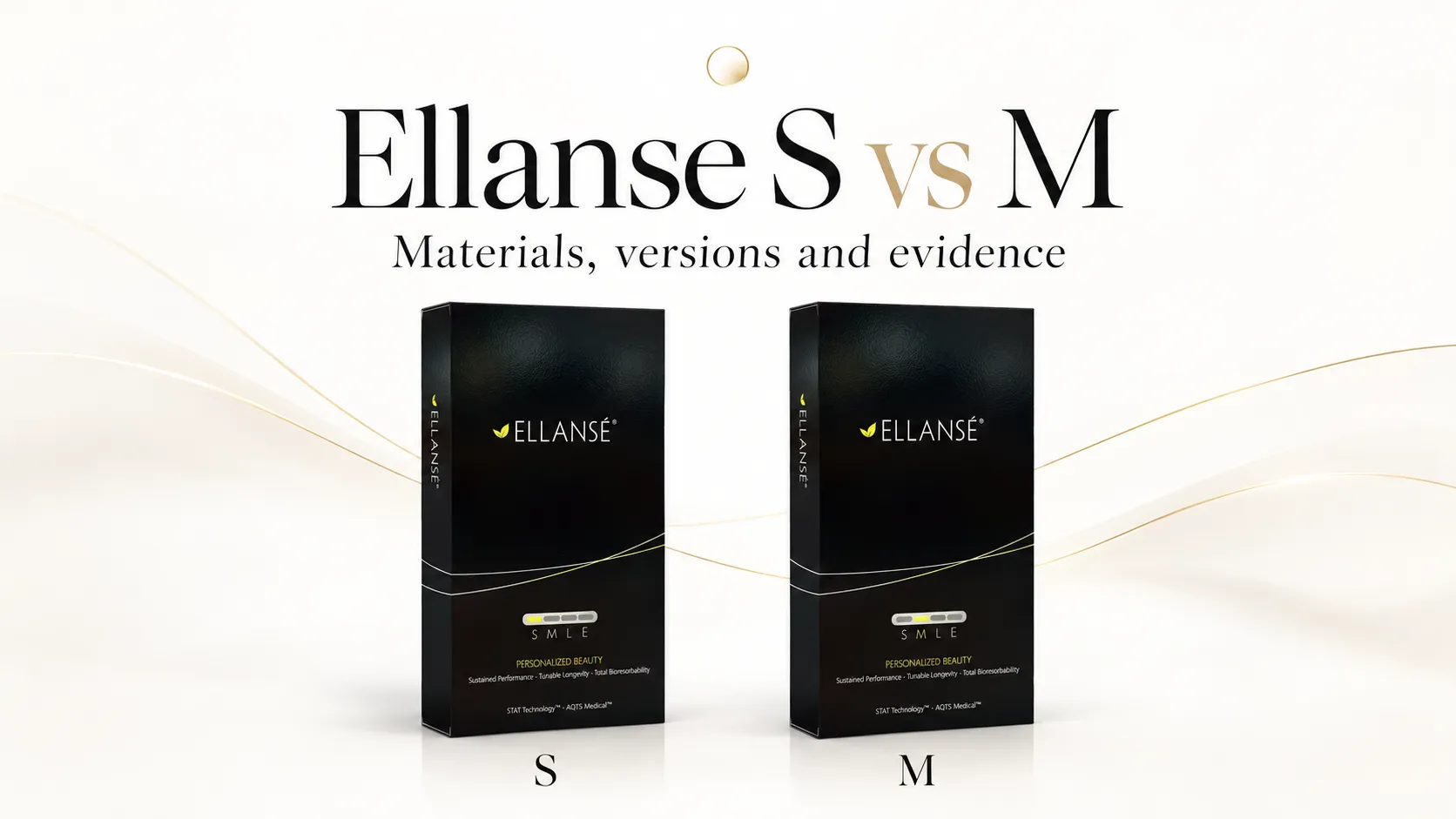
Ellanse S and M are versions within the same PCL-based product family. The meaningful comparison concerns their documented material characteristics, the evidence on persistence of correction, and the version-specific information supplied with the product. It is not a comparison between an HA filler and a completely different material, nor can the letter M be read as a universal rating of greater strength.
For readers researching the two versions, duration is usually the first question. It is also the question most easily oversimplified. A stated longevity range, an assessment at a particular study visit, and the time at which a material resorbs describe different things. Understanding those distinctions makes an S-versus-M comparison more informative than repeating a pair of numbers without their sources.
Identify M within the shared product family
The Ellanse M listing identifies the M version of the PCL product. Sinclair’s March 2022 expert guide describes the family as 30% polycaprolactone microspheres in a 70% carboxymethyl cellulose gel carrier, with a two-syringe presentation of 1 mL per syringe. It attributes the S/M distinction to PCL chain length, with longer chains in M. [1]
These facts establish the basis of the comparison. The letters do not describe two different box volumes, and they should not be interpreted as two HA concentrations. A buyer should retain the version letter in the product record because the shared brand name alone does not specify which item has been ordered.
The material names also deserve to remain separate. PCL identifies the microsphere material, while CMC identifies the carrier described in the manufacturer guide. Using a broad term such as filler is convenient in conversation, but it loses information needed for a technical comparison. A product record should preserve the actual composition category before moving on to claims about outcomes.
Compare like fields rather than a single headline
| Comparison field | Ellanse S | Ellanse M |
|---|---|---|
| Product family | PCL microspheres in CMC carrier | PCL microspheres in CMC carrier |
| Version identifier | S | M |
| Manufacturer explanation of difference | Shorter PCL chains relative to M | Longer PCL chains relative to S |
| Presentation in the 2022 guide | Two 1 mL syringes | Two 1 mL syringes |
| Duration assessment | Requires a defined source and endpoint | Requires a defined source and endpoint |
The table intentionally does not rank overall quality. A version difference can be real without creating a universally preferable option. The clinical question, applicable documentation, and individual circumstances determine whether a particular characteristic is relevant. Purchasing information can identify the version accurately, but it cannot replace that clinical assessment with an alphabetical or numerical shortcut.
This matters when comparing offers that use only the word Ellanse. A quotation should specify S or M, the pack configuration, and the documentation applicable to the supplied stock. If those fields are missing, a price difference is difficult to interpret. The offers may concern different versions, different commercial units, or different remaining shelf life.
Why duration numbers need a date and a definition
Even manufacturer literature needs to be read carefully. The March 2022 guide contains an S/M timeline labeled 12 and 24 months, while a separate packaging figure describes 18 and 24 months. Those differing S statements should not be silently combined into one guaranteed duration. A comparison should identify the document, page context, and meaning of the quoted figure. [1]
The practical response is to request the current local product information and clarify which claim applies to the supplied version. A historical brochure can be useful evidence of what was stated at that time, but it should not be presented as a timeless specification. Retaining the document date is especially helpful when an online search returns materials from several years.
Duration also needs an endpoint. Visible correction, investigator-rated improvement, patient satisfaction, and material persistence can have different timelines. A statement that improvement was observed at a follow-up visit does not mean every participant had the same result until that exact month. Likewise, a resorption discussion does not automatically establish the duration of an aesthetically meaningful change.
What the comparative clinical trial actually studied
A 2013 prospective randomized controlled trial followed 40 patients for 24 months after treatment of nasolabial folds with two PCL formulations. The longer-lasting formulation maintained correction better at the final assessment. The study provides a relevant comparative dataset, but its population, treatment area, sample size, and outcome scales define the scope of that evidence. [2]
That scope should remain visible when the trial is used in an S-versus-M discussion. It is not a demonstration that one version is better for every person or every anatomical area. A study can support a difference in persistence under its conditions without establishing a universal ranking of appearance, satisfaction, safety, or suitability across all potential uses.
The follow-up period should also be read literally. A 24-month trial supplies observations through its scheduled assessments, not a complete account of every later year. Claims beyond the measured period need a separate basis. Conversely, a final study visit is not a built-in expiration date for the result. The observation window and the individual outcome are different concepts.
Understand the rating scale behind the outcome
A wrinkle severity scale evaluates a defined visible feature, while an overall aesthetic improvement scale asks a broader question. Patient satisfaction adds another perspective. These measures can complement one another, but a percentage from one should not be relabeled as a percentage improvement in another. The name of the scale belongs beside the finding when results are summarized.
For example, a statement that a certain proportion remained improved is not the same as saying that each person’s appearance improved by that percentage. One describes the number of participants meeting a criterion; the other describes the magnitude of an individual change. Confusing them can turn an accurate study statistic into an exaggerated marketing claim.
The useful comparison therefore asks how improvement was defined, who assessed it, and when the assessment occurred. It also checks whether participants with missing follow-up were included in the calculation. These questions help a reader interpret a duration claim without needing to reproduce the original statistical analysis or infer an outcome from the product letter alone.
Collagen findings answer a different question
A small human histology study published in 2015 examined tissue from two participants 13 months after administration of a PCL-based filler. The investigators observed collagen formation around PCL particles. This provides mechanistic evidence in human tissue, but the study’s size and design do not establish an average cosmetic outcome or a precise duration for every patient. [3]
Histology and visible results should therefore be discussed as related but distinct forms of evidence. A tissue observation can help explain a biological response, while a clinical assessment evaluates what that response means for a defined outcome. Neither should be used as a substitute for the other when the claim concerns appearance, satisfaction, or comparative longevity.
This distinction also prevents the phrase collagen stimulation from becoming an all-purpose promise. A product description should say which evidence supports the mechanism and which evidence supports the visible result. The presence of a biological process does not supply a missing comparison between versions, nor does it remove the need to identify the population and follow-up period.
Translate the evidence into a useful product comparison
An internal S/M record can contain four separate entries: exact version, material description, applicable manufacturer documentation, and the clinical evidence being used. This structure keeps a commercial specification from absorbing every claim found in a brochure. It also makes later updates manageable because the team can replace a dated document without rewriting the product’s entire identity.
Within the Cytollia product catalog, the M listing can serve as the starting point for a version-specific document request. Ask for the current label and accompanying information for the stock being offered. The response should connect the M designation to the actual pack, rather than provide a generic explanation of the whole Ellanse range.
For any comparison article or purchasing summary, avoid reducing the conclusion to longer is better. A longer-lasting effect is one characteristic among others, and its value depends on the question being considered. The defensible result of the document review is an accurate distinction between versions and a clear account of what the evidence measures.
Questions about S and M
Is Ellanse M an HA filler
The manufacturer guide describes a PCL microsphere formulation in a CMC carrier. It should therefore be identified by that material platform, rather than described as an HA gel. Comparisons based on HA concentration do not explain the S/M distinction.
Does M contain a larger syringe than S
The 2022 guide describes two 1 mL syringes for the available presentations. The version letter should not be read as a volume indicator. Confirm the configuration of the supplied stock on the current quotation and label before placing an order.
Can one duration number summarize the difference
Only with a clear source, date, and definition of duration. Manufacturer statements and clinical follow-up times may describe different endpoints. They should not be converted into a guaranteed number of months for every individual or every treatment area.
Does the trial prove that M is always preferable
No. The cited comparative study addresses defined formulations, participants, and nasolabial fold outcomes. It informs the persistence question within that setting. It does not establish a universal choice for all people, anatomical areas, or clinical objectives.
Does collagen formation prove the visible effect lasts equally long
No. A histological finding and a visible clinical outcome are different observations. The small human tissue study supports a biological mechanism under its conditions. It does not establish an identical duration of aesthetic benefit for everyone receiving the product.
Compare the version and the evidence together
An informed S-versus-M review starts with the actual formulation and version, then evaluates duration claims against their source and endpoint. Request current documentation for the exact product being quoted. That gives the comparison a defensible basis without turning a version letter into a promise of a particular result.
References
1. Sinclair. ELLANSÉ: An Expert’s Guide. Date of preparation March 2022. Document UKBR-00665954-001-000.
2. Moers-Carpi MM, Sherwood S. Polycaprolactone for the correction of nasolabial folds: a 24-month, prospective, randomized, controlled clinical trial. Dermatologic Surgery. 2013;39(3 Pt 1):457–463.
3. Kim JA, Van Abel D. Neocollagenesis in human tissue injected with a polycaprolactone-based dermal filler. Journal of Cosmetic and Laser Therapy. 2015;17(2):99–101.
