

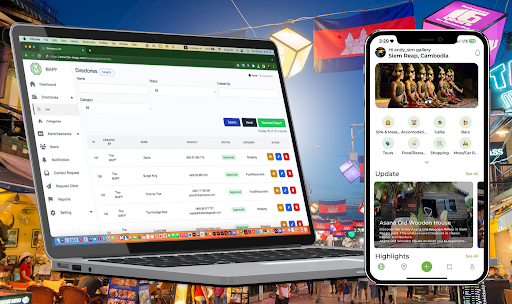
Just five years ago, mobile internet was a rarity in Cambodia’s provinces. Today, the situation has changed dramatically. A farmer can now receive payment for a harvest right from the rice field – provided they have a smartphone with internet access. Over that short period, the number of device users in Cambodia has jumped from 8 to 14 million, in a country with a total population of around 17 million.
Technology has advanced faster than the banking system, giving rise to a unique digital ecosystem unlike any other. Payment apps work without linking to bank cards, streaming platforms feature local content in Khmer, and a wide range of entertainment platforms has emerged. Digital finance and entertainment are evolving particularly fast. Users try 1xBet Cambodia app along with other popular platforms. Experts predict the market will grow by more than 30% annually.
Digital wallets instead of banks
Wing, ABA Mobile, Pi Pay — these names are familiar to virtually every Cambodian. More than 10 million people use mobile wallets for transactions every day. Traditional banks often require extensive paperwork and in-person visits, and in rural areas, bank branches are nearly impossible to find. Now, it’s a different story: download an app, enter your phone number — and you’re ready to send money. For millions of Cambodians, this was their first-ever access to digital payments.
Why mobile banking is so popular in Cambodia
Experts call this phenomenon leapfrogging — a technological leap that skips over an intermediate stage. In Cambodia, this shift has brought rapid and widespread access to digital financial services:
- Transfers are instant and often free of charge.
- Paying bills takes less than a minute.
- Mobile top-ups can be done with a single click.
- Microloans are available even without a credit history.
The low barrier to entry has fueled the growth of small businesses and increased public trust in digital technologies.
Table 1. Popular financial apps
| App | Active users | Main feature |
| Wing | 6,5 mln | Transfers without commissions |
| ABA Mobile | 2,8 mln | Full-fledged bank on your phone |
| Pi Pay | 1,2 mln | Pay for purchases using QR codes |
The growing accessibility of financial services is gradually reshaping user behavior and fueling the expansion of Cambodia’s digital economy.
Entertainment and new forms of leisure
Cambodians spend around four hours a day on digital entertainment — more than in many neighboring countries. Interestingly, global giants like TikTok and YouTube haven’t displaced locally developed platforms.
What are people watching and playing?
What the Cambodian audience chooses:
- Karaoke apps featuring national hits;
- Online games with strategic elements;
- Streaming platforms for K-dramas and other Asian series;
- Platforms for live sports broadcasts.
Local companies have adapted their interfaces to Khmer and taken cultural nuances into account. As a result, they are successfully competing with Western brands.
Education via smartphone
After the pandemic, educational platforms experienced a real boom. A student in Siem Reap can now take lessons with a teacher from Phnom Penh, and online courses have become a regular part of life.
The most popular apps are those for learning English and programming, which incorporate game-like elements such as badges, points, and user competitions.
Table 2. Popular learning trends
| Direction | Popularity | Cost per month |
| English | Top 1 query | $5-15 |
| Programming | Stable growth | $10-30 |
| Design and Graphics | Average interest | $8-20 |
Geography no longer matters
In the past, high-quality courses were only available in the capital. People living in rural areas could only dream of accessing a good education. Today, anyone from the countryside can earn an online certificate, and employers take it seriously. The gap between the capital and the provinces is shrinking as the digital economy continues to expand into more sectors.

Online shopping and delivery
E-commerce in Cambodia is growing rapidly. Electronics, clothing, and even fresh fruit are being ordered through platforms like Khmer24, Cambodia Post Shop, and Shopee.
A special mention goes to food delivery. FoodPanda and Nham24 partner with thousands of cafes and restaurants, with couriers delivering orders in just 30 to 40 minutes. This model took off during lockdowns and has since become a staple of urban life.
Logistics and Infrastructure
The boom in online shopping has attracted investments in warehouse infrastructure and transportation. Pickup points are now opening even in smaller cities. When customers can track their packages in real time, trust in the service naturally increases, which in turn drives market growth.

Entertainment platforms and personalization
Modern apps combine multiple functions into one: chat, streaming, mini-games. Cambodians appreciate versatility and simplicity in their apps.
Personalization algorithms analyze user preferences and suggest relevant content — such as live sports betting on 1xBet, with real-time odds volatility analysis to optimize results. This not only saves time but also increases user engagement. These algorithms are successfully applied across both entertainment platforms and educational services.

What’s next – projections through 2027
Cambodia’s digital economy is just getting started. By 2027, smartphones are expected to reach 80% of the population. On the horizon are the integration of artificial intelligence and augmented reality.
Table 3. App market forecast
| Year | Smartphones emergence | App market size |
| 2025 | 65 % of the population | $280 mln |
| 2026 | 72 % of the population | $350 mln |
| 2027 | 80 % of the population | $450 mln |
The government is investing in IT education and supporting new projects. The Cambodian government is actively investing in IT education and backing the launch of new digital initiatives. Venture capital funds are increasingly turning their attention to local startups, giving young professionals the opportunity to bring big ideas to life. Gradually, Cambodia is emerging as one of the region’s key digital hubs.
