

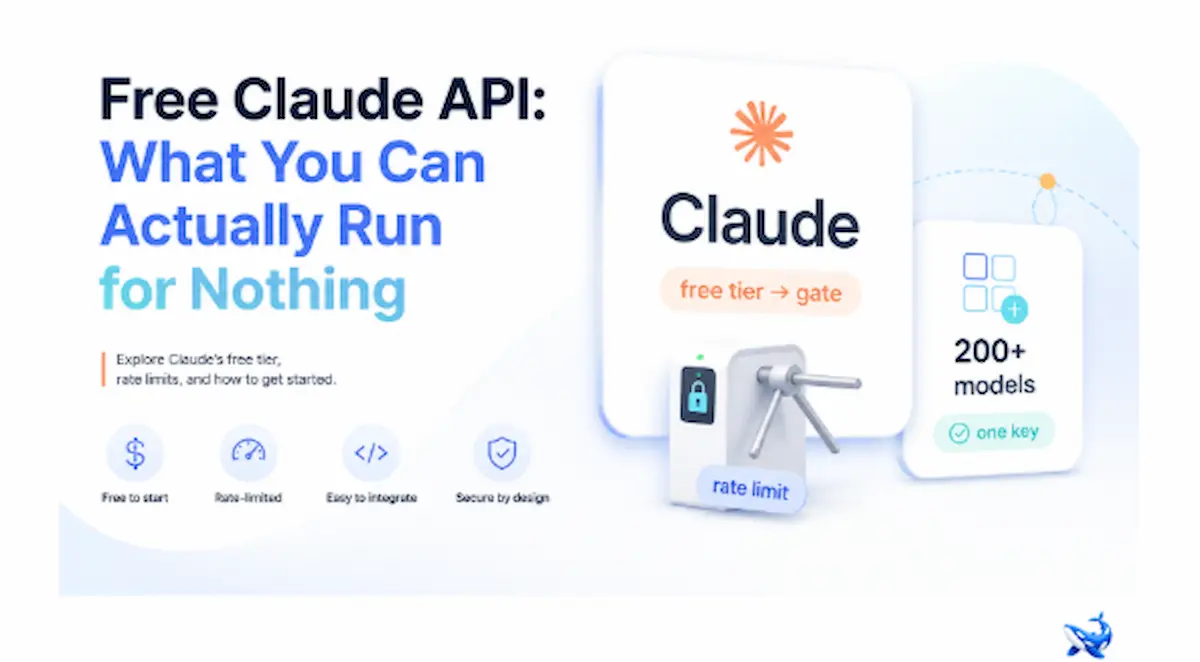
A free Claude API lets you run Anthropic’s models for nothing, and the fastest way to reach it is a layer that holds the key for the whole family — Claude Sonnet 5 is the mid-tier that sits where the price and the quality-bar balance usually lands. The catch is the same one every free tier shares: the models are genuinely Anthropic’s, and the amount you can call them in an hour is not.
Searching for a free Claude API usually means one of two things. A developer wants to write a prompt or build a small agent without creating an account and a card for every lab, or a team wants to evaluate whether Claude is the right model before committing a production path. Both are reasonable, and both hit the same wall: the free tier is a quota, and the quota is what determines whether you can actually try what you came to try. This article is about what the “free Claude API” you find will really let you do, and when it stops being worth the trouble.
What a free Claude tier actually gives you
Anthropic’s own free and low-cost access, and the free tiers various platforms hang on the same models, all share a shape. You get real Claude models — not a toy that approximates them — but the access is bounded by rate limits and a monthly or daily budget. That is enough to do meaningful work if the work is the point.
For prompting, for a short agent loop, for a batch of a few hundred calls that can tolerate waiting for the cap to reset, the free tier is genuinely sufficient. Its purpose is to let you verify a judgment call: is Claude better than the model I’m using, for the thing I actually run? You can answer that with a free tier.
What it won’t do is carry a live customer path. The cap, the missing SLA, the burst that becomes an error at 3pm — none of that is compatible with synchronous user traffic. Free tiers are evaluation tools, and the sooner a team treats them that way, the fewer surprises they get.
The two questions that decide if it’s worth it
Before you design anything around a free Claude API, ask two things and answer them in numbers.
How much can I actually run? Write down the requests-per-minute, tokens-per-minute, and the daily cap. A free tier that feels generous in a demo often collapses under a real loop that retries and re-prompts. Your loop’s token burn is the thing that matters, not the headline “free.”
Is it the same model I’ll pay for? If the free entry is a smaller or slower Claude variant than the one you’d buy, your prototype’s quality is not representative. Pin the exact model ID. This is the detail that turns a free-tier test from a proof into a mirage.
Both answers point the same way: the value of a free Claude tier is in confirming the direction, not in proving production behavior. That is enough to justify using it — it’s just not enough to build a product on.
Why a router is the smart way to use a free tier
The frustrating part of free tiers is that they’re per-vendor. A Claude free budget, an OpenAI budget, a Google budget — three keys, three quotas, three different limits to track. The free tier becomes the thing you manage rather than the thing you use.
An aggregator collapses that. One key reaches the whole catalog, and because a router decides per request, the same tier you use for a free Claude test can call Anthropic’s model on one prompt and the cheapest model that clears the bar on another [OURS]. You are not locked into one lab’s free quota; you are using whichever model fits the task, and pay-per-use at list price whenever you outgrow the free budget [OURS]. A 0% markup pass-through means the price you see on the card is the price on the invoice, so the decision to move off free is a clean one [OURS].
The threshold where free stops being worth it
Free tiers are not free; they are paid in attention. Every minute you spend watching a quota, coding around a cap, and debugging a rate-limit error is a cost, and it’s a cost you don’t see on an invoice. For a short evaluation, the price is a few minutes — cheap. For a workload that runs continuously, the price compounds until the engineering time far exceeds any dollar the free tier saved.
The crossover shows up roughly when a project moves from evaluation to steady use. At that point the honest answer is usually not “find a bigger free tier” but “pay list price for the cheapest model that clears the bar.” That is a small number when the model list is wide and the routing is smart — and a router that spans 200+ models makes it a config change rather than a rebuild [OURS].
The free tier is for making a call, not running a pattern
The most common way teams misuse a free Claude API is to let it become a pattern rather than a decision. They start with a prompt, keep the prototype running, add a few more calls, and before long the free tier is silently carrying something that looks like a workload — until the cap hits and everything that depended on it fails at once. The free tier did not change; the team stopped treating it as finite.
A free budget works well when the job is bounded and the endpoint is clear: evaluate Claude, settle a prompt, confirm the direction. It works badly when the job is open-ended and the free tier just happens to be carrying it. The difference is whether you have an exit plan — a record of the token counts, a confirmed model ID, and a stated point at which you move to paid. Teams that set that before they start rarely get caught; teams that don’t are the ones hunting for a bigger free tier at 3pm.
That is also why the cleanest free-tier strategy is the one that doesn’t need a tier in the long run. A single key that reaches the whole catalog and bills at list price means the free stage is just the cheapest way to test a direction, and the production stage is the same integration with one routing rule changed. You never rebuild; you re-point, and the model you land on is whichever one clears your bar for the least.
The takeaway
A free Claude API is the right tool for a specific job: proving whether Claude is the model you want, and drafting the prompt or agent that would use it. It is not the right tool for steady production traffic. Use it to make the call, log what you run, and when you know the direction, move to the cheapest model that clears your bar — at the vendor’s own list price, reached by one key instead of a quota per lab. That is how “free” becomes a step, not a ceiling.
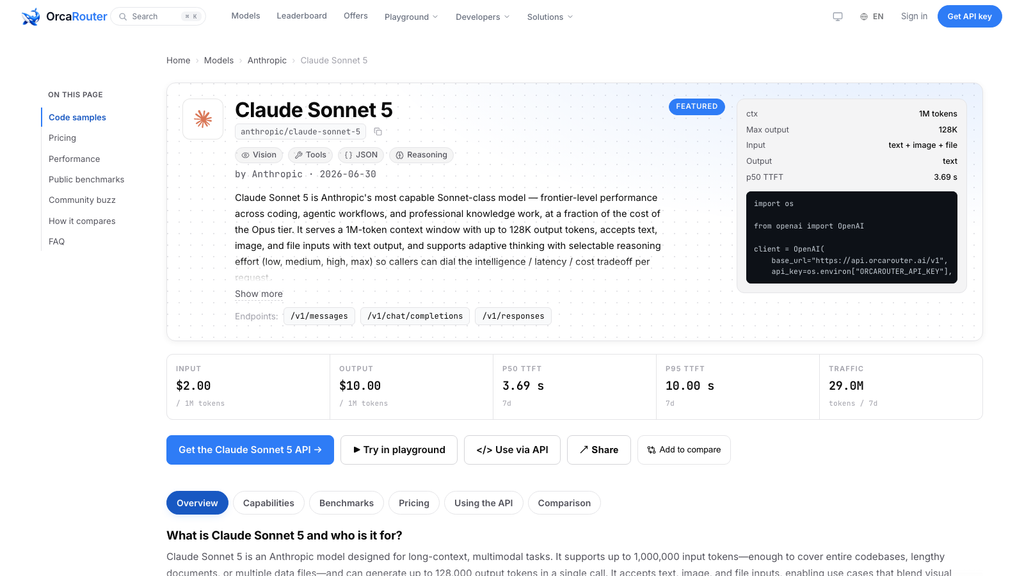
Sourcing note: the free-tier-is-a-quota framing and the two-question method are the article’s own framing, not a vendor claim. Claude Sonnet 5’s price and context figures are vendor-reported from Anthropic’s rate card, checked 2026-08-22. OrcaRouter product facts (one key for 200+ models, routing per prompt, 0% markup pass-through) are from its official site, checked 2026-08-22. Free-tier quotas change without notice.
