

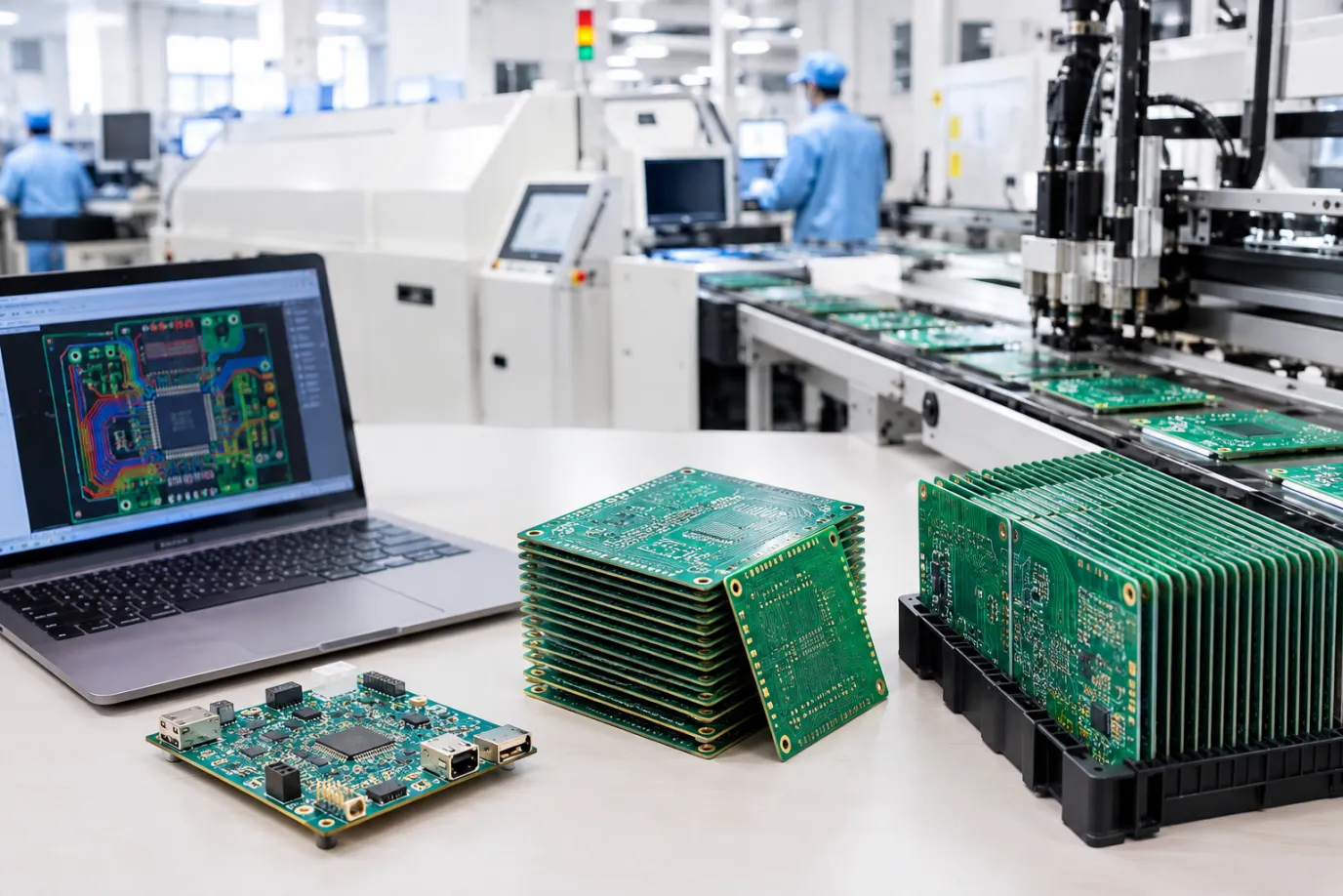
A prototype proves that a circuit can work. Mass production proves that it can be built repeatedly, at the required quality, cost, and delivery rate. Those are very different tests.
Many hardware teams discover this distinction too late. A supplier may deliver ten excellent prototypes through a highly manual process, then struggle when the order grows to 1,000 units. Materials change, yields fall, component substitutions appear, and lead times become unpredictable. The problem is rarely a single bad batch. More often, the manufacturer was selected for prototype speed without determining whether its processes could support the product’s full life cycle.
Choosing a PCB manufacturing partner therefore requires more than comparing online quotes. It means examining engineering capability, process control, supply-chain discipline, capacity, communication, and commercial terms as one system. The following framework helps teams make that assessment before production risk becomes expensive.
Start With the Production Destination
Before contacting suppliers, define what successful production will look like. A manufacturer cannot propose the right process when the buyer has not established the product’s technical and commercial requirements.
Create a manufacturing brief that covers:
- Board technology: layer count, finished thickness, copper weight, minimum trace and spacing, smallest drill, via structure, controlled impedance, and surface finish
- Materials: laminate family, glass transition temperature, dielectric requirements, thermal performance, flammability rating, and acceptable alternates
- Assembly: package types, smallest passive, BGA pitch, through-hole content, press-fit parts, selective soldering, conformal coating, and box-build needs
- Quality level: applicable IPC workmanship and performance requirements, regulatory obligations, and customer-specific criteria
- Testing: bare-board electrical test, automated optical inspection, X-ray, in-circuit test, functional test, burn-in, and data-retention needs
- Business profile: prototype quantity, pilot quantity, annual volume, demand variability, target cost, lead time, and expected product life
This brief should distinguish non-negotiable requirements from preferences. It should also identify foreseeable changes, such as a higher layer count in the next revision or a likely increase in annual demand. The goal is not simply to find a supplier that can build today’s board. It is to find one whose normal production window includes tomorrow’s product.
Evaluate Engineering Depth, Not Just Published Limits
Capability tables are useful, but a maximum specification is not the same as a stable production capability. A factory may advertise 3 mil traces, for example, while its best yields and most competitive pricing occur at 4 mil. The distinction matters because a design placed at the edge of a process window is more sensitive to normal manufacturing variation.
Ask the supplier to review the actual stackup, Gerbers or ODB++ data, fabrication drawing, drill files, IPC-356 netlist, BOM, centroid data, assembly drawings, and test requirements. A strong engineering team should return specific questions and a structured design-for-manufacturability review. Generic approval within minutes is not necessarily a sign of efficiency; it may indicate that the design has not been examined closely.
Useful DFM feedback should address issues such as annular ring, copper-to-edge clearance, solder-mask dams, drill aspect ratio, impedance geometry, copper balance, panel utilization, fiducials, component orientation, thermal relief, paste-aperture design, test-point access, and depanelization stress. It should separate mandatory corrections from yield or cost recommendations.
The right Custom PCB manufacturer should also be able to explain the manufacturing consequence of each recommendation. “Increase this clearance” is less valuable than “increasing this clearance will move the feature into our standard process window, improve yield, and avoid an additional imaging step.” That level of explanation shows that the supplier is connecting design decisions to real factory processes.
Match Certifications to the Product
Certificates should be treated as the start of verification, not the end. ISO 9001 indicates that a quality-management system is in place, but it does not by itself prove that a factory can hold a particular impedance tolerance or assemble a fine-pitch BGA reliably. Likewise, an IPC training certificate is different from demonstrating that production and inspection are controlled to the applicable IPC requirements.
Request current certificates, confirm the legal entity and manufacturing address, and check the scope and expiration date. Then connect each standard to the product:
- IPC-6012 is commonly used for the qualification and performance of rigid printed boards, while IPC-A-600 provides acceptance criteria for bare boards.
- J-STD-001 defines requirements for soldered electrical and electronic assemblies, while IPC-A-610 covers assembly acceptability.
- UL recognition may be relevant to printed wiring boards and material flammability. Verify that the factory, construction, materials, thickness range, and markings fall within the appropriate recognition rather than relying on a UL logo alone.
- Industry-specific systems may be required for automotive, medical, aerospace, defense, or other regulated applications.
Do not choose a higher IPC class simply as a vague synonym for better quality. Product class should follow the end use and reliability requirements because it affects design rules, inspection criteria, process burden, and cost.
Determine What Is Done In-House
Many suppliers outsource selected processes, and outsourcing is not automatically a problem. Uncontrolled outsourcing is.
Ask which operations are performed at the quoted facility and which are subcontracted. This includes PCB fabrication, surface finishing, via filling, laser drilling, electrical testing, component procurement, assembly, coating, programming, functional testing, cable work, and box build. For every outsourced operation, determine how the subcontractor is approved, how incoming quality is verified, and whether changes require customer notification.
This question also reveals whether the company quoting the job is the actual factory, a trading company, or an integrator managing several specialized sites. Any of these models can work, but the responsibilities must be clear. The partner should remain accountable for the complete deliverable rather than directing the buyer to resolve problems with an unknown sub-tier supplier.
Test the Supply Chain Before It Is Under Pressure
For assembled products, component availability often determines the real production schedule. The lowest assembly price has little value if critical parts are sourced late, bought through unapproved channels, or substituted without engineering approval.
Request a line-by-line BOM review during supplier qualification. The manufacturer should identify lifecycle status, long-lead items, allocation risk, minimum order quantities, packaging constraints, and possible alternates. Agree on approved sources and define the documents required for traceability. Customer approval should be mandatory before any manufacturer, part number, material, or functional substitute is used.
Also establish how excess material, attrition, price changes, and obsolete inventory will be handled. For long-life products, consider bonded inventory, scheduled releases, last-time-buy planning, or customer-owned stock. These decisions should be made before shortages create negotiating pressure.
Use a Pilot Build as a Production Audit
Prototype success is necessary, but it is not sufficient evidence for volume production. A pilot build should use the intended production materials, equipment, tooling, work instructions, inspection plan, and test method wherever practical. Its purpose is to validate the process, not merely to produce a larger sample.
Before the pilot begins, freeze the release package and record all approved deviations. Define measurable acceptance criteria for yield, defects, test coverage, cycle time, and documentation. After the build, conduct a joint review covering first-pass yield, rework, scrap, bottlenecks, operator feedback, test failures, and proposed design changes.
When evaluating an integrated provider such as OrinewPCB, ask it to map the complete route from incoming materials through fabrication, assembly, inspection, testing, and packing. That process map makes handoffs visible and helps both sides identify where ownership, data, or approval could be lost during scale-up.
Do not rush directly from a successful pilot into the full annual requirement. Use a controlled ramp, for example prototype, engineering validation, pilot, initial production, and then volume releases. The exact stages will vary, but each stage should have a clear exit criterion.
Compare Total Landed Cost
Quotes should be normalized before they are compared. Confirm whether each price includes engineering charges, tooling, test fixtures, impedance coupons, electrical test, solder-paste stencils, programming, inspection reports, packaging, freight, duties, and non-recurring expenses. Verify Incoterms, payment terms, quotation validity, minimum order quantity, and price-break assumptions.
Then account for the costs that do not appear on the quote: engineering time spent resolving unclear DFM feedback, repeated prototypes, line stoppages, premium freight, field failures, slow corrective action, and excess component inventory. A slightly higher unit price can be economically better when it comes with stronger yield, predictable delivery, and fewer production interruptions.
Open-book cost discussions can be useful during scale-up. Panel utilization, material selection, via structure, copper weight, surface finish, component packaging, stencil strategy, and test time can all influence cost. The best reductions remove waste without weakening reliability or transferring hidden risk to the buyer.
Score the Partner, Not the Sales Presentation
A cross-functional scorecard keeps the decision grounded in evidence. Weight the categories according to product risk rather than giving every item equal importance. A typical scorecard might assign the greatest weight to technical fit and quality systems, followed by supply-chain control, delivery and capacity, communication, and total cost.
Require evidence beside every score: a report, certificate, production record, audit observation, named process owner, or pilot result. Record major risks and the action needed to close each one. If a requirement is critical, make it a pass-or-fail gate instead of allowing a low score to be averaged away by a good price.
Communication should be evaluated throughout qualification. Notice how quickly the supplier acknowledges questions, whether answers come from engineers or only sales staff, how it manages conflicting files, and whether bad news is raised early. These behaviors during the sales process usually foreshadow how the company will act during a production problem.
The Best Partner Makes Scale Predictable
Moving from prototype to mass production is not a single purchase-order event. It is a controlled transfer of design intent into a repeatable manufacturing process. The right partner helps define that process, provides evidence that it is under control, and communicates before variation becomes disruption.
Select for the complete production journey. Validate technical capability with real files, connect certifications to the product, examine process records, run a representative pilot, verify capacity, normalize total cost, and formalize change control. A supplier that performs well across those areas does more than build boards. It reduces the uncertainty between a working prototype and a product customers can rely on at scale.
