

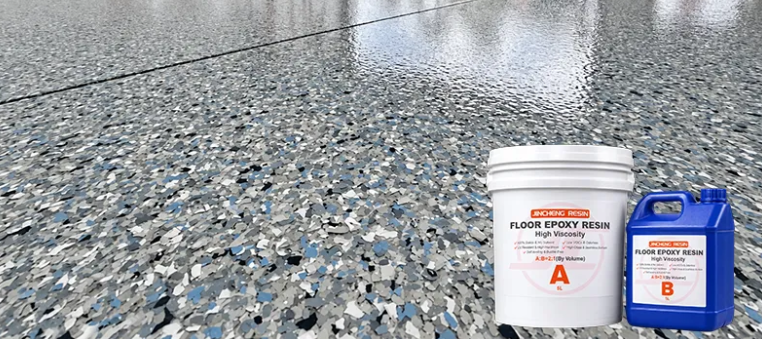
Hot weather is the hardest test for an industrial floor coating. Above 35°C, ordinary epoxy can cure too fast, trap air, crack, or leave pinholes. Contractors in tropical climates need a formulation that stays workable in the heat and still forms a thick, durable film. A high-viscosity epoxy resin is designed for exactly that job.
This guide explains what it is, why viscosity matters, how it performs in summer, what specifications to check, and where Jincheng Summer Grade Coating fits.
What Is It?
A high-viscosity epoxy resin is a thick epoxy base used to make floor coatings, primers, midcoats, and screeds. Viscosity measures how thick a liquid is and how easily it flows. Jincheng Summer Grade Coating has a dynamic viscosity of 8,000 to 15,000 mPa·s at 25°C, tested to ASTM D445. That is far thicker than a low-viscosity resin, which flows easily but can run off vertical surfaces and soak unevenly into concrete.
The thickness is created by advanced rheology modification, which controls how the resin flows under a roller or trowel. When applied, it forms a thick film, stays where it is placed, and seals concrete pores. This helps prevent outgassing bubbles, a common defect when air escapes from warm concrete into a thin, fast-curing coating.
Why Viscosity Matters for Flooring
Viscosity decides how a coating behaves during application. A thin resin levels easily, but it can sag on slopes, run off edges, and leave thin spots. A thick resin offers better thixotropy control, meaning it holds its shape after application and resists sagging.
This matters for three reasons. First, film build: a thick coat can be built in one pass, reducing the number of coats. Second, pore sealing: it fills small pores in concrete, creating a smoother base. Third, filler loading: it wets quartz sand well, so it can be mixed with 40 to 120 mesh quartz sand for strong midcoats. On walls and covings, it forms a thick film without running off.
The Summer Problem: Heat, Fast Curing, and Defects
In summer, heat speeds up the reaction between resin and hardener. Pot life shortens, the mix can overheat, and the surface can cure before air escapes, causing thermal runaway, cracking, or pinholing.
Jincheng addresses this with retarders and exotherm inhibitors. A high-viscosity epoxy resin made this way keeps a pot life of 25 to 30 minutes even above 35°C, giving applicators time to mix, spread, and finish, and helping prevent cracking and pinholing.
Jincheng also supplies a Winter Grade version for curing down to 5°C. Together, the grades cover curing from 40°C heat to 5°C cold.
Key Performance Specifications to Check
Before buying, compare tested values, not marketing claims. Jincheng reports these results for its Summer Grade resin:
- Viscosity at 25°C: 8,000 to 15,000 mPa·s (ASTM D445)
- Shore D hardness: 82 or higher (ASTM D2240)
- Compressive strength: 85 MPa or higher (ASTM D695)
- Adhesion to concrete: 3.5 MPa or higher, concrete failure (ASTM D4541)
- Abrasion: 0.025 g or less, Taber CS-17, 1,000 g / 1,000 revolutions (ASTM D4060)
These figures compare well with leading systems. Sika Sikafloor-1230 and Sikafloor-1210 also report compressive strength of 85 N/mm² or higher, adhesion of 3.0 N/mm² or higher, and a 12-month shelf life. Jincheng matches that strength, offers higher adhesion, and reports lower abrasion loss, at 0.025 g versus around 50 mg for Sikafloor-1230. Together, hardness, adhesion, and abrasion predict how long a floor survives forklifts, pallets, and heavy traffic.
Where It Is Used
A high-viscosity epoxy resin suits many industrial users because it combines thick film build, strong adhesion, and seasonal reliability. Typical uses include factories, warehouses, workshops, parking garages, logistics centres, food processing areas, laboratories, and commercial buildings.
It is used for self-levelling, epoxy mortar, anti-slip, chemical-resistant floors, and repair screeds. In clean areas such as pharmaceutical and electronics plants, its seamless surface helps control dust. In heavy-traffic areas, its strength protects concrete from impact and wear. Filled with quartz sand, it also works as a midcoat: primer seals concrete, the midcoat builds thickness, and a topcoat adds colour and chemical resistance.
How to Apply It Correctly
Good results depend on preparation as much as on the resin. Concrete must be clean, dry, sound, and free of dust, oil, and laitance, and the surface should be at least 3°C above the dew point to reduce condensation and blooming.
Mix resin and hardener in the correct ratio, scraping the sides and base of the container. In hot weather, work in smaller batches, keep materials out of direct sun, and apply during cooler hours. Do not apply material that has already started to thicken. For midcoats, mix with 40 to 120 mesh quartz sand. Allow each coat to cure before the next, and follow the data sheet for recoat times and thickness.
How to Choose the Right Resin
Start with climate. If your project is in a tropical or hot region, choose a summer-grade formulation with a controlled pot life above 35°C, not a standard resin designed for 25°C. A high-viscosity epoxy resin for summer should list viscosity, pot life, and exotherm control in its data sheet.
Next, check compatibility with your hardener, primer, topcoat, and quartz filler. Then check packaging: Jincheng offers 20 kg pails, 200 kg steel drums, and 1,000 kg IBC totes, with formulations customised to regional needs. Store unopened containers at 15°C to 25°C, away from direct sunlight. Shelf life is 12 months, the same as many leading systems.
Conclusion
Thick epoxy is a deliberate choice for floors that need thick film build, no sagging, strong adhesion, and reliable curing in hot weather. The right resin should offer controlled viscosity, a workable pot life in summer, high compressive strength, strong adhesion, and low abrasion loss.
Jincheng Summer Grade Coating meets those needs, with 8,000 to 15,000 mPa·s viscosity, 85 MPa compressive strength, 3.5 MPa adhesion, and a 25 to 30 minute pot life above 35°C. For contractors in tropical climates, it is a practical, tested option for durable industrial flooring.
Frequently Asked Questions
1. What is the main advantage over a thin epoxy?
Better thixotropy control. It forms a thick film without running off, seals concrete pores, and helps avoid outgassing bubbles.
2. How does it perform in hot summers?
With retarders and exotherm inhibitors, pot life stays at 25 to 30 minutes above 35°C, helping prevent thermal runaway, cracking, and pinholing.
3. Can it be mixed with quartz sand?
Yes. It can be mixed with 40 to 120 mesh quartz sand or powder for midcoats, and it wets filler well.
4. Are Summer Grade and Winter Grade both available?
Yes. Jincheng supplies both versions for reliable curing in 40°C heat or 5°C cold.
5. What packing sizes are available for wholesale?
20 kg pails, 200 kg steel drums, and 1,000 kg IBC totes. Shelf life is 12 months when stored at 15°C to 25°C in a dry, cool place.
