

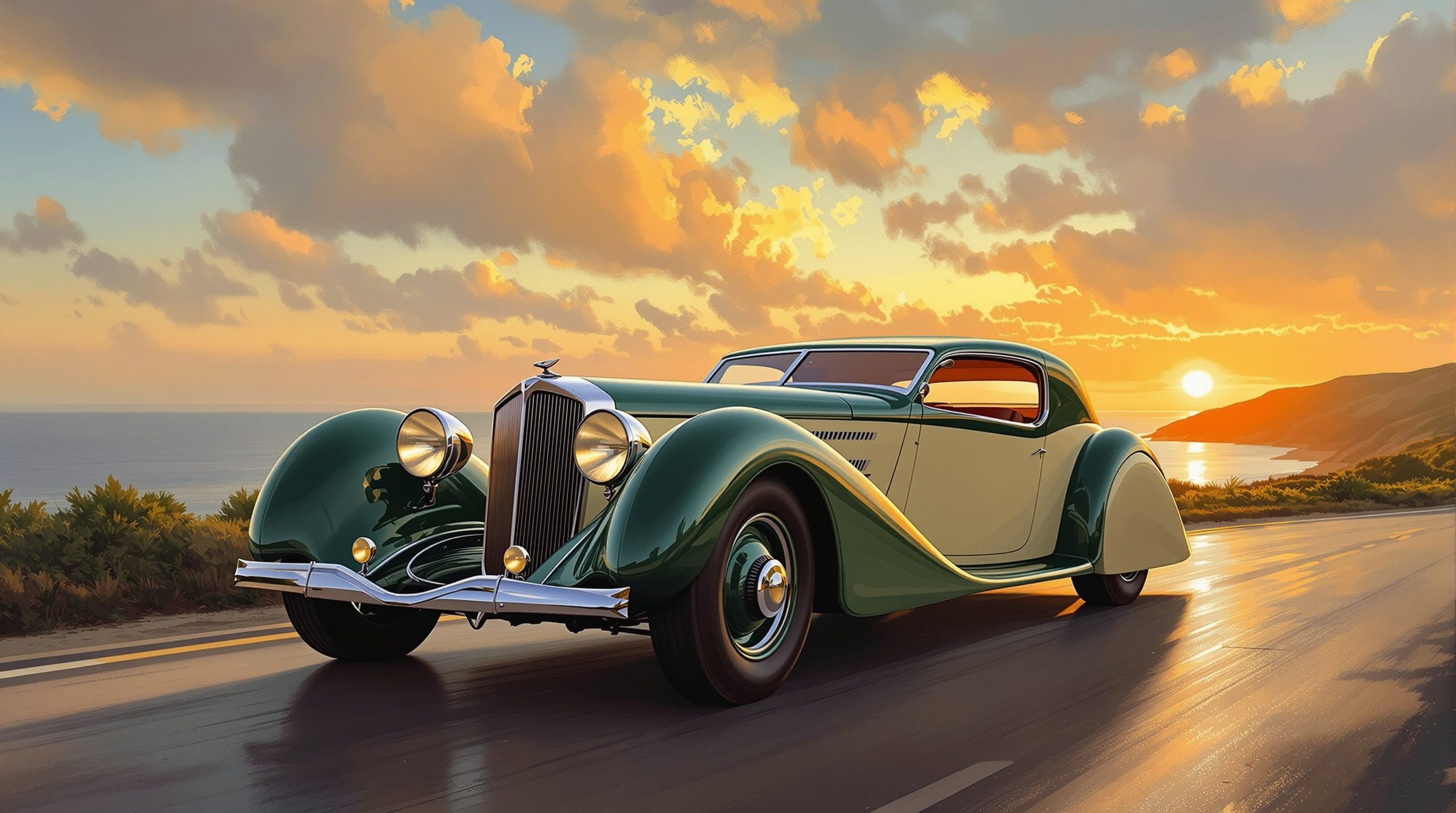
Every enthusiast has a story about the car that first captured their attention. It may have belonged to a parent, appeared in a movie, competed on a racetrack, or simply passed by at the perfect moment. Years later, the memory often remains surprisingly detailed: the shape of the headlights, the sound of the engine, the design of the wheels, or the position of the gauges.
These details explain why certain cars become more than machines. They represent specific people, places, ambitions, and stages of life. Artovelo transforms those connections into handcrafted three-dimensional displays, giving automotive memories a permanent place on the wall.
Rather than treating cars as generic decoration, Artovelo explores the design features and engineering stories that make individual models meaningful.
Cars as Markers of Time
Automotive history is usually described through technical developments, production dates, and performance figures. Personal automotive history works differently.
Someone may remember a car because it was parked outside their childhood home. Another person may associate a particular model with weekend journeys, their first job, or the years spent completing a restoration. Even a vehicle they never owned can represent a long-term goal.
As time passes, the physical car may be sold, modified, damaged, or become financially inaccessible. The memory, however, often grows stronger. Photographs and scale models can help preserve it, but carefully selected wall art can place that story within everyday surroundings.
A display becomes especially powerful when it includes details the owner recognizes immediately. The correct wheel, instrument face, generation, or body shape can evoke a much more personal response than a broadly branded accessory.
The Porsche 911 as a Visual Timeline
Few automobiles demonstrate the relationship between memory and evolution as clearly as the Porsche 911. Its continuous development allows several generations of enthusiasts to recognize the same essential car while maintaining strong preferences for particular eras.
An older air-cooled model may remind one person of childhood posters and mechanical simplicity. A later water-cooled generation might represent the first 911 another person drove. A modern GT3 or Turbo S can symbolize current performance and engineering ambition.
When multiple generations appear together, the viewer can trace how the 911 changed without losing its identity. Headlights, bumpers, wheels, proportions, and aerodynamic elements evolved, but the familiar silhouette remained.
This makes evolution artwork particularly suitable for buyers considering porsche 911 gifts. Instead of choosing an item based only on the Porsche name, they can select a display that acknowledges the history of the model and the recipient’s place within that history.
Remembering a Car Through Its Wheels
Wheels are practical components, but they can also become defining design features. Enthusiasts often recognize a generation or performance variant by its wheel pattern before noticing other details.
Changes in wheel design reveal developments in manufacturing, materials, braking requirements, aerodynamics, and visual taste. A style associated with an early model can evoke an entirely different period from the design fitted to a modern high-performance car.
Presenting these wheels together turns a familiar component into an automotive timeline. It allows viewers to compare decades of design without the distraction of complete vehicles.
For designers and detail-oriented collectors, wheel artwork may be more interesting than a conventional portrait. It focuses on an element that combines function and identity—a quality shared by many of the most memorable automotive details.
The View from the Driver’s Seat
Exterior styling is what first attracts many people to a car, but ownership creates a different set of memories. Drivers spend their time looking at the dashboard, steering wheel, and instruments rather than the body.
The tachometer is especially significant in performance cars. It communicates engine speed, guides gear changes, and becomes closely connected to sound and acceleration. Its markings, colors, and redline can identify a specific era or model.
A tachometer display captures the car from the driver’s perspective. To someone who has owned or driven the model, a familiar gauge can recall the sensation of an entire journey.
Collections showing instruments from different generations also reveal how interiors evolved. Digital information gradually joined traditional analog displays, layouts became more complex, and technology changed how the vehicle communicated with its driver.
Despite those developments, the instrument panel remained one of the most personal points of contact between human and machine.
Understanding a Car by Taking It Apart
Some enthusiasts remember cars through the driving experience. Others connect with them by understanding their construction.
Mechanics, engineers, restorers, and model builders often see a vehicle as a system of related components. They appreciate how individual elements contribute to the performance, appearance, and character of the finished machine.
A deconstructed car display reflects this way of thinking. It separates the vehicle into visible parts and organizes them within a single composition. Components normally hidden inside or beneath the completed model become subjects worthy of attention.
This presentation does not reduce the magic of the car. Instead, it demonstrates how much thought lies behind its apparently effortless form. The artwork becomes both a technical study and a celebration of design.
For someone who enjoys working with machines, a deconstructed composition may feel more personal than a dramatic photograph of a car at speed.
Passing Automotive Enthusiasm Between Generations
Car culture is often shared between parents and children. A young enthusiast may learn model names while helping in a garage, attending races, or listening to stories about vehicles owned years earlier.
These experiences create family traditions. The same model can mean different things to different generations: nostalgia for one person, discovery for another, and future ambition for someone younger.
Automotive artwork can help preserve this shared history. A father and child might identify the generation each remembers most clearly. A display could mark the completion of a project they worked on together or celebrate a model that has remained in the family.
The artwork then represents more than the vehicle itself. It becomes a reminder of time spent learning, repairing, travelling, and talking together.
This makes dimensional car art suitable for Father’s Day, milestone birthdays, retirement, anniversaries, and other occasions that recognize a long relationship with automobiles.
Creating a Personal Automotive Archive
An enthusiast’s collection does not need to resemble a crowded memorabilia shop. A few intentional displays can create a more meaningful record than dozens of unrelated objects.
Start with the car that has the strongest personal significance. Add an evolution piece if its history matters, a tachometer collection if driving memories are central, or a deconstructed frame if engineering is the main interest.
Photographs, manuals, race programs, and small models can then support the central artwork. The result is a personal automotive archive rather than a collection built around logos alone.
Artovelo’s wall-based format is useful where shelf space is limited. Three-dimensional elements provide the presence of a physical collectible, while the completed frame keeps the composition organized and protected behind acrylic glazing.
The displays can be used in garages, but they are also suitable for home offices, studies, living rooms, studios, and hallways. Their placement allows automotive history to become part of daily life rather than remaining hidden in storage.
Choosing the Right Display as a Gift
The most important step is identifying which car carries the recipient’s story.
Listen for the model they mention repeatedly. Look at old photographs, saved images, books, social-media posts, and miniature collections. If they own a Porsche, determine the generation or variant rather than stopping at the marque.
Next, think about how they engage with cars. A history-focused collector may enjoy comparing generations. A driver may prefer gauges and dashboard details. A mechanic might be drawn to individual components, while a design enthusiast could appreciate wheel evolution.
The occasion can also guide the choice. Artwork featuring a current vehicle can celebrate ownership. A display of a former car can preserve a memory. A dream model can represent a future objective.
By connecting the subject, format, and occasion, the gift becomes far more specific than standard automotive merchandise.
A Story That Remains Visible
Great cars leave impressions through small details. A gauge needle, wheel pattern, body line, or mechanical component can bring back an entire period of life.
Artovelo frames these details so that they remain visible. Its three-dimensional displays give enthusiasts a way to celebrate automotive history while preserving their own experiences within it.
The car itself may eventually leave the garage. Technology will continue to change, and new generations will appear. But the stories formed around a meaningful automobile can remain part of the home, ready to be remembered and shared.
That is what makes automotive art more than decoration: it gives a personal history a physical place to live.
Artovelo creates original artwork inspired by automotive culture. Unless explicitly stated otherwise, its products are not manufactured, licensed, endorsed by, or affiliated with any vehicle manufacturer.
