

Whether you’re sketching a diagram on a whiteboard, aligning elements in a report, or guiding students through a geometry lesson, precise measurement underpins countless daily tasks. The metric measurement scale has long served as the global standard for accuracy, evolving from simple wooden straightedges into sophisticated instruments that meet the demands of modern professionals.
Today, metric measuring rulers come in forms that early craftsmen could never have imagined—digital displays, laser-guided edges, and app-connected devices that turn a humble ruler into a powerful productivity tool.
For teachers seeking interactive and affordable ways to bring measurement concepts to life, and for office workers who need efficient, compact instruments that won’t clutter a desk, the right metric ruler can solve real workflow problems.
This article explores how these tools have transformed and how educators and professionals can leverage them to work smarter, teach more effectively, and maintain precision without sacrificing convenience or budget.
The Evolution of the Measuring Tool: From Analog to Digital Precision
Measurement has shaped human progress since ancient civilizations first standardized lengths using body parts, grains of barley, and carved stone references. For centuries, wooden and metal straightedges served craftsmen, scholars, and merchants, but inconsistencies between regional systems created confusion in trade and science.
The adoption of the metric system in the late 18th century changed everything—its decimal-based structure made calculations intuitive, conversions seamless, and international collaboration possible. Today, the metric measurement scale remains the foundation of scientific research, manufacturing, and education across most of the world.
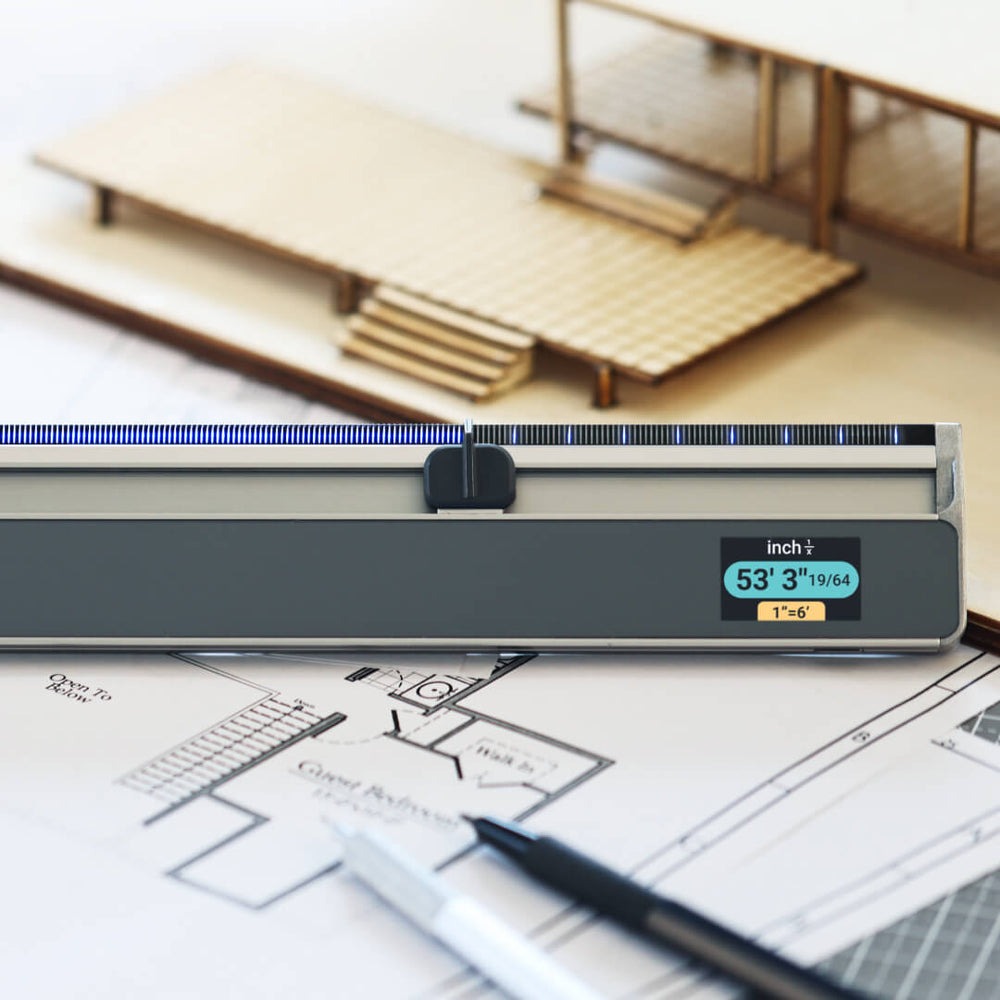
What has changed dramatically is the instrument itself. Traditional analog rulers, while reliable, offer limited functionality beyond drawing straight lines and reading graduations. The shift toward digital measuring devices introduced LCD displays that eliminate parallax errors, memory functions that store multiple readings, and Bluetooth connectivity that transfers data directly into design software. Manufacturers like HOZO have pushed this evolution further by engineering rulers that combine rolling mechanisms, digital readouts, and ergonomic portability into a single device.
These innovations aren’t merely technological novelties—they address real frustrations. Teachers no longer need to squint at tiny markings during demonstrations, and office professionals can measure irregular layouts without juggling multiple tools. This progression from analog simplicity to digital precision sets the stage for transformative applications in both classrooms and workplaces, where accuracy, speed, and ease of use determine how effectively people accomplish their goals.
Enhancing Classroom Learning with Metric Measurement Scales
Teachers face a persistent challenge: making abstract mathematical concepts tangible for students who learn best through doing. The metric measurement scale offers an ideal entry point because its decimal structure mirrors the base-ten number system students already understand. When a student physically measures a desk in centimeters, converts that figure to meters, and then calculates the area, the lesson moves from textbook theory into lived experience.
Metric rulers serve as bridges between conceptual understanding and practical application across subjects—measuring plant growth in biology, calculating velocity in physics, or creating scale drawings in art class. The key lies in choosing tools that invite participation rather than passive observation, and that fit within the budget constraints every school faces.
Interactive Measuring Tools for Engaging Classroom Activities
Digital metric rulers with large LCD displays transform front-of-class demonstrations by making readings visible to every student, not just those in the first row. Teachers can connect certain smart rulers to projectors or interactive whiteboards, displaying real-time measurements as they demonstrate concepts like perimeter or unit conversion.
A practical exercise involves pairing students to measure classroom objects, record results on a shared digital spreadsheet, and identify patterns—turning a simple ruler activity into a collaborative data analysis lesson. Rolling digital rulers prove especially effective for measuring curved surfaces, such as globes or cylindrical containers, giving students hands-on exposure to circumference without requiring string-and-straightedge workarounds. These interactive approaches increase engagement because students see immediate, accurate feedback rather than debating whether a marking falls between two graduations.
Affordable Options for Student Use and Budget Management
Equipping an entire classroom doesn’t require expensive technology for every desk. Basic transparent metric rulers with clearly printed millimeter graduations remain effective for daily exercises and cost very little when purchased in bulk sets of thirty or more.
For departments seeking a middle ground, semi-digital rulers with simple electronic displays offer enhanced readability without the expense of full smart-device connectivity. When evaluating bulk purchases, teachers should prioritize shatter-resistant materials like flexible polycarbonate over brittle acrylic, since replacements quickly erode any initial savings. Requesting quotes from educational suppliers during back-to-school sales periods can reduce per-unit costs significantly.
A practical strategy is to maintain a small set of advanced digital rulers for teacher demonstrations and group projects while supplying students with durable analog versions for individual practice—balancing instructional impact against realistic budget limits.
Boosting Office Efficiency with Precision Measuring Devices
Office professionals routinely encounter tasks that demand spatial accuracy—aligning printed materials for binding, verifying margins on legal documents, sizing graphics for presentations, or planning furniture layouts during office reorganizations. Yet many workers rely on whatever ruler happens to be in a drawer, often an imprecise freebie from a trade show that wastes time through repeated measurements.
A quality metric measuring ruler eliminates these micro-frustrations by delivering consistent, readable results on the first attempt. In environments where deadlines compress and attention to detail separates polished deliverables from amateur ones, the right measuring device becomes a genuine productivity asset rather than a mere accessory.
Efficient Tools for Professional Presentations and Reports
When designing presentation slides or formatting reports, precise spatial relationships determine visual credibility. A digital metric ruler allows professionals to quickly verify printed element spacing, confirm that charts maintain consistent proportions across handouts, and check that physical mockups match on-screen dimensions before client meetings.
The practical workflow involves measuring a printed draft, noting discrepancies against the intended layout specifications, and adjusting margins or image sizes in software like PowerPoint or InDesign accordingly. For CAD users preparing architectural or engineering documents, a metric ruler with fine millimeter graduations serves as a rapid verification tool for plotted drawings, catching scale errors before documents reach stakeholders.
This measure-verify-correct cycle, when supported by an accurate instrument, reduces revision rounds and elevates the professional quality of every deliverable that leaves your desk.
Compact Measuring Devices for Clutter-Free Office Use
Desk real estate is precious, and traditional thirty-centimeter rulers create awkward storage challenges alongside keyboards, monitors, and document trays. Modern solutions address this directly—foldable metric rulers collapse to pocket size, rolling digital measurers occupy no more space than a thick pen, and retractable tape-style instruments tuck into pencil cups.
Multi-functional designs that combine straightedge capabilities with digital measurement, unit conversion, and even stylus tips consolidate several tools into one compact device. The selection strategy is straightforward: identify which measurement tasks recur most frequently at your workstation, then choose the smallest form factor that handles those tasks without compromise. Professionals who travel between meeting rooms or client sites benefit particularly from pocket-sized instruments that slip into a laptop bag, ensuring measurement capability is always available without adding bulk to an already heavy carry.
Choosing the Right Metric Ruler: A Practical Guide
Selecting the ideal metric measuring ruler requires matching the tool’s capabilities to your specific workflow rather than defaulting to the most feature-rich or cheapest option available. Start by identifying your primary use case. Teachers delivering front-of-class demonstrations need large, visible displays and durability against daily handling by dozens of students. Office professionals formatting documents or verifying printed layouts prioritize fine millimeter precision, compact storage, and speed of use. Once the core need is clear, evaluate three critical factors in sequence.
First, consider precision requirements. If your tasks involve measurements below one millimeter—such as verifying CAD plot accuracy or aligning fine typographic elements—a digital ruler with electronic readout eliminates guesswork. For general classroom exercises or basic office layout checks, clearly printed analog graduations at half-millimeter intervals provide sufficient accuracy without added complexity. Second, assess material quality relative to environment. Educational settings demand shatter-resistant polycarbonate or flexible plastic that survives drops and backpack compression. Office instruments benefit from aluminum or stainless steel edges that maintain straightness over years of use.
Third, weigh the digital-versus-analog trade-off honestly. Digital models offer memory storage, unit conversion, and connectivity, but they require batteries or charging and cost more upfront. Analog rulers need no power, never malfunction electronically, and replace inexpensively—making them ideal for high-volume student distribution.
A practical decision framework follows these steps: define your three most frequent measurement tasks, determine the minimum precision each requires, set a realistic budget per unit, then select the simplest tool that satisfies all three criteria. This disciplined approach prevents overspending on features you rarely use while ensuring the instrument you choose genuinely enhances productivity rather than collecting dust in a drawer.
Leveraging Metric Rulers for Smarter Teaching and Professional Precision
The metric measuring ruler has traveled a remarkable path from simple carved straightedge to intelligent digital instrument, and along the way it has become indispensable in two environments that shape our daily lives—classrooms and offices. For teachers, the right metric tool transforms abstract decimal relationships into tactile discoveries, turning passive listeners into active measurers who grasp unit conversion, area calculation, and data collection through direct experience.
For office professionals, a precise and compact measuring device eliminates the small inaccuracies that compound into costly revisions, elevating the quality of presentations, reports, and spatial planning without consuming valuable desk space.
Innovation continues to drive this category forward. Digital displays, rolling mechanisms, Bluetooth connectivity, and multi-functional designs from forward-thinking manufacturers demonstrate that even the simplest tool can evolve to meet contemporary demands. Yet the underlying principle remains unchanged: accurate measurement empowers better decisions.
Whether you invest in a classroom set of durable analog rulers or a single advanced digital instrument for your workstation, the key is aligning the tool’s capabilities with your most frequent tasks. Take time to assess your workflow, define the precision you genuinely need, and select accordingly. In doing so, you ensure that every line drawn, every layout verified, and every lesson delivered rests on a foundation of confidence that only reliable measurement can provide.
