

Audio and video content are growing faster than ever. From podcasts and interviews to YouTube videos, webinars, online meetings, and voice recordings, spoken information has become one of the internet’s most important content formats. However, audio itself is difficult to search, summarize, edit, or reuse unless it is converted into readable text.
Fortunately, modern AI tools now make it possible to Transcribe Audio to Text online within minutes — without downloading software, creating an account, or paying subscription fees.
How to Transcribe Audio to Text Online?
Modern Audio Transcription platforms have simplified the entire workflow. Instead of manually typing subtitles or installing complicated desktop applications, users can now generate transcripts directly in the browser.
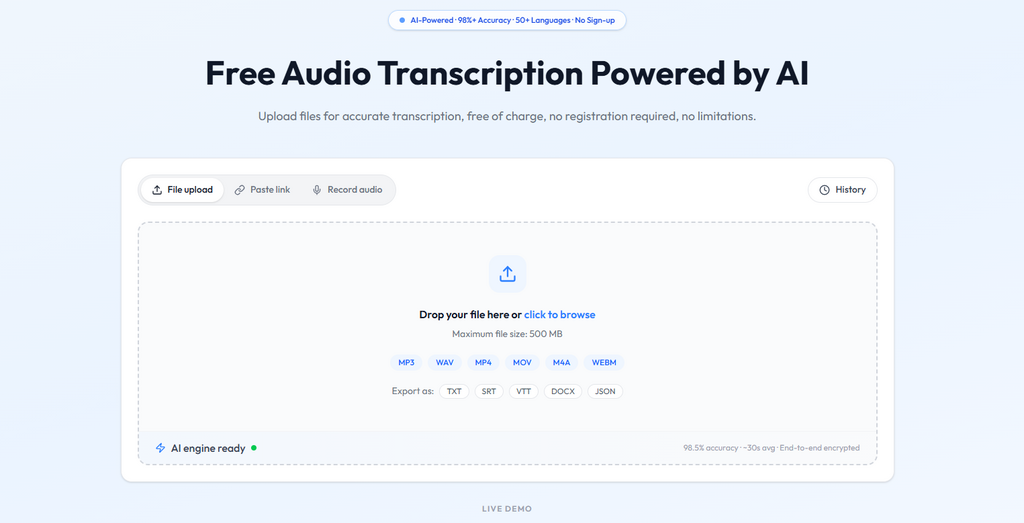
Platforms like AudioTranscription.io provide a fast browser-based AI transcription solution that supports audio files, video files, recordings, and online URLs. Unlike many traditional tools, the platform is completely online, requires no registration, and allows users to access free unlimited transcription without downloading software.
Here’s how the process typically works:
Step 1: Upload Your Audio or Video File
Upload an audio recording, video file, podcast episode, lecture, meeting recording, or voice memo directly to the platform.
Most modern AI systems support formats such as:
- MP3
- WAV
- MP4
- MOV
- M4A
- WebM
Some platforms also allow users to transcribe online videos directly from URLs.
Step 2: AI Automatically Detects Speech
After uploading, the AI analyzes the spoken content using advanced automatic speech recognition (ASR) models.
The system identifies:
- Spoken words
- Sentence structure
- Natural pauses
- Contextual language patterns
Modern AI models can recognize speech with surprisingly high accuracy, even across different accents and recording conditions.
Step 3: Generate the Transcript
Within minutes, the platform converts the spoken audio into readable text and subtitles automatically.
Users can then:
- Copy the transcript
- Edit subtitles
- Export captions
- Create notes
- Repurpose content for blogs or social media
This workflow dramatically reduces the time required for manual transcription.
Why More People Need AI Audio Transcription?
Manual transcription is slow, repetitive, and expensive. Typing subtitles line by line can take hours, especially for long recordings or videos.
This is why AI-powered speech recognition tools are becoming increasingly popular. With advanced automatic speech recognition (ASR), users can now Transcribe Audio to Text in just a few minutes.
AI transcription is widely used for:
- Podcast subtitles
- Meeting notes
- YouTube captions
- Online course transcripts
- Interview documentation
- Lecture summaries
- Voice memo conversion
Instead of replaying recordings repeatedly, AI can instantly generate accurate text from spoken content.
The Biggest Problems with Traditional Transcription Tools
Although many speech-to-text platforms exist today, users often encounter several frustrating limitations.
Some tools require:
- Large software downloads
- Mandatory registration
- Credit card signups
- Daily usage limits
- Watermarked exports
- Slow processing queues
For users who simply need fast subtitle generation, these restrictions create unnecessary friction.
Many people now prefer online AI transcription tools that work instantly without technical setup.
Why Browser-Based AI Transcription Is Becoming Popular
One of the biggest trends in the AI industry is browser-based transcription.
Instead of installing desktop software, users can process audio directly online from any device.
This offers several major advantages.
No Download Required
Users can start transcribing immediately without installing applications or worrying about compatibility issues.
No Registration Needed
Many users want quick access without creating accounts or verifying emails.
Faster Workflow
Browser-based systems reduce unnecessary steps and allow users to upload files instantly.
Multi-Device Compatibility
Online transcription tools work across desktops, tablets, and mobile devices.
This convenience is one reason why AI transcription adoption continues growing rapidly.
Modern AI Can Transcribe More Than Audio Files
Earlier speech-to-text systems mainly supported basic audio uploads. Modern AI transcription platforms are much more flexible.
Today’s tools can process:
- Audio recordings
- Video files
- Podcasts
- Screen recordings
- Meeting exports
- Voice memos
- Online video URLs
This flexibility is especially useful for creators and remote teams that work with multiple media formats daily.
For example:
- A YouTuber can generate subtitles automatically
- A student can convert lectures into searchable notes
- A business team can archive meetings instantly
- A journalist can transcribe interviews faster
AI transcription is evolving into a universal content productivity tool.
Why Transcripts Improve SEO and Accessibility
Transcription provides benefits far beyond convenience.
Search engines cannot fully understand spoken audio inside videos or podcasts, but they can crawl and index text transcripts.
This helps improve:
- Search visibility
- Keyword relevance
- Organic traffic
- Content discoverability
For creators and businesses, subtitles can significantly improve SEO performance.
Accessibility is another major advantage.
Many users rely on captions because they:
- Watch videos without sound
- Prefer reading while listening
- Speak different native languages
- Have hearing impairments
Accurate subtitles make content easier to consume globally.
URL-Based Transcription Is Changing the Workflow
A growing trend in the industry is URL transcription.
Instead of downloading media files manually, users can simply paste a video link into an AI platform.
The AI automatically extracts the speech and generates subtitles or transcripts.
This workflow is especially useful for:
- YouTube videos
- Online courses
- Webinars
- Public interviews
- Educational content
URL-based transcription saves time and simplifies large-scale content processing.
What Makes a Good AI Transcription Platform?
Not all AI transcription tools provide the same experience.
An effective platform should offer:
- Fast processing speed
- Accurate speech recognition
- Multi-format support
- Browser accessibility
- Simple interface
- Stable performance
Most importantly, users increasingly want tools that are:
- Free to use
- Unlimited
- Online
- No-download
- No-registration
Platforms like Audio Transcription are becoming popular because they simplify the entire process into a fast browser-based workflow.
Users can:
- Upload audio or video directly
- Paste online URLs
- Generate transcripts instantly
- Use the platform without creating accounts
- Access unlimited transcription online for free
This dramatically lowers the barrier for subtitle creation and speech-to-text conversion.
The Future of AI Audio Transcription
AI speech recognition technology continues improving rapidly.
Future transcription systems will likely include:
- Better multilingual recognition
- Real-time translation
- Automatic summarization
- Speaker detection
- Smarter subtitle formatting
- Higher noisy-audio accuracy
As AI evolves, transcription will become an even more important part of digital communication and online content workflows.
Final Thoughts
Audio and video dominate modern communication, but spoken content becomes significantly more valuable when converted into searchable text.
AI-powered transcription tools now allow users to generate subtitles and transcripts within minutes directly in the browser.
Instead of downloading software or paying expensive subscription fees, users increasingly prefer fast online solutions that work instantly.
If you need a simple way to convert recordings, meetings, podcasts, videos, or online URLs into accurate text, browser-based AI transcription tools provide one of the most efficient solutions available today.
