

Introduction to Custom Cut Sheet Metal
Custom cut sheet metal refers to metal sheets or plates cut to specific dimensions, profiles, holes, and features according to a part design. Cutting may be followed by forming, welding, finishing, or assembly as part of the broader sheet metal fabrication process.
Custom sheet metal fabrication of components allows you to achieve extremely tight tolerances of ±0.05 mm, which is useful to create functional parts with complex geometries.
Sheet Metal Cutting Technologies: How to Cut Sheet Metal
Sheet metal fabrication, often involving sheet metal laser cutting, involves using various machines to create custom parts. Each process and machine has different precision, speed, and material compatibility. This allows you to create various parts with different requirements.
Laser Cutting
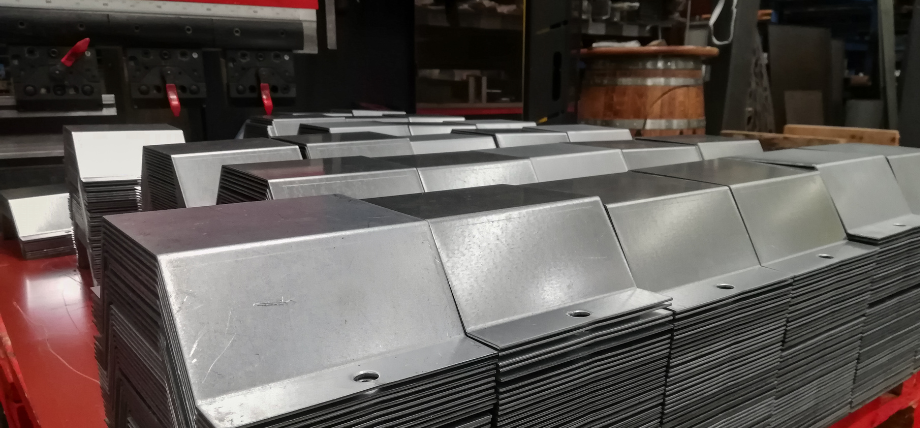
Sheet metal laser cutting works by vaporising or melting the metal along a pre-programmed path. It uses CNC technology along with CO2 or fibre lasers, depending on the material to cut metal.
Metals with shiny and reflective surfaces, such as aluminium, use fibre lasers. Typical parameters for cutting include a power range of 1-20 kW and speeds of up to 10 m/min, with a precision of ±0.1 mm and a kerf of 0.15 mm.
Laser cutting can process steel plate across a range of thicknesses depending on the machine and material. Because it is a thermal cutting process, a heat-affected zone can form along the cut edge, although its size can be minimized through appropriate cutting parameters.
Water Jet Cutting
Water jet cutting uses high-pressure water combined with an abrasive that slowly cuts the metal without the use of heat. It can cut metal with a thickness of up to 200mm with a tolerance of ±0.1 mm.
It does not have a HAZ and operates at speeds of 0.1-1 mm/min. The primary cost of this process comes from the abrasive that it uses for cutting.
Plasma Cutting
The plasma cutting process works by ionising gas at an extremely high temperature arc that can reach up to 20,000°C. It can easily cut metal with thicknesses of up to 150 mm at high speeds of up to 5m/min.
The downside of the process is that it creates a significant HAZ of up to 1-3mm that requires post-processing and edge cleanup.
Saw Cutting
Saw cutting uses a metal blade that rotates at a high speed to shear metal. It is mainly used for thick metal parts that don’t require high tolerances. It has a speed of 0.05-0.5m/min and can achieve a tolerance of ±0.5 mm.
Saw cutting usually does not produce much heat, but it does produce a burr that requires cleanup for a polished and neat look.
| Cutting Method | Precision (mm) | Max Thickness (mm) | Speed (m/min) | Material Suitability | Cost per Hour ($) | Heat-Affected Zone |
| Laser | ±0.1 | 25 (steel) | 1-10 | Metals, reflective | 20-50 | Yes (0.1-0.5 mm) |
| Water Jet | ±0.1-0.2 | 200 | 0.1-1 | All metals | 30-60 | No |
| Plasma | ±0.5-1 | 150 | 1-5 | Conductive metals | 10-30 | Yes (1-3 mm) |
| Saw | ±0.5 | >100 | 0.05-0.5 | Ferrous/non-ferrous | 5-20 | Minimal |
Types of Custom Cut Sheet Metal Parts
Custom parts vary by industry, addressing specific demands for durability and precision.
Automotive Industry
- Chassis brackets are custom-made for special suspension that is used in off-road vehicles.
- Exhaust flanges, such as downpipe flanges, are made from stainless steel.
- Body panels are custom-made using aluminium to reduce weight for racing.
- Heat shields are produced using sheet metal laser cutting to precisely fit the gap between the catalytic converter.
Aerospace Industry
- Airframe stringers
- Wing ribs are CNC cut for UAV drones to support their frames.
- Engine mounts that are made of titanium are used to mount various components.
- Multi-piece bracket assemblies for mounting avionics equipment.
Electronics Industry
- Enclosures made of aluminium for RF transmitters.
- Heat sink plates for high-power LED modules.
- Mounting plates are used to mount PCBs and GPUs in server racks.
- Copper mesh EMI shielding cover for 5G communication modules.
Medical Industry
- Instrument trays that can be sterilised are used for organising surgical tools.
- Device housings for common medical equipment, such as monitors.
- Surgical brackets, such as custom titanium brackets for laparoscopic instruments.
- Implant frames and plates are made by laser cutting titanium and steel.
Construction Industry
- Galvanized sheet metal ductwork for HVAC systems
- Roofing and flashing components
- Corrugated aluminum panels
- Custom façade and ventilation panels
Custom Cut Metal Part Tolerances
Tolerances should be defined according to part function, fabrication process, and drawing requirements. General tolerance standards such as ISO 2768 may be referenced for dimensions that are not individually toleranced on the technical drawing.
Dimensional Tolerances
The variation in the dimensions of the final part is only ±0.1 mm for parts up to 1000mm, and the tolerance ±0.05-0.1 mm for thin sheets is tighter because it has less resistance.
Flatness Tolerances
Flatness tolerance has a variation of 0.1 mm for every 100mm, and the tolerance is even tighter for water jets and laser cutting, which have minimal HAZ and heat generation.
Hole Position Tolerances
This ensures that holes across a sheet are compatible with mating parts. A tolerance of ±0.1 mm for the center and ±0.05 mm for the diameter in holes that are less than 10 mm.
Angular Tolerances
Angles sued in part are accurate to within ±0.5-1° and even tighter, ±0.2°, for laser-cut assemblies.
Edge Perpendicularity
Edge perpendicularity shows the straightness of an edge, with a variation of around 0.1-0.3 mm every 100 mm.
Applications of Custom Cut Sheet Metal Parts
- Parts made from sheet metal are used in different fields because they are easy to manufacture and improve the performance of machines and parts.
- Sheet metal brackets made using aluminum can reduce weight by up to 20%, which improves the efficiency of cars.
- Aerospace ribs made using sheet metal minimize drag and reduce the fuel usage by 5-10%
- Housing made for electronic devices has IP protections, which improve the longevity of the device.
- Medical uses include trays and housing that allow for sterile conditions and isolate the equipment.
- Cladding used for sheet metal improves efficiency and reduces cost while providing a corrosion-resistant solution.
Conclusion
Custom-cut sheet metal enables the creation of components with complex geometries, allowing for precision with various modern technologies, including water jets and laser cutting.
Using precision methods allows you to achieve tight tolerances that enhance efficiency and durability. This enables custom cut sheet metal, including custom cut steel plate, to be used in various fields, such as the automotive and aerospace industries.
FAQ
How to cut sheet metal?
Sheet metal can be cut using various methods like water jet, plasma, laser cutting, sawing depending on the precision and sheet metal thickness.
