

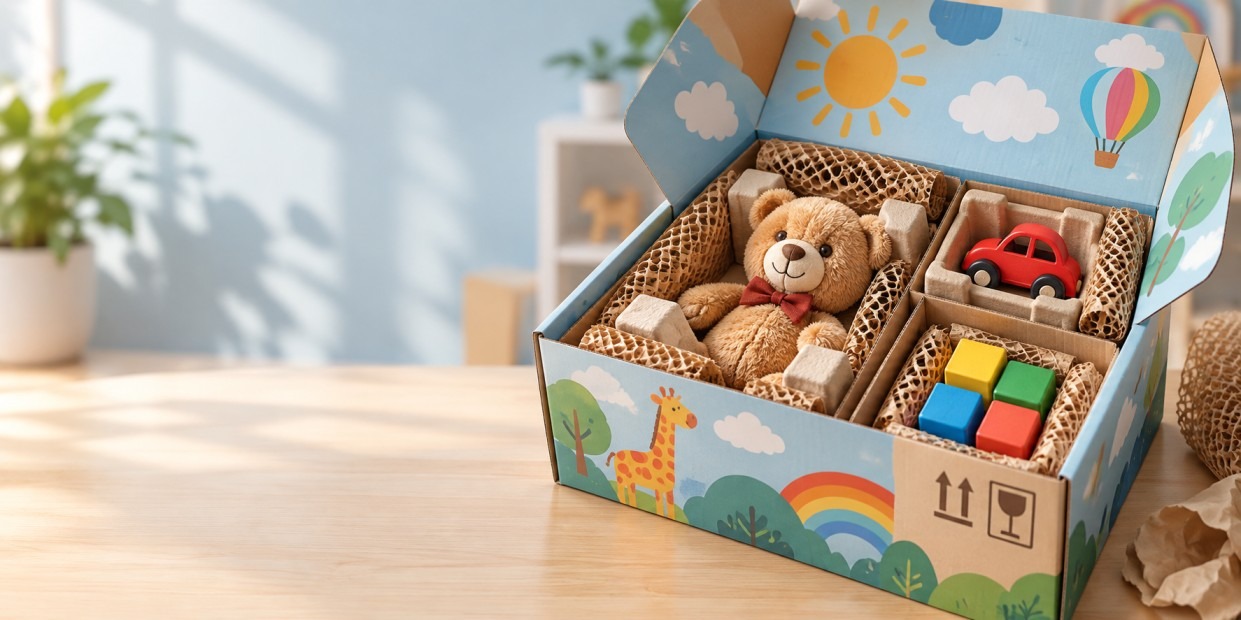
A toy may seem as tough as nails on the shelf but shipping is quite another story. Things such as drops, stacking issues and vibration, along with dust can ruin even the sturdiest of products. That’s why custom printed toy boxes help. They offer a neat combination of keeping things safe while also looking good, helping toys get delivery-ready.
Custom Toy Boxes Create a Strong Protective Barrier
The first line of defence between your toy and the hazards of shipping is a well-made box. Everyday pressure is absorbed into strong walls before it ever reaches the product.
Custom boxes are perfect for holding the weight, shape, or fragility of a toy and are thicker than generic packaging like thin cardboard because they can be tailored to your needs in terms of how it will ship.
Strong Packaging Materials Reduce Damage
Different degrees of strength are provided by corrugated cardboard, kraft board and quality paperboard. When toys benefit from more strength when being impacted or compressed, corrugated material performs well. The right thickness for a board prevents the package from being too thick while still protecting it from becoming flimsy.
Custom Sizing Keeps Toys From Moving
Here is an honest-to-God truth: every time something moves, it opens itself up to the possibility of being destroyed. An extra-large package allows the toy to sneak and bump around.
Custom dimensions cut this excess space down and still provide room for all of your essential inserts or cushioning.
A Snug Fit Protects Delicate Components
Custom size is like a customized seat belt, fit for your body. It keeps the product secure without squeezing it. Wheels, handles, delicate parts of a figurine (as well as affordable decorative ends that can bend or scratch), buttons, and screens are also sometimes covered.
Internal Inserts Hold Products Securely
Not all toys can be contained within four cardboard walls. Custom inserts segregate the box into separated compartments to keep parts from clashing.
They especially come in handy for toy sets that contain accessories, removable parts, controllers, figurines and other small pieces.
Inserts Protect the Most Vulnerable Areas
Instead of putting random, useless filling in a box to save your items during shipping — plastic peanuts or whatever else you may imagine — packaging designers can now strategically place cardboard or molded inserts around areas that need it. A toy vehicle could need extra support about its wheels, while an electronic plaything may require security around the display.
Custom Boxes Help Absorb Shipping Impacts
Packages seldom have a perfectly soft road to take. They may go through sorting facilities, delivery vehicles, warehouses and multiple loading points before arriving at consumers.
With each step, the package can be subjected to any amount of vibration and shocks from impacts; drops during operation or stacked pressure from other cartons in delivery vehicles.
Corrugated Structures Add Shock Resistance
Well, a corrugated board has a layer of fluting sandwiched between two outer layers. The structure allows for some stress distribution, but also serves as a softer cushion against the impact of daily handling. It certainly doesn’t make a package unbreakable; however, well-designed corrugated packaging improves protective performance significantly over unsupported paperboard.
Strong Box Walls Resist Stacking Pressure
They are typically grouped together on warehouse shelves and in delivery vehicles. Toys located near the bottom can be under pressure for hours or even days.
Good Custom boxes retain better form when designers choose the appropriate board strength for box structure.
Reinforced Edges Prevent Box Collapse
Shipping usually puts pressure on corners and edges. That force is distributed thanks to reinforced folds, stronger panels and better box styles. Keeping the structural shape is important because if a carton collapses in (as they often do), the pressure will simply go directly onto a toy.
Secure Closures Keep Toys Inside
No matter how strong the packaging is, it really serves no purpose when opened in an inappropriate manner. Tuck flaps, locking tabs, adhesive strips or shipping seals keep toys closed in the box.
They also keep small accessories secured when packages tip over or are flipped upside down.
Closure Style Should Match Toy Weight
A simple tuck-end box might be all that you require for a lightweight plush toy. A heavier-duty kit might need reinforced fasteners or extra sealing. By matching the closure to the product, it protects from accidental opening without creating intimacy as a battle for unboxing.
Custom Packaging Prevents Scratches and Scuffs
Not every shipping issue ends in a shattered toy. When a product is quite functional and does its job, the surface scratches—scuff marks—and even rubbed finishes can make it look used.
The protective outer box keeps the toy safe from rough cartons, shelves, machinery, and other abrasive surfaces.
Compartments Prevent Parts From Rubbing Together
Picture a handful of painted toy bits rattling around in a box for hours. And even a slight movement is enough to make visible traces. Dividers inside keep individual components apart, shielding paint finishes and trim strips from scratches as well as dust within clear pockets that hold the polished surfaces at all times while maintaining everything neatly organized until revealed.
Printed Toy Boxes Block Dust and Dirt
Distribution environments aren’t always spotless. That dust, fibers, dirt or any other particles in a warehouse (trucks, fulfillment centers and storage areas).
Continuing with the product, its completely closed toy packaging keeps these contaminants from reaching it while turning it into a new, clean item, as customers expect.
Clean Products Create Better First Impressions
Customers notice the presentation immediately. No one likes to open up the fresh toy just so they can see dust on its surface. For example, the way you package a product—clean and secure packaging communicates care to your customer before they even touch their purchase—which ensures that protection is just as important in creating an overall buying experience.
Coatings Can Improve Surface Protection
Printing isn’t merely decoration. Appropriate laminations or coatings can help provide resistance to rubbing, fingerprints and light moisture exposure for printed surfaces.
And they help graphics stay presentable after cartons go through periodic abuse while in storage and during the shipping process.
Moisture Resistance Has Practical Limits
Paper-based packaging on its own is not necessarily waterproof. But some coatings and laminations can additionally stand up to moderate dampness. Finishes need to be chosen based on achievable shipping conditions and not just assume the decorative coating is going to protect a package from extended times in water.
Custom Boxes Protect Small Toy Accessories
An accessory is an essential puzzle piece that can destroy a perfect order. Toy instrumentation includes stickers, cards, figures, tools, cables, batteries, or detachable components.
Custom compartments help organize these smaller pieces and minimize the risk that they will slide, get crushed or slip through openings in packaging.
Organized Packaging Improves Unboxing Too
A good organization does two jobs at once. To begin with, it protects single items better during delivery. Secondly, it assists customers in grasping what they received. Parents can quickly spot accessories, while the kids love a neat presentation rather than rummaging through a messy pile.
Packaging Protects Important Printed Information
Toy boxes often list age recommendations, assembly instructions, barcodes, toy details & specifications along with branding and safety information. Heavy scratches and damage to the packaging can render those details hard to read.
Essential information is printed in a durable way and finished with protective coatings so it can be enduring as the product moves through distribution.
Clear Labels Matter for Toy Packaging
If products contain age recommendations or safety instructions, readable packaging is all the more relevant. The box physically protects the toy, but it must also preserve information customers need before use. Since the product is both presented and effectively communicated in a constructed way, strong construction promotes this.
Custom Boxes Can Lower Return Risks
A broken package can cost much more than you expect. In addition to the costs of replacing a toy, businesses can also accrue return shipping fees and customer service expenses, besides lost inventory and bad reviews.
More protective package sizes that fit better minimize preventable damage before it turns into a customer loss.
Better Protection Supports Customer Satisfaction
You will learn: Customers never see the journey through your warehouse. They can only see what comes through their door. A crushed box or a damaged toy can break confidence immediately. This provides businesses with a straightforward way to enhance shipping protection, and customers with an effortless experience while minimizing post-purchase disappointment due to avoidable processes.
Right-Sized Boxes Improve Shipping Efficiency
Bigger doesn’t always mean safer. In fact, oversized packaging leaves voids inside the box which creates useless movement disrupts a supply chain lead time cycle and may take up excessive shipping capacity.
Custom printed toy boxes help brands strike a balance between minimal space and enough to offer structural protection and inserts, along with ideal cushioning.
Efficient Packaging Reduces Wasted Space
Imagine sending shipping trucks full of boxes that are largely air. It wastes valuable room. Correctly sized packaging helps the product fit into master cartons, storage areas and pallets more efficiently while also being adequately protective against typical distribution and handling conditions.
Packaging Tests Reveal Weak Points
While packaging appears strong, it may still fail in actual shipping. Testing reveals vulnerabilities prior to distribution of the thousandth box.
Tests to Analyze Hazards — Industry testing can assess hazards like shock, vibration, and compression. These hazards are explicitly listed by ISTA as physical challenges for transport testing.
Realistic Testing Improves Packaging Decisions
Tests that are useful should have a distribution that reflects what is happening generally at production; i.e., ISTA points out that knowing how products are shipped, handled, and stored should influence the choice of test procedures. Depending on the shipping conditions, tests may focus on vibration, drops, compression or exposure to temperature and humidity.
Custom Printed Boxes Protect Brand Presentation
Prevention is not just about avoiding cracks. While an undamaged toy is worth more money, the crushed outer retail box can make a great condition toy look cheap, old or dirty due to mishandling.
Custom packaging allows for clean graphics; straight edges, and a good presentation while showcasing colours associated with the brand, logos, illustrations and product information.
Collectible Toys Need Extra Box Protection
Sometimes the box is part of the product for collectors. Scratched windows, creased panels and dented corners can diminish its allure. So, Scupi’s stronger structures that not only protect the item but also the packaging for displaying shallow-depth toys are definitely helpful for premium figures and limited-edition toys.
How Custom Printed Toy Boxes Improve Shipping Protection
Successful packaging serves as a mini-alarm system around the toy. While movement is limited by custom-imprinted sizes and weights, durable materials respond with absorption. Inserts make unstable parts more secure, and closure safety features keep them closed to avoid accidental opening; Protective finishes ensure surface preservation.
Each feature also serves a different protective role.
The Right Design Depends on the Toy
There is no toy box that fits everything. The plush animal, toy electronic learning device, collectible figure and vehicle are subject to varying risks. Before deciding the final form of packaging structure, consider size and weight properties, fragile areas in combination with shipping distance, as well as accessories included.
Final Thoughts
Custom printed toy boxes act like a safe wall for toys as they are being shipped by preventing the movements, impacts, and stacking pressure that come from other packages in transit; plus, they act against dirt particles/dust, scratches, and even routine handling.
But more importantly, the reasonable packaging finds something less tactile than any ornament: customer expectations. If the toy reaches its destination in one piece and it is aesthetically pleasing, then your packaging has done its part already!
