

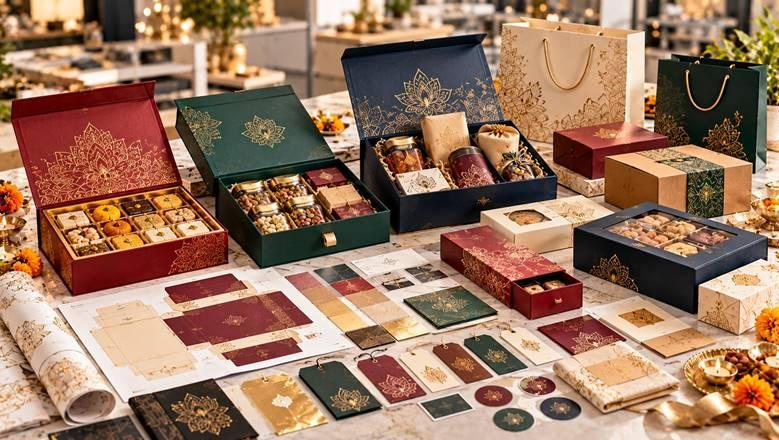
The festive sleeve may change for Diwali, but the food inside still has its own packaging requirements. A brittle snack, an oily savoury and a soft sweet cannot be treated as the same product simply because they appear in one festive collection.
For food brands, selecting food packaging boxes means balancing product protection, filling operations, readable information and the selling price. The best place to begin is the product specification, not the artwork.
Write a Packaging Brief for Each Product
Record the portion size, filled weight, dimensions and intended storage conditions. Identify whether the food will touch the box or remain inside a pouch, tray or other primary pack.
Sweet packaging boxes may need compartments or supports for delicate pieces. Snack packaging boxes might hold loose products or several sealed retail packs.
Tell the supplier how the product will be sold: across a shop counter, through a distributor or by courier. Custom food packaging boxes should reflect that actual journey rather than an ideal display photograph.
Choose Materials for the Food and Its Storage Conditions
Board thickness is only one part of the decision. Ask about strength, construction and any liner or coating needed for the intended use.
For direct food contact, obtain specifications and the relevant conformity documentation for the contact material. FSSAI’s packaging regulations require suitable food-grade materials and keep printed surfaces out of direct contact with food. A glossy surface alone is not evidence of food-contact suitability.
Discuss oil and moisture exposure with the packaging supplier and your food quality team. If a sealed pouch provides the necessary barrier, make that clear when specifying the outer box. Do not assume the carton will perform the pouch’s job.
Treat Shelf Life as a Product Validation Question
A box cannot establish shelf life by appearance or board weight. The food formulation, processing, primary pack and storage conditions all need consideration.
Trial the complete packaging arrangement with the actual product before approving a freshness claim. Where relevant, assess staining, odour transfer, texture changes, closure performance and damage during handling.
Diwali gift packaging also needs realistic dispatch planning. If a product requires controlled storage or a short delivery window, a festive outer carton does not remove those requirements. Match the sales and delivery plan to the product’s validated conditions.
Check Packing Speed and Transport Performance
A complicated carton can become inconvenient when the packing team is working through a large order. Time a sample assembly and filling run. Check whether inserts stay in position and whether the closure remains secure once the box is filled.
Then review the secondary shipping carton, stacking arrangement and handling conditions. Use a suitable trial to identify crushing, movement or opening during distribution.
Compare the cost of the complete pack, including inserts, labels, assembly and transport protection. A cheaper empty box may not be cheaper once the packing process is included.
Design Print Around the Information Customers Need
Custom printed packaging boxes should make the product easy to identify before adding festive decoration. Plan readable areas for ingredients, allergens, quantity, dates, storage instructions and other applicable declarations.
Have the responsible food compliance team approve the final artwork against current requirements. Leave suitable space for batch-specific printing or labels.
A seasonal sleeve can carry the Diwali message while retaining a familiar core design. Check that it does not obscure information on the underlying pack. Approve text, colours and finishing on the chosen material rather than relying only on a screen proof.
Set Clear Specifications for Bulk Orders
Bulk packaging solutions are easier to compare when every supplier receives the same specification. Include box dimensions, material requirements, print colours, finish, quantities by product and delivery arrangements.
Ask for minimum order quantities, sampling stages, production lead times and delivery charges. Confirm who approves substitutions if the specified material becomes unavailable.
Keep an approved sample and agreed artwork version as references. For repeat deliveries, check dimensions, fit, print and closure against those references.
Work With a Printer Who Understands the Product
A printing and packaging company in Mumbai should understand what will be packed, how it will be handled and which specifications need confirmation.
Blossom Print & Pack’s food packaging printing service includes customised box structures, sizes and finishes, with design, sampling and production handled in-house.
Share product samples and the packaging brief before requesting a quotation. Well-chosen food packaging boxes need to work on the packing table, through distribution and when the customer finally opens them.
