

Introduction
The medical device industry is experiencing rapid innovation driven by advancements in technology, materials science, and precision manufacturing. As healthcare providers demand smaller, more accurate, and minimally invasive medical tools, manufacturers are turning to micro machining to meet these evolving requirements. This advanced manufacturing process enables the creation of highly detailed components with exceptional precision, making it a critical technology for modern medical device development.
From surgical instruments and implantable devices to diagnostic equipment and drug delivery systems, micro machining is revolutionizing how medical products are designed and manufactured. The ability to produce microscopic features with tight tolerances has opened new possibilities for improving patient outcomes, reducing recovery times, and enhancing the overall effectiveness of medical treatments.
In this article, we will explore how micro machining is driving the next generation of medical devices, its key benefits, applications, and why it has become indispensable in the healthcare manufacturing sector.
What Is Micro Machining?
Micro machining is a specialized manufacturing process used to create extremely small and precise components, often measured in microns. Unlike conventional machining methods, micro machining focuses on producing intricate features, miniature parts, and complex geometries that are impossible to achieve with standard manufacturing techniques.
Medical manufacturers rely on A detailed overview of medical micro machining to understand how these precision processes enable the production of sophisticated healthcare components that meet strict industry standards.
Using advanced CNC machines, laser machining systems, and micro-cutting tools, manufacturers can fabricate parts with exceptional accuracy while maintaining high-quality surface finishes and dimensional consistency.
The Growing Demand for Miniaturized Medical Devices
Modern healthcare is increasingly moving toward minimally invasive procedures. Patients and healthcare providers prefer treatments that reduce pain, shorten hospital stays, and accelerate recovery times. This shift has significantly increased the demand for smaller and more advanced medical devices.
Examples include:
- Catheters
- Endoscopic tools
- Cardiovascular implants
- Neurostimulation devices
- Wearable health monitoring systems
- Drug delivery mechanisms
These products require tiny components that must function reliably within the human body. Micro machining provides the precision necessary to manufacture these complex parts while maintaining strict quality standards.
How Micro Machining Supports Medical Innovation
1. Exceptional Precision and Accuracy
Medical devices often contain components that measure only a few millimeters or even microns in size. Any manufacturing error can impact device performance and patient safety.
Micro machining delivers:
- Tight dimensional tolerances
- High repeatability
- Superior accuracy
- Consistent quality across production batches
This level of precision is essential for manufacturing surgical tools, implants, and diagnostic devices, where exact specifications must be maintained.
2. Complex Geometries and Intricate Features
Many next-generation medical devices require intricate structures that conventional machining methods cannot produce efficiently.
Micro machining enables manufacturers to create:
- Micro-holes
- Fine channels
- Thin walls
- Complex contours
- Precision slots and grooves
These features are critical for applications such as microfluidic devices, surgical instruments, and implantable medical technologies.
3. Improved Device Performance
Smaller and more precise components often result in better-performing medical devices. Micro machining helps improve:
- Device reliability
- Functional efficiency
- Mechanical strength
- Fluid control accuracy
- Patient comfort
The ability to manufacture highly optimized components allows engineers to push the boundaries of medical innovation.
Key Applications of Micro Machining in Medical Devices
Surgical Instruments
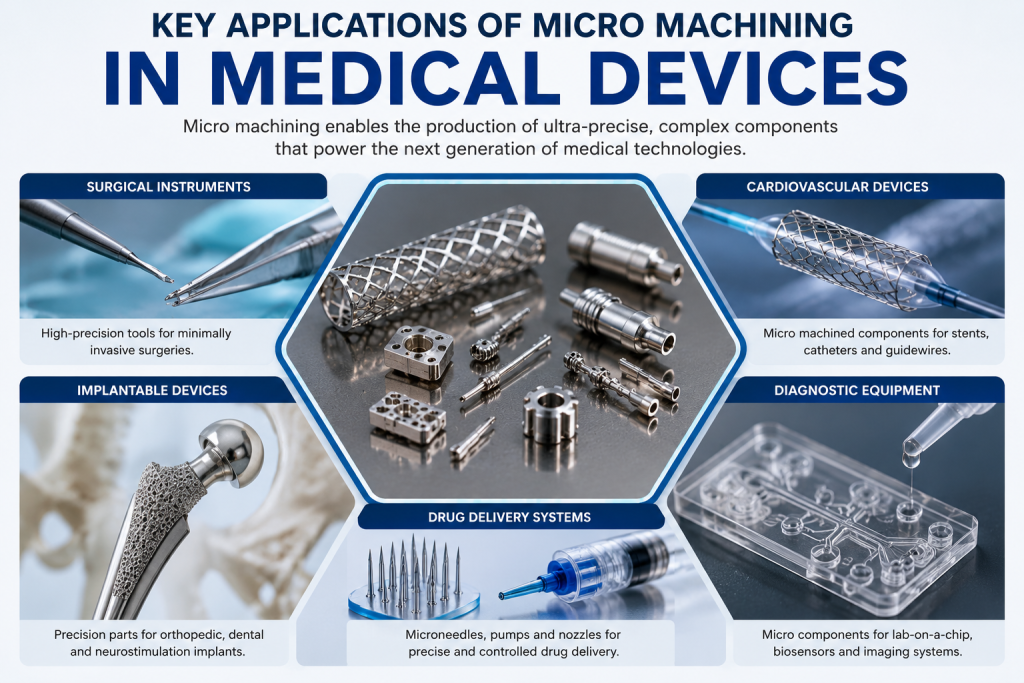
Modern surgical tools are becoming increasingly sophisticated. Micro machining allows manufacturers to create highly precise cutting instruments, forceps, clamps, and robotic surgery components.
These tools offer:
- Enhanced surgical precision
- Reduced tissue damage
- Better patient outcomes
- Faster recovery periods
Implantable Devices
Medical implants require exceptional accuracy because they must function safely inside the human body for extended periods.
Micro machining is commonly used to manufacture:
- Orthopedic implants
- Dental implants
- Cardiac implants
- Hearing devices
- Neurostimulation components
The process ensures that each implant meets stringent biocompatibility and dimensional requirements.
Cardiovascular Devices
Cardiovascular treatments rely heavily on miniature medical devices such as stents and catheter-based systems.
Micro machining supports the production of:
- Coronary stents
- Guide wires
- Catheter components
- Heart valve parts
These devices require extremely fine features to ensure safe and effective performance.
Diagnostic Equipment
Diagnostic technology continues to evolve toward smaller, more portable, and highly accurate systems.
Micro machining contributes to the manufacturing of:
- Laboratory testing devices
- Biosensors
- Imaging system components
- Microfluidic diagnostic platforms
These innovations help healthcare professionals detect diseases earlier and more accurately.
Drug Delivery Systems
Precision drug delivery devices allow medications to be administered more effectively and safely.
Micro machining enables the production of:
- Insulin pumps
- Inhalers
- Microneedles
- Controlled-release systems
The microscopic features produced by micro-machining ensure accurate dosing and improved treatment outcomes.
Materials Used in Medical Micro Machining
Medical devices often require specialized materials that offer durability, biocompatibility, and resistance to corrosion.
Common materials include:
Stainless Steel
Widely used for surgical instruments and implants due to its strength and corrosion resistance.
Titanium
Highly biocompatible and lightweight, making it ideal for orthopedic and dental implants.
Cobalt-Chromium Alloys
Known for excellent wear resistance and long-term durability.
Medical-Grade Plastics
Suitable for disposable devices and components requiring lightweight construction.
Nitinol
A shape-memory alloy commonly used in cardiovascular devices and minimally invasive surgical tools.
Micro machining technology can process these materials while maintaining the precision necessary for medical applications.
Benefits of Micro Machining for Medical Device Manufacturers
Faster Product Development
Medical companies face intense pressure to bring innovative products to market quickly. Micro machining supports rapid prototyping and short production cycles, allowing manufacturers to accelerate development timelines.
Reduced Manufacturing Waste
Because micro machining removes material with exceptional accuracy, it minimizes waste and improves material utilization. This is particularly important when working with expensive medical-grade materials.
Enhanced Product Quality
Precision manufacturing reduces defects and ensures consistent performance across every component. This helps manufacturers meet regulatory requirements and maintain high product standards.
Scalability
Micro machining can support both prototype development and full-scale production. This flexibility makes it a valuable solution throughout the product lifecycle.
Regulatory Compliance and Quality Standards
The medical industry operates under strict regulatory requirements designed to protect patient safety.
Micro machining helps manufacturers comply with standards such as:
- ISO 13485
- FDA medical device regulations
- CE marking requirements
- Good Manufacturing Practices (GMP)
The process provides the traceability, consistency, and quality control necessary for regulatory approval.
The Role of Custom Manufacturing in Medical Device Development
Every medical application presents unique challenges. Standard manufacturing approaches often cannot address the specialized requirements of advanced healthcare products.
This is where Custom manufacturing solutions for medical devices become essential. Tailored manufacturing processes allow companies to develop highly specialized components that meet specific functional, material, and regulatory requirements.
Custom solutions provide:
- Design flexibility
- Application-specific engineering
- Faster prototyping
- Improved device performance
- Enhanced product differentiation
As medical technology continues to advance, customized manufacturing approaches will play an increasingly important role in supporting innovation.
Emerging Trends in Medical Micro Machining
Micro Robotics
Micro machining is enabling the development of robotic-assisted surgical systems with unprecedented precision and control.
Smart Medical Devices
Wearable sensors and connected healthcare devices require miniature components that can be manufactured efficiently through micro machining.
Personalized Medicine
Customized implants and patient-specific medical devices are becoming more common, creating new opportunities for precision manufacturing.
Advanced Microfluidics
Microfluidic technologies are transforming diagnostics and laboratory testing. These systems rely heavily on micro machining to create intricate channels and fluid control structures.
Hybrid Manufacturing Technologies
Manufacturers are increasingly combining micro machining with additive manufacturing and laser processing to achieve even greater design flexibility and performance.
Challenges and Future Opportunities
Although micro machining offers numerous benefits, manufacturers must address challenges such as:
- Tool wear
- Material limitations
- Complex quality control requirements
- High equipment costs
However, ongoing advancements in machine technology, automation, and process optimization continue to improve efficiency and reduce production costs.
The future of medical device manufacturing will likely involve even smaller, smarter, and more sophisticated products. Micro machining will remain a foundational technology that enables these innovations.
Conclusion
Micro machining has become one of the most important manufacturing technologies in the medical industry. Its ability to produce ultra-precise components with exceptional accuracy supports the development of advanced medical devices that improve patient care, enable minimally invasive treatments, and drive healthcare innovation.
From surgical instruments and implants to diagnostic equipment and drug delivery systems, micro machining continues to expand the possibilities of modern medicine. As healthcare technology evolves, manufacturers that leverage precision micro machining and customized production strategies will be better positioned to create the next generation of life-changing medical devices.
FAQs:
1. What is medical micro machining?
Medical micro machining is a precision manufacturing process used to create extremely small and highly accurate components for medical devices, surgical tools, implants, and diagnostic equipment.
2. Why is micro machining important for medical devices?
Micro machining enables the production of miniature, complex, and highly precise components that improve device performance, patient safety, and treatment outcomes.
3. Which materials are commonly used in medical micro machining?
Common materials include stainless steel, titanium, cobalt-chromium alloys, Nitinol, and medical-grade plastics due to their strength, durability, and biocompatibility.
4. What medical devices use micro-machined components?
Micro-machined components are used in surgical instruments, cardiovascular devices, implants, catheters, diagnostic systems, biosensors, and drug delivery devices.
5. How does micro machining support minimally invasive procedures?
Micro machining allows manufacturers to create smaller, more precise medical instruments and implants, helping reduce surgical trauma, shorten recovery times, and improve patient comfort.
