

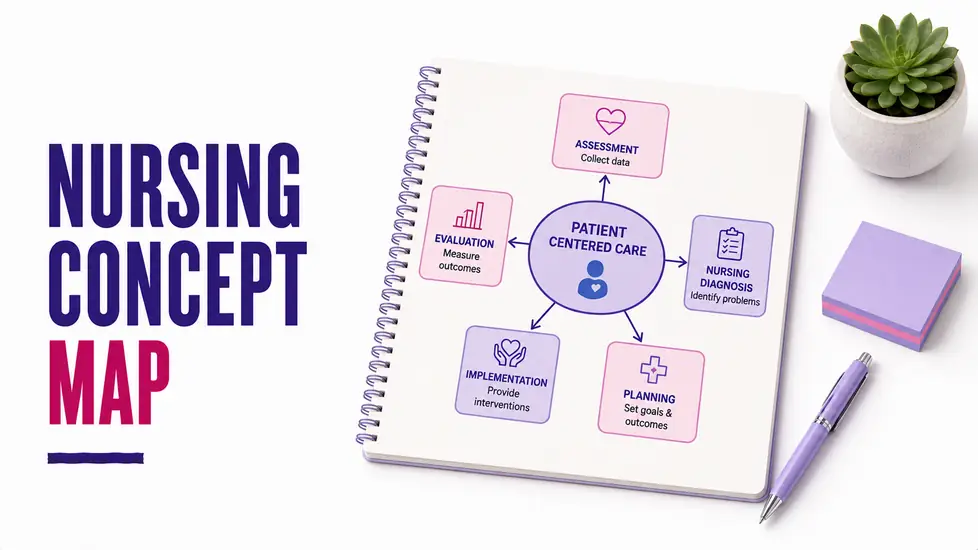
A nursing concept map helps students organize patient information and make their clinical reasoning visible. It links assessment data to associated nursing diagnosis risk factors, interventions, and measurable patient outcomes, providing a structured perspective on clinical decision-making. This guide, composed by nursing assignment help experts affiliated with The Academic Papers UK—a reliable UK essay help firm since 2003—offers in-depth instruction on creating a focused clinical map, making meaningful clinical evaluations, and then analyzing each connection for the provision of safe, patient-centered care services.
Key Takeaways
- A nursing concept map illustrates the relationships of clinical decisions.
- Assessment results are relevant to patient problems and serve as the foundation.
- Assessment evidence should support each nursing diagnosis concept map decision.
- Nursing priorities should guide the selection of appropriate interventions.
- Interventions should connect to measurable patient outcomes.
- Review the completed map to ensure its connections demonstrate clear clinical reasoning.
Introduction
A nursing concept map is more than a visual summary of patient information. It helps students in structuring clinical information in an effective manner to promote subsequent patient care based on the diagnosis. Effective nursing concept mapping connects assessment data with patient problems, nursing diagnoses, interventions applied and expected outcomes. This can make the reasoning behind students’ clinical decisions more visible.
For students who find it challenging to organize these complex concepts, seeking nursing dissertation help can provide them a valuable opportunity to structure clinical information effectively.
Existing literature evidence supports the educational value of concept mapping. Faraji et al. (2025) reviewed 44 studies with 3,434 students and found that educational performance was significantly better in groups using concept mapping than in control groups (P < 0.001). The results also indicated a greater positive impact among nursing students.
In another study, active learning improved nursing knowledge and skills for 206 fourth-year nursing students, with significant differences between pre-test and post-test scores for both theoretical knowledge (P < 0.05) and skills (P < 0.05) (Šahbaz et al., 2025).
A strong clinical reasoning concept map must, therefore, include more than just the patient’s information. It should present the rationale for findings, identify problems that must be prioritized, and outline the potential for nursing interventions to produce measurable outcomes. The following guide explains how to build this reasoning into each stage of a concept map.
What Is a Nursing Concept Map?
A concept map is a visual, organisational tool for nursing which displays and labels the information and relationships among different clinical factors related to a patient’s presenting issue and diagnosis. It helps nursing students translate information into interpretations of findings and plan appropriate care. A patient concept map nursing approach makes it easier to understand connections between patient needs, nursing decisions, and expected outcomes.
Key Elements of a Nursing Concept Map
A well-developed concept map should include:
- Patient information: Relevant history and presenting information.
- Assessment findings: Important subjective and objective clinical data.
- Health concerns: Identified health problems or concerns from the assessment.
- Nursing diagnoses: Problems with evidence from the patient.
- Relationships between problems: Connections showing how different findings or concerns interact.
- Nursing priorities: Problems that require urgent attention as per patient’s need and health condition.
Nursing interventions: Actions chosen to solve identified problems. - Expected outcomes: Specific results that indicate whether care is effective.
- Evaluation: Review of outcomes and any need to adjust care.
How Nursing Concept Mapping Supports Clinical Reasoning
Using nursing concept mapping, students can organise patient information into a logical sequence of clinical decisions. The nursing process is
- Assessment
- Interpretation
- Nursing diagnosis
- Priority
- Intervention
- Outcome
- Evaluation
They should follow one another in sequence, with the map explaining why a care decision has been made.
From Patient Data to Clinical Priorities
Nursing students and nursing staff first assess the health findings relevant to the patient’s presenting problem. They then analyze the results and relate them to appropriate patient issues or nursing diagnoses. This helps nurses identify the issues that need the most attention and urgent resolution. A clinical nursing concept map should therefore include not only the observation but also why it is significant to patient care.
From Priorities to Nursing Actions
After setting priorities, interventions should target the identified problems. Nursing students can then link each intervention to what they think the patient will accomplish and consider how they will measure the outcome. This connects clinical evidence to nursing action. This sequence can help students develop a map that illustrates clinical thinking, not just the organisation of information. A useful reasoning check is:
What did I find?
Why does it matter?
What problem does it indicate?
What should come first?
What should I do?
What outcome should I expect?
Nursing Concept Map Step by Step
A good concept map begins with pertinent patient information and concludes with a review of the clinical logic. Each stage should address the following questions: What does this patient need, and why? A scaffolded strategy can help students develop a map around a line of thinking rather than just information.
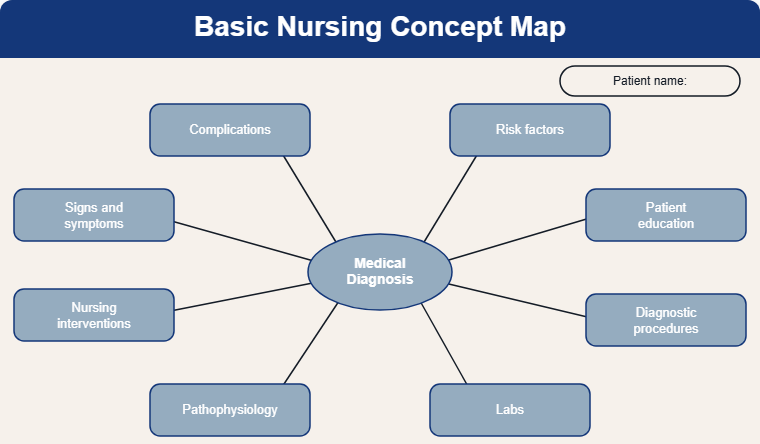
1. Begin with a focused nursing assessment
Start with information that will impact targeted patient care. Add objective and subjective findings, vital signs, symptoms, medical history, laboratory results, diagnostic findings and risk factors as appropriate. You do not have to include all the information from the patient’s record at this stage.
A helpful nursing concept map assessment should filter out important information from background data. Consider whether each detail is relevant to a problem, diagnosis, or care decisions. This will help the map stay concise and understandable.
2. Determine the Primary Patient Issues
Then, analyze the clinical assessment results and determine whether there is a problem that the nurse needs to address. Think about what is unusual, what could impact a patient’s safety, and what may be related. Then analyze all possible risk factors serving as a root cause of the problem or health condition of the patient. These questions are designed to shift patient data to collect meaningful clinical questions rather than leaving findings in isolation.
3. Connect findings with nursing diagnoses.
Link the identified problems to appropriate nursing diagnoses. The assessment evidence for each diagnosis should be relevant and not chosen just because it relates to the patient’s medical condition. This relationship should be evident in a nursing diagnosis concept map. Students must be able to trace each diagnosis back to what they found in the case to support it. This promotes the nursing assessment and diagnosis and demonstrates the role evidence plays in clinical decision-making.
4. Establish Nursing Priorities
Not all identified issues need to be addressed equally. When prioritising, consider patient safety aspects, physiological needs, severity, risk of health deterioration and time sensitivity. Instead of picking the most obvious issue, identify the most important issue or causative factor. This supports more meaningful nursing priorities and interventions and better clinical decision-making for safer outcomes.
5. Choose appropriate nursing interventions
After determining priorities, choose interventions directly linked to the identified issues. Each intervention should be clearly defined and relate to the diagnosis/priority The nursing interventions concept map should link each planned action to the identified need it addresses.
6. Identify Measurable Patient Outcomes
The map should show the anticipated improvements after the planned interventions are implemented. Outcomes must be specific enough to judge whether the desired change has been achieved. Consider the relationship:
Intervention → Expected response → Measurable patient outcome
Relevant measures for patient outcomes in nursing might be changes in symptoms, vital signs, observations or functional ability. Clear outcomes also give a basis for evaluation.
7. Integrate the Map and Review the Clinical Logic
Lastly, link the elements together with arrows, lines or other appropriate connectors. Every connection needs a meaningful clinical relationship. Read the map in order from top to bottom. Ensure that assessment results logically align with the identified problems, diagnoses and priorities. Next, ensure that the interventions address the priorities and that the expected outcomes are directly linked to the planned interventions.
When the links are clear and clinically appropriate, the finished map isn’t just a way to structure patient data. It brings out the student’s clinical reasoning.
Nursing Concept Map Example: Turning Assessment into Clinical Reasoning
A worked example can show how the concept map supports clinical decision-making. For instance, a 62-year-old patient who comes into the emergency department with a complaint of increased shortness of breath (SOB), productive cough, and chest tightness. Upon evaluation, it was observed that the patient has a history of Chronic Obstructive Pulmonary Disease (COPD).
A useful nursing concept map example can follow this simple pathway:
Patient presentation → Assessment findings → Clinical interpretation → Priority problem → Nursing interventions → Patient outcomes → Evaluation
From Findings to a Priority Problem
The assessment identifies several relevant findings:
- Respiratory rate: 28 breaths per minute
- Oxygen saturation: 88% on room air
- Wheezing on auscultation
- Productive cough with thick sputum
- Accessory muscles are used more.
- Fatigue and difficulty breathing
Students must not simply record these findings on a diagram. They need to consider what the findings mean together.
| Stage | Patient example | Reasoning behind the connection |
| Assessment | SpO₂ 88%, RR 28, wheezing and thick sputum | Indicates an abnormal respiratory status |
| Interpretation | Difficulty with breathing and secretion clearance | Findings suggest a respiratory problem |
| Priority problem | Ineffective airway clearance, as supported by assessment evidence | Links the diagnosis to clinical findings |
| Interventions | Positioning, prescribed oxygen or medication, respiratory monitoring | Addresses the identified priority |
| Expected outcomes | Improved SpO₂ and reduced respiratory distress | Shows the intended patient response |
| Evaluation | Compare actual response with expected outcomes | Determines whether care needs adjustment |
- Clinical reasoning: The assessment provides the evidence. Interpretation explains why that evidence matters.
From Priority to Nursing Action
Link the priority problem to the appropriate nursing interventions on a patient care concept map. These can include patient positioning (to aid breathing), promoting appropriate coughing techniques, giving prescribed treatment, and monitoring respiratory status, depending on the patient’s treatment and clinical assessment.
The purpose of each action should be apparent. Do not list an intervention just because it is a common nursing task in a nursing student concept map. It should be directed toward the patient’s identified need.
From Intervention to Outcome
The map should continue beyond the intervention. Patient outcomes in nursing may include improved oxygen saturation, easier breathing, decreased respiratory distress, and improved secretion clearance.
Evaluation is the last step in the reasoning pathway. If this does not happen, the nurse should know they need to expand their assessment and adjust their care.
This moves the clinical reasoning concept map beyond a simple, organised diagram. It shows the process from evidence to interpretation, priorities, interventions, and measurable outcomes. That logical chain is the map’s real value.
Common Mistakes in a Nursing Concept Map Assignment
A nursing concept map assignment should show clinical thinking, not just information about the patient. Do not make these common mistakes:
- Information presented without relationships: The map is hard to interpret when information is presented as isolated facts. Relate assessment results to diagnoses, priorities and interventions.
- Adding irrelevant patient information: Do not add all of the patient’s information. The patient concept map nursing approach should be based on information that affects the care decision.
- Selecting diagnoses with no assessment evidence: Avoid picking diagnoses that do not have supporting evidence. There should be a logical link between each diagnosis and evidence of nursing assessment and diagnosis.
- Including interventions that have no evident clinical significance: Do not include interventions just because they are used. A nursing care plan concept map should include an action that corresponds to each identified patient problem.
- Using vague or unmeasurable outcomes: Avoid statements such as “the patient will improve”. Indicate the desired change and how you will evaluate it.
- Too many boxes, arrows and information can obscure the primary priorities. A good nursing concept map example should be detailed enough to show reasoning and be easy to follow.
Students who feel overwhelmed by the technical requirements of these assignments may benefit from professional nursing essay help to ensure their concept maps meet clinical standards.
FAQs
How do you create a nursing concept map?
Start with relevant patient assessment findings. Recognise key issues and relate them to nursing diagnoses. Prioritise, choose appropriate interventions and set up measurable objectives. Show the clinical relationships between each of the elements using arrows or lines.
What should be included in a nursing concept map?
Provide relevant patient information, assessment, health problem and/or nursing diagnosis, priorities, interventions, expected outcomes and evaluation. All the elements should relate to each other.
How is a concept map used in nursing care planning?
A concept map is a tool for organising complex patient information, and it illustrates the relationships between problems, interventions and outcomes. It helps students see the rationale behind care decisions and take a more structured approach to nursing care.
What is the difference between a nursing concept map and a care plan?
A concept map visually represents relationships between patient findings and care decisions. Typically, a care plan outlines problems, goals, interventions and evaluation in a structured manner.
How can nursing students use concept maps to develop clinical reasoning?
Students can make multiple links between assessment evidence and diagnoses, priorities, interventions and outcomes. This helps them articulate their choices and allows their clinical reasoning to be assessed.
Conclusion
A strong nursing concept map does more than organise patient information. It makes the reasoning behind nursing decisions clear and traceable. By linking assessment findings with diagnoses, priorities, interventions and measurable outcomes, students can present a logical approach to patient care. The relevance of information and clinical connections are therefore what determine the quality of a map. Students must check each link and ensure every nursing action has a clear purpose. Well-conceptualised concept mapping can represent complex patient information and focus clinical reasoning on a more targeted, outcome-oriented approach.
