


Learning how to rank for featured snippets can help your website gain greater visibility in Google Search and attract users looking for quick, reliable answers. These highlighted results often appear above traditional organic listings, making them valuable opportunities for relevant content. However, there is no guaranteed formula for winning a featured snippet. The best approach is to understand search intent, provide clear answers, and make your content genuinely useful.
How to Rank for Featured Snippets by Understanding Search Intent
Featured snippets are selected by Google’s systems when a page provides a useful response to a search query. Common formats include paragraphs, numbered lists, bulleted lists, and tables.
Before changing your content, identify the questions your audience actually asks. Queries beginning with “how,” “what,” “why,” and “which” can be useful starting points, although not every question triggers a featured snippet.
For example, consider these searches:
- “What is a meta description?”
- “How do you calculate reading time?”
- “Which SEO metrics should beginners track?”
Each query requires a slightly different answer format. A definition may work best as a concise paragraph, while a process is easier to follow as a numbered list.
The key is to match the format to the searcher’s task, not to force every answer into the same template.
Use Google Search to inspect the results for your target keyword. Look at the existing snippet, if one appears, and ask three questions:
- What question is Google trying to answer?
- How does the selected page organize its response?
- What important detail could make your answer more useful or accurate?
This analysis helps you identify a realistic content opportunity before investing time in optimization.
How to Rank for Featured Snippets with Better Content Structure
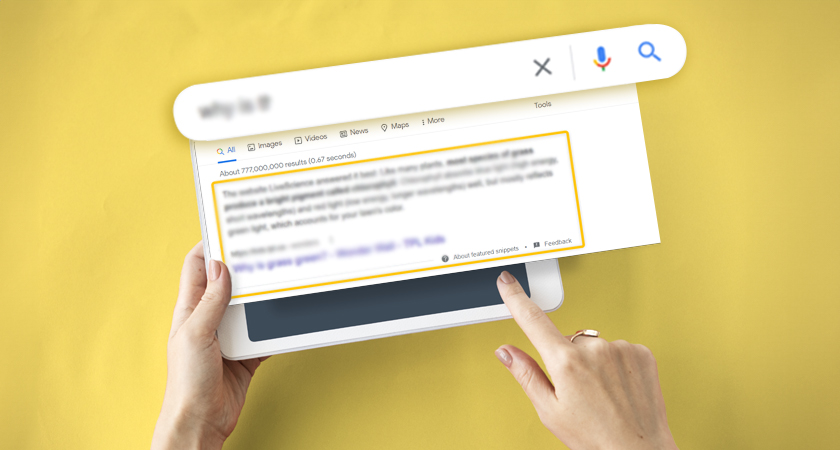
Once you understand search intent, organize the page so readers and search engines can identify the relevant answer quickly.
1. Answer the question directly
Place a concise answer immediately after a relevant H2 or H3 heading. For a definition, one or two clear sentences may be sufficient. Follow them with additional context, examples, and limitations.
For instance:
What is a meta description?
A meta description is an HTML element that summarizes a webpage’s content. Google may use it to generate the descriptive text shown beneath a search result, although it can select text from the page instead.
This structure answers the question first without sacrificing depth.
2. Choose a format that fits the answer
Use numbered lists for sequential instructions, bullet points for independent items, and tables for comparisons. Keep paragraphs focused and avoid unnecessary introductions before the main answer.
| Search intent | Recommended content format | Example |
| Definition | Short paragraph | What is technical SEO? |
| Instructions | Numbered list | How to submit a sitemap |
| Comparison | Table | SEO tool A vs. SEO tool B |
| Selection | Bulleted list with criteria | How to choose a keyword tool |
These formats improve readability, but none guarantees a featured snippet.
3. Support concise answers with meaningful detail
A short answer should be the starting point, not the entire article. Explain exceptions, give examples, and link to relevant resources where they help readers.
If readers need additional tools for research, a curated guide to the Best SEO Tools can help them compare keyword research, rank tracking, and site auditing options. The goal is to support the next step in their workflow rather than insert unrelated promotional links.
How to Rank for Featured Snippets by Improving Existing Pages
You do not always need a new article to compete for a featured snippet. Updating an existing, relevant page may be a more efficient starting point, especially when it already receives impressions for related queries.
4. Find opportunities in Google Search Console
Open the Performance report in Google Search Console and examine queries and pages. Look for searches that closely match your content, particularly where the page receives impressions but could answer the query more directly.
Prioritize pages with:
- A strong match between the search query and the page’s purpose.
- Useful information that is missing, outdated, or difficult to locate.
- Existing visibility that suggests Google already considers the page relevant.
Do not assume that a particular average position guarantees a snippet opportunity. Search results vary, and Google does not publish a fixed ranking threshold for featured snippets.
5. Improve clarity without rewriting everything
Imagine a website publishing a guide to reading time calculators. The page already explains reading speed, but the explanation is buried halfway down the article.
A sensible update would place a direct definition near the relevant heading, explain the calculation, and include an example showing how word count and reading speed affect the estimate.
For example, a 1,000-word article read at 200 words per minute takes approximately five minutes, excluding pauses.
This is an illustrative optimization scenario, not a claim of a measured ranking improvement. Its value lies in making the answer easier to find and verify while preserving the rest of the useful content.
Review the updated page after Google recrawls it. Search Console can help you assess impressions, clicks, and query changes, but it does not provide a dedicated report that confirms every featured snippet won or lost.
You can also use a Google SEO meta description checker to review your meta description’s length. Remember that a meta description may influence how your ordinary search result is presented, but it is not a direct featured-snippet ranking factor. Google can generate snippets from page content instead.
How to Rank for Featured Snippets: A Practical Optimization Framework
Not every page deserves the same amount of optimization effort. Use the following framework to decide what to do first.
| Page situation | Recommended action | Priority |
| Relevant page with existing impressions and a weak answer | Rewrite the answer section and improve structure | High |
| Strong article that does not fully match the query | Reassess search intent and content coverage | High |
| New page targeting a broad, competitive term | Research competitors and build comprehensive content | Medium |
| Page with little relevance to the target question | Choose a better-matched query or page | Low |
This framework reflects practical prioritization, not a Google ranking formula.
6. Make the answer more useful than competing pages
A useful way to differentiate your content is to include the detail that a short answer alone cannot provide: a calculation, a decision rule, a limitation, or a clear example.
For example, an article about choosing an SEO tool could explain not only what each tool does, but also which option makes sense for a beginner with a limited budget. That additional decision support creates value beyond simply repeating a definition.
7. Monitor results and refine your approach
After updating a page, allow time for crawling and reassessment. Compare performance before and after the change, accounting for seasonality and other SEO updates.
Track:
- Impressions for the target query and related searches.
- Clicks and click-through rate.
- Changes in the page’s average position.
- Whether the search results display a featured snippet and which source appears.
A featured snippet can improve visibility, but it does not automatically increase clicks. Users may find the answer they need directly in the search results. Evaluate success through relevant traffic and business outcomes, not snippet ownership alone.
Frequently Asked Questions About Featured Snippets
1. What is a Google Featured Snippet?
A featured snippet is a highlighted search result that presents an excerpt from a webpage to help answer a user’s query. Google selects the source automatically.
2. Do you need to rank first to get a featured snippet?
There is no published rule requiring a page to hold the number-one organic position. Relevance, usefulness, and Google’s selection systems determine which result is shown.
3. How long does it take to win a featured snippet?
There is no fixed timeline. Results depend on factors such as crawling, indexing, competition, query intent, and Google’s systems. Some pages may never receive one.
4. What content format works best for featured snippets?
It depends on the query. Paragraphs suit definitions, lists suit processes, and tables suit comparisons. Choose the format that communicates the answer most clearly.
5. Can schema markup help you get a featured snippet?
There is no dedicated schema markup that guarantees a featured snippet. Structured data can help Google understand eligible content and support certain rich results, but featured snippets are selected automatically.
Final Thoughts
The most effective way to approach featured snippets is to make the right answer easy to identify, understand, and verify. Start with queries that closely match your content, improve the structure of relevant pages, and monitor what changes in search performance.
Rather than chasing a special format or repeating keywords, focus on delivering the clearest and most useful response to the searcher’s actual question. That is a more sustainable strategy for improving search visibility, whether or not Google ultimately selects your page for a featured snippet.
