

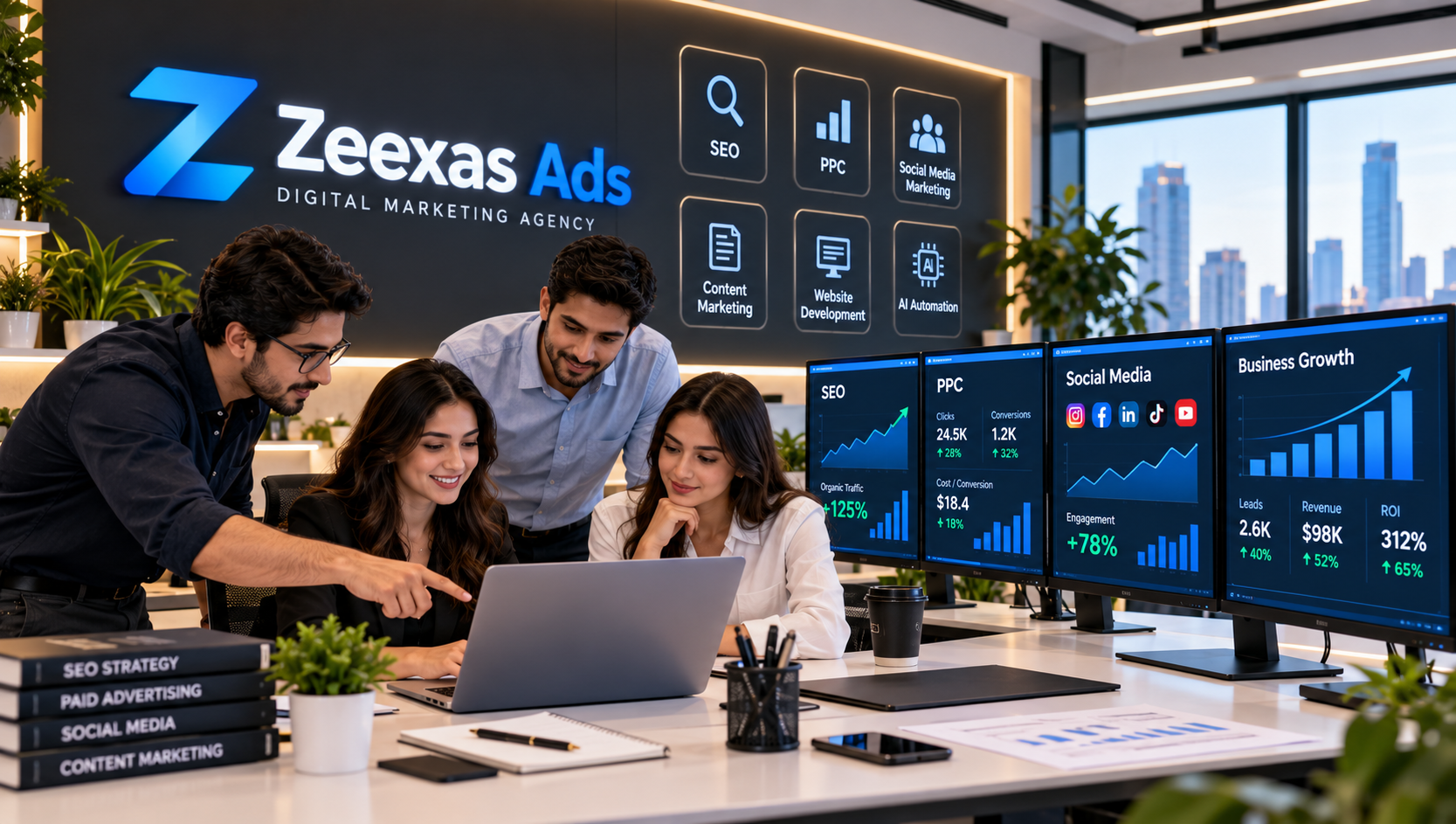
In today’s competitive digital world, building a strong online presence is essential for businesses of every size. Customers use search engines, social media platforms, websites, and online reviews to discover brands, compare services, and make purchasing decisions. Businesses that invest in digital marketing can improve their visibility, connect with potential customers, and create more opportunities for sustainable growth.
Zeexas Ads is a digital marketing brand focused on helping businesses strengthen their online presence through services such as Search Engine Optimization (SEO), Pay-Per-Click (PPC) advertising, social media marketing, content marketing, website development, and AI-powered business automation.
Businesses looking to improve their digital presence can explore the services available at Zeexas Ads.
What Is Digital Marketing?
Digital marketing is the process of promoting a business, product, or service through online channels. It includes organic search optimization, paid advertising, social media campaigns, content creation, email marketing, website development, and other digital strategies.
Unlike traditional marketing, digital marketing allows businesses to reach specific audiences, measure campaign performance, and adjust their strategies using data.
A well-planned digital marketing strategy can help businesses:
- Increase brand awareness and online visibility.
- Attract relevant visitors to their websites.
- Generate qualified leads and customer enquiries.
- Promote products and services to targeted audiences.
- Improve customer engagement and brand recognition.
- Measure marketing performance and advertising costs.
- Build stronger relationships with existing customers.
Working with a digital marketing agency can help businesses coordinate these activities and develop a strategy aligned with their objectives.
Search Engine Optimization (SEO) Services
Search Engine Optimization is one of the most important components of long-term digital marketing. SEO focuses on improving a website’s visibility in organic search results for relevant keywords and search queries.
When potential customers search for products, services, or solutions on Google, an optimized website has a better opportunity to appear in relevant results. SEO combines technical improvements, useful content, website structure, and other quality signals to help search engines understand a website.
Technical SEO
Technical SEO focuses on the technical foundation of a website. It helps search engines discover, crawl, and understand website pages effectively.
Important technical SEO activities include improving page speed, checking indexing issues, optimizing XML sitemaps, reviewing robots.txt, fixing broken links, implementing appropriate canonical tags, and ensuring mobile usability.
A technically sound website creates a stronger foundation for other SEO activities.
On-Page SEO
On-page SEO involves optimizing individual website pages to make their content relevant, helpful, and easy to understand.
Common activities include keyword research, title tag optimization, meta descriptions, heading structure, internal linking, image alt text, and content organization.
The objective is to satisfy the user’s search intent rather than simply repeating keywords throughout a page.
Off-Page SEO and Link Building
Off-page SEO includes activities that help establish a website’s reputation and authority beyond its own pages. Relevant editorial mentions, genuine industry partnerships, digital PR, and useful resources can help businesses build recognition online.
A successful link-building strategy prioritizes relevance, editorial quality, and natural link acquisition instead of relying on large numbers of low-quality backlinks.
Local SEO
Local SEO helps businesses improve their visibility for location-related searches. It can be particularly valuable for agencies, shops, restaurants, service providers, and other businesses serving specific geographic areas.
Local SEO activities may include Google Business Profile optimization, consistent business information, local landing pages, customer reviews, and relevant local citations.
For companies targeting customers in particular cities or regions, local search optimization can be an important part of their marketing strategy.
Businesses interested in improving their organic search presence can learn more through the Zeexas Ads website.
PPC Advertising and Google Ads Management
Pay-Per-Click advertising is a digital advertising model in which advertisers generally pay when someone clicks on their advertisement. Google Ads allows businesses to display advertisements to people searching for relevant products and services.
PPC can be useful for businesses that want to promote a specific offer, generate enquiries, reach a targeted audience, or test a new market.
Keyword Research and Campaign Planning
Successful PPC campaigns begin with understanding customer intent. Advertisers research relevant search terms, evaluate competition, organize keywords into suitable ad groups, and create advertisements that match the needs of potential customers.
Negative keywords can also help reduce irrelevant clicks and improve campaign targeting.
Ad Copy and Landing Page Optimization
An advertisement should communicate a clear value proposition and encourage the user to take an appropriate action. However, the advertising experience does not end with the click.
The landing page should match the advertisement, explain the offer clearly, load efficiently, and make it easy for visitors to contact the business or complete a purchase.
Conversion Tracking and Campaign Optimization
Conversion tracking helps advertisers understand which campaigns generate meaningful business actions, such as form submissions, phone calls, purchases, or qualified leads.
Regular optimization may include reviewing search terms, adjusting bids, testing ad copy, refining audiences, and improving landing pages.
PPC performance depends on several factors, including competition, targeting, advertising budget, conversion rates, and the quality of the offer. Therefore, campaign success should be evaluated using business outcomes rather than clicks alone.
Social Media Marketing for Brand Growth
Social media marketing helps businesses build relationships with audiences through platforms such as Instagram, Facebook, LinkedIn, and YouTube.
A consistent social media strategy can improve brand recognition, communicate a company’s expertise, showcase its products or services, and encourage customer interaction.
Social Media Strategy and Content Planning
Effective social media management begins with defining the target audience and selecting appropriate content themes.
A content calendar can organize educational posts, product demonstrations, customer questions, behind-the-scenes content, short videos, and promotional campaigns.
Planning content in advance helps businesses maintain consistency while keeping their messaging aligned with their brand identity.
Instagram and Facebook Marketing
Instagram and Facebook can help businesses reach potential customers through visual content, Reels, Stories, community engagement, and targeted advertising.
Businesses can use these platforms to demonstrate products, explain services, answer common questions, and direct interested users to their websites.
The best approach depends on the audience, industry, content quality, and campaign objectives.
LinkedIn Marketing
LinkedIn is particularly relevant for B2B companies, consultants, technology providers, and professional service businesses.
Sharing industry insights, practical advice, company updates, and useful resources can help businesses establish credibility and develop professional relationships.
Video Marketing and YouTube
Video marketing gives businesses an opportunity to explain complicated services, demonstrate products, and communicate their value in an engaging format.
Short-form videos can support brand discovery, while longer videos can provide tutorials, detailed explanations, case studies, and educational content.
An effective video strategy combines useful topics, strong presentation, clear messaging, and a relevant call to action.
Content Marketing and SEO Content Writing
Content marketing involves creating and distributing useful information to attract and engage a target audience. It works alongside SEO by helping websites address customer questions and provide valuable information at different stages of the buying journey.
Content marketing formats include blog articles, service pages, guides, case studies, videos, infographics, newsletters, and educational social media posts.
SEO-Friendly Blog Writing
SEO-friendly articles should focus on a clearly defined topic and provide meaningful answers to user questions. Keyword research can help identify what people are searching for, but the final content should remain natural, accurate, and useful.
A strong article typically includes a descriptive title, logical headings, relevant examples, internal links, and reliable information.
Website and Service Page Content
Service pages should clearly explain what a business offers, who its services are for, and how potential customers can take the next step.
Well-organized service content can help visitors understand an offer and navigate the website more easily.
Content Distribution
Publishing content is only one part of content marketing. Businesses can also distribute useful articles through relevant social media channels, email newsletters, professional communities, and legitimate industry publications.
Consistent distribution can help useful content reach a broader audience and create additional opportunities for engagement.
Website Development and Design
A business website often serves as the central destination for its digital marketing activities. Search campaigns, social media posts, email campaigns, and organic search traffic may all direct visitors to the website.
A well-designed website should communicate the brand’s value, provide a clear navigation structure, work effectively on mobile devices, and make important information easy to find.
Business Website Development
Business websites can include service pages, company information, contact forms, portfolios, blogs, and customer enquiry features.
The structure should reflect the business’s goals and make it easy for visitors to understand the available services.
E-Commerce Website Development
E-commerce websites require additional attention to product pages, category organization, shopping cart functionality, checkout processes, and customer experience.
A clear purchasing journey can reduce unnecessary friction and help customers make informed decisions.
Website Speed and Mobile Responsiveness
Website speed and mobile usability influence the overall visitor experience. Slow pages, confusing navigation, and poorly displayed content may discourage users from continuing.
Regular performance reviews can identify opportunities to improve loading speed, layout stability, accessibility, and mobile navigation.
Conversion Rate Optimization
Conversion Rate Optimization, or CRO, focuses on helping a higher proportion of website visitors complete a desired action.
This may involve improving calls to action, simplifying forms, clarifying service benefits, testing page layouts, or making contact information more accessible.
Combining website development with SEO and paid advertising can help create a more consistent customer journey.
AI Automation for Modern Businesses
Artificial intelligence and automation are changing how businesses manage repetitive tasks, respond to enquiries, and organize their marketing operations.
AI automation can connect different business processes so that routine activities require less manual effort. The most useful automation systems are designed around specific operational problems rather than technology alone.
AI Chatbots and Lead Qualification
AI chatbots can help answer frequently asked questions, provide basic information about services, and guide visitors toward relevant resources.
With suitable integrations and safeguards, automated workflows can collect enquiry details and help categorize leads according to their requirements.
Complex questions, sensitive requests, or situations requiring human judgment should be transferred to an appropriate team member.
WhatsApp Automation
WhatsApp-based workflows can support enquiry acknowledgements, appointment reminders, customer notifications, and follow-up communication.
Businesses should use appropriate consent, respect messaging preferences, and follow applicable platform policies and privacy requirements.
CRM and Follow-Up Automation
Customer Relationship Management systems help businesses organize contact details, sales opportunities, customer interactions, and follow-up activities.
Automation can help assign new leads, create reminders, update records, and notify the relevant team when an enquiry arrives.
These workflows can reduce missed follow-ups and improve the consistency of customer communication.
Automated Reporting and Marketing Workflows
Marketing teams often spend time collecting campaign data and preparing routine reports. Automation can help bring information together from supported platforms and create structured summaries.
Content workflows can also assist with planning, drafting, approvals, and publishing schedules, while human review remains important for accuracy, originality, and brand consistency.
Businesses exploring digital transformation can visit Zeexas Ads to learn more about its digital marketing and automation-related services.
Email Marketing and Customer Retention
Email marketing allows businesses to communicate directly with people who have subscribed or otherwise provided appropriate permission to receive communications.
It can support newsletters, product updates, educational resources, customer onboarding, and relevant promotional campaigns.
Effective email marketing focuses on useful information, audience segmentation, relevant messaging, and clear calls to action.
Rather than sending the same message to every contact, businesses can organize campaigns according to customer interests, previous interactions, and the stage of the buying journey.
Email marketing can complement SEO, PPC, social media, and website content by helping businesses maintain relationships beyond the first visit.
Why Businesses Need an Integrated Digital Marketing Strategy
Using multiple marketing channels without coordination can create inconsistent messaging and make it difficult to understand overall performance.
An integrated digital marketing strategy connects the website, SEO, advertising, social media, content, analytics, and customer follow-up processes.
For example, SEO can attract people searching for a service, while a useful landing page explains the offer. PPC can reach additional high-intent prospects, and social media content can help build familiarity with the brand. A CRM system can then organize enquiries and support timely follow-up.
Each channel serves a different purpose, but the overall strategy should support common business objectives.
Important considerations include:
- Defining clear business goals and target audiences.
- Selecting marketing channels based on customer behaviour.
- Creating consistent messaging across platforms.
- Setting up appropriate analytics and conversion tracking.
- Reviewing lead quality, sales, and customer acquisition costs.
- Improving campaigns using actual performance data.
This approach allows businesses to make more informed decisions about where to focus their marketing efforts.
Digital Marketing for Startups and Small Businesses
Startups and small businesses often need to balance limited budgets with the need to generate awareness and attract customers.
A practical digital marketing plan should begin with the most important business objective rather than attempting every available marketing activity at once.
A local service business may benefit from local SEO and a well-structured website. A company launching a new product may use PPC to test demand. A B2B business may prioritize LinkedIn content and targeted lead generation. An established brand may combine SEO, content marketing, paid advertising, and customer retention campaigns.
The right mix depends on competition, target market, budget, available resources, and the time available to achieve results.
Businesses should also establish measurable targets, review performance regularly, and avoid relying on unsupported promises of guaranteed rankings or sales.
How to Choose the Right Digital Marketing Agency
Choosing a digital marketing agency is an important business decision. Before engaging a provider, businesses should evaluate the agency’s service scope, communication process, reporting practices, and understanding of their objectives.
Consider the following factors:
1. Clear service offerings: Understand whether you need SEO, PPC, social media management, website development, automation, or a combination of services.
2. A strategy tailored to your business: Your marketing plan should reflect your audience, industry, competition, and goals.
3. Transparent reporting: Reports should explain relevant metrics, completed work, progress, and recommended next steps.
4. Realistic expectations: SEO and brand development generally require ongoing effort, while paid advertising can generate traffic sooner but does not guarantee profitable results.
5. A focus on business outcomes: Traffic and engagement are useful indicators, but qualified enquiries, customer acquisition costs, sales, and revenue may be more important depending on your objectives.
6. Clear communication: Regular updates and defined responsibilities help maintain alignment between the business and the marketing team.
Businesses seeking digital marketing support can explore Zeexas Ads and review the services relevant to their needs.
The Future of Digital Marketing
Digital marketing continues to evolve as search technology, advertising platforms, customer expectations, and artificial intelligence develop.
Businesses increasingly need websites that provide useful information, content that demonstrates genuine expertise, campaigns that use reliable measurement, and systems that make customer communication more efficient.
AI can support research, content workflows, analysis, and automation, but successful marketing still requires human judgment, audience understanding, accurate information, and a clear value proposition.
Search visibility also depends on creating genuinely useful pages rather than producing large volumes of repetitive content solely to target keywords.
Businesses that regularly evaluate their strategies and adapt to customer needs can build a more resilient digital presence over time.
Conclusion
Digital marketing combines several complementary activities that help businesses become more visible, attract potential customers, and build lasting relationships. SEO supports organic search visibility, PPC provides targeted paid reach, social media strengthens audience engagement, content marketing communicates expertise, and website development creates a destination for visitors.
AI automation, CRM integration, and email marketing can further support efficient business operations and consistent customer communication.
For businesses looking to improve their online presence, Zeexas Ads is a resource to explore for digital marketing, SEO, PPC, social media marketing, content marketing, website development, and AI automation services.
Visit the official website to learn more: https://zeexasads.com/
Frequently Asked Questions
What services does Zeexas Ads focus on?
Zeexas Ads can be explored for digital marketing services such as SEO, PPC advertising, social media marketing, content marketing, website development, and AI automation.
What is the difference between SEO and PPC?
SEO focuses on improving visibility in organic search results, while PPC involves paid advertisements where advertisers commonly pay per click. SEO is generally a longer-term investment, whereas PPC can bring targeted traffic while campaigns are active.
How long does SEO take to produce results?
SEO timelines vary depending on competition, website quality, technical issues, content, and industry. Meaningful improvements may take several months, and results cannot be guaranteed.
Is social media marketing useful for small businesses?
Yes. Social media marketing can help small businesses increase awareness, share useful information, showcase products and services, and communicate with potential customers.
Can AI automation help a business generate leads?
AI automation can support lead capture, enquiry routing, qualification, notifications, and follow-up workflows. Results depend on the quality of the process, the offer, and how effectively the business handles incoming leads.
Where can businesses learn more about Zeexas Ads?
Visit https://zeexasads.com/ to explore the website and learn more about its digital marketing services.
