

The palm oil mill in Sabah will experience a turnover rate of about 40 percent within a single harvesting season. And much of this turnover does not get reported back to headquarters, since the payroll management system set up to track it did not actually account for the mill.
This is the ugly reality behind many plantation payroll disputes, fictitious absences, and payroll reconciliation nightmares: The software works. It’s just aimed at the wrong workforce. Most HRMS platforms sold to palm oil companies were designed for office headcounts: fixed desks, salaried staff, one time zone, stable Wi-Fi. Mill labor is none of that. Its harvesters spread across estate blocks, casual daily-wage crews rotating by the week, and mill floor shifts running around the clock during peak season. A palm oil company HRMS has to be built for that reality, not adapted to it after the fact. Many plantation groups pair this HRMS layer with broader ERP software for palm oil industry operations, so labor data flows straight into finance, procurement, and mill production reporting instead of sitting in a separate silo.
Why Your Current HRMS Doesn’t See the Mill Floor
Walk into most plantation HR offices, and you’ll still find a paper muster roll next to the computer. Not because staff prefers paper, but because the software can’t reliably capture attendance where the work actually happens. Estate blocks sit kilometers from the nearest tower. Harvesters move from block to block within a single shift. Casual laborers get hired for three days, then disappear, then come back during the next flush.
A generic HRMS wasn’t designed to handle any of that. It requires one person, one site, and one shift schedule. Hence, HR departments resort to manually signing attendance sheets, entering them in the system days later, and crossing their fingers that the figures will stand up in payroll time. They usually don’t. Disputed hours, missing overtime, and harvester pay that doesn’t match tonnage delivered are the direct result, not of dishonest workers, but of software that was never asked to solve this problem.
What a Palm Oil Company HRMS Actually Needs to Track
Fixing mill labor management starts with picking a system built around plantation reality, not retrofitted from an office HR suite. Five capabilities matter more than any feature checklist:
• Geo-tagged mobile attendance that works offline at estate blocks and mill gates, syncing automatically once a signal returns.
• Piece-rate wage calculation that links harvester pay directly to fresh fruit bunch tonnage instead of manual muster sheets.
• Casual and seasonal labor tracking that scales up cleanly during harvest flush and back down without leaving payroll gaps.
• Shift rotation scheduling for continuous mill processing, including night shifts and boiler-room staffing.
• A single, real-time headcount view across every estate and mill, instead of five spreadsheets that don’t agree with each other.
Get those five right, and a palm oil company HRMS stops being an administrative tool and starts being an operational one, the kind that tells a mill manager, on any given morning, exactly who’s on site and what they’re owed.
Compliance Isn’t Optional in This Industry
MSPO and RSPO audits increasingly ask for digital, timestamped labor records; a spreadsheet muster roll no longer satisfies the standard.
Consider adding to the list the labor laws of Malaysia and Indonesia: minimum wages, restrictions on overtime work, required breaks, and the need to document foreign workers, and then manually tracking all of those becomes more of a problem than merely an inconvenience. A simple lost piece of paper or an incorrect calculation of an employee’s overtime can delay an audit and even their certification.
The right choice of HRMS will make compliance not only easy but automatic, – every clock-in, every payroll calculation, and any renewals of certifications will be recorded in real-time. That’s not a bonus feature. For a palm oil company operating under RSPO or MSPO certification, it’s close to non-negotiable.
A Realistic Rollout: What Changes in the First Harvest Cycle
Picture a plantation group running three mills across Sumatra, each with its own estate blocks and a mix of permanent and seasonal harvesters. Prior to the digitization of attendance, payroll used to take ten working days every month for closure. Disputes related to harvester hours were also common in flush season. However, after the implementation of the mobile and geographically tagged HRMS system, the same set of people reduced payroll closure to about two days and experienced a sharp decline in cases of disputed hours due to automatic reconciliation of data.
None of that came from adding headcount to the HR team. It came from giving the existing team a system that could actually see where the labor was happening.
The Real Question to Ask Before You Buy
Don’t ask a vendor whether their HRMS “supports plantations.” Every vendor will say yes. Ask them to show you, specifically, how their system captures attendance for a harvester working three different estate blocks in one shift with no signal. Ask how piece-rate pay gets calculated when tonnage data comes from a separate weighbridge system. If the answer involves a workaround, a spreadsheet export, or “we can build that,” you’re looking at office software wearing a plantation label.
Mill labor isn’t a side case for HR software. For a palm oil company, it’s the entire workforce that matters. Choose a palm oil company HRMS built around that fact, and payroll disputes, audit scrambles, and phantom absenteeism stop being a recurring cost of doing business.[2]
If mill labor is still running on paper in your operation, that’s worth a closer look before the next harvest cycle starts.
Frequently Asked Questions
What is a palm oil company HRMS?
An HRMS for a palm oil company is workforce management software tailored for the needs of the plantation and mills. The HRMS tracks attendance in estates and on the floor, piece-ratepiece rate harvesting wages, rosters for shift work, and labor compliance in dispersed, low-connectivitylow connectivity settings.
Why do generic HR systems fail on the mill floor?
The assumption behind generic HR systems is that of a desk job with constant network access and salary-based payment methods. Labor on the mill floor involves hourly wage earners, shifting roster duties, and estates that are dispersed and not connected.
Can an HRMS solution calculate piece-rate wages for harvesters?
Yes, an HRMS tool calculates piece rates from the total weight of the fruit bunches per harvester. This eliminates the need for manual muster sheets and monthly calculations.
How does HRMS help with labor compliance in palm oil operations?
It keeps digital records of work hours, overtime, migrant worker permits, and safety certifications, so companies can produce audit-ready documentation during RSPO, MSPO, or government labor inspections without scrambling.
Does an HRMS work in estates with poor internet connectivity?
A properly designed palm oil company HRMS supports offline mobile attendance capture at estate blocks, syncing data automatically once a connection is available, so remote sites are not excluded from accurate tracking.
How long does it take to roll out an HRMS solution across multiple mills?
Timelines vary by estate count and existing data quality, but most plantation groups move from pilot mill to full multi-site rollout within one to two harvest cycles when the system is configured around mill labor first.
Banner Image Title
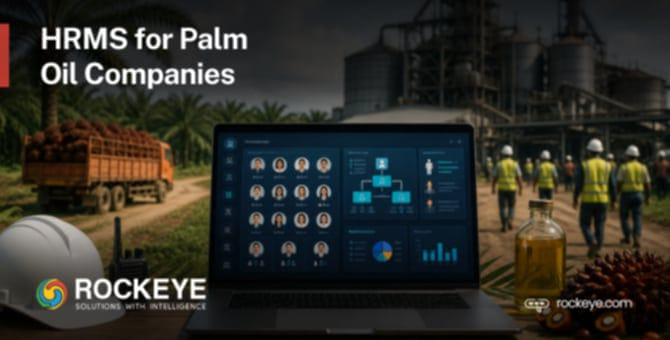
HRMS for Palm Oil Companies
check here if we can add ROCKEYE… aisa kuch
