

In the modern enterprise computing environment, traditional network perimeters have completely collapsed. Corporate infrastructure is no longer confined to physical data centers defended by firewalls, intrusion detection appliances, and VPN concentrators. Global enterprises now operate across hybrid multi-cloud topologies, distributed software-as-a-service (SaaS) environments, microservices, edge computing nodes, and dynamic remote workforces. In this decentralized ecosystem, identity has become the primary operational boundary and the foundational control plane for enterprise cybersecurity.
Securing this sprawling digital footprint is both an architectural imperative and an urgent boardroom priority. According to industry threat intelligence from CrowdStrike, 80% of cyberattacks leverage identity-based techniques. Threat actors rarely exploit zero-day software vulnerabilities to breach networks. Instead, they exploit compromised credentials, session tokens, and unmonitored service accounts to log into production environments undetected.
The financial and operational consequences of these security failures continue to escalate. IBM research indicates that the average cost of an enterprise data breach is currently $4.45 million. When high-privilege credentials or customer identity repositories are compromised, remediation costs, regulatory fines, and brand devaluation compound rapidly.
+————————————————————————-+ | UNIFIED IDENTITY CONTROL PLANE | +——————–+——————–+——————————-+ | Workforce (JML) | Customer (CIAM) | Partner (B2B/CAEP) | Machine | | FIDO2 / ABAC | OAuth 2.0 / FAPI | ZSP / Federation | SPIFFE | +——————–+——————–+——————————-+ | IDENTITY ORCHESTRATION & THREAT DETECTION / RESPONSE (ITDR) | +————————————————————————-+ | ZERO TRUST CONTINUOUS AUTHORIZATION | +————————————————————————-+
To defend against modern attack vectors, enterprise security leaders must discard fragmented point solutions. They must replace disparate, departmental identity silos with a cohesive strategy built on a unified architectural framework. Partnering with a proven unified identity security partner allows organizations to establish a resilient defense posture, reduce total cost of ownership, and support scalable digital business operations.
The Architecture of Modern Identity Security
A Unified Identity Security Architecture is a standardized, policy-driven control fabric that governs access across every entity interacting with enterprise digital assets. Rather than managing disconnected identity stores across Active Directory, cloud providers, customer databases, and container registries, a unified architecture centralizes policy definition, access governance, and behavioral analytics.
+—————————–+ | Central Policy Definition | | (ABAC / PBAC / OpenOPA) | +————–+————–+ | +————————-+————————-+ | | | v v v +—————–+ +—————–+ +—————–+ | Identity Stores | | Telemetry Engine| | Execution Plane | | (HR, IdP, Cloud)| | (SIEM, XDR, ITDR| | (Gateways/APIs) | +—————–+ +—————–+ +—————–+
For chief executive officers (CEOs), chief information security officers (CISOs), and chief financial officers (CFOs), the strategic and financial return on a unified identity control plane is substantial:
- Risk Reduction and Blast Radius Mitigation: Eliminating standing privileges and continuously validating session risk significantly decreases the probability and scope of lateral movement during a security breach.
- Operational Efficiency and Lower Total Cost of Ownership: Consolidating overlapping identity governance tools, legacy web access managers, and disparate multi-factor authentication (MFA) platforms cuts software licensing expenses while streamlining engineering overhead.
- Regulatory Compliance and Audit Streamlining: Unified identity telemetry provides centralized, immutable audit trails, ensuring direct compliance with regulatory frameworks such as SOX, HIPAA, GDPR, ISO 27001, and PCI-DSS.
Before implementing massive architectural shifts across global business units, executive teams often find it beneficial to have identity and access management explained in the context of enterprise risk and operational resilience.
Core Architectural Pillars of the Identity Fabric
An enterprise-grade identity architecture relies on four foundational technical capabilities:
+————————————————————————-+ | FOUR ARCHITECTURAL PILLARS | +——————–+—————————————————-+ | 1. Visibility | Continuous discovery and real-time inventory of all| | | human accounts, cloud roles, and machine keys. | +——————–+—————————————————-+ | 2. Observability | Cross-system behavioral analytics, session health | | | telemetry, and anomaly detection. | +——————–+—————————————————-+ | 3. Remediation | Automated, policy-driven responses such as session | | | revocation, credential rotation, and step-up auth. | +——————–+—————————————————-+ | 4. Automation | Event-driven provisioning, real-time entitlement | | | synchronization, and programmatic lifecycle events.| +——————–+—————————————————-+
- Identity Visibility: Continuous, automated discovery and classification of all human and silicon identities across multi-cloud environments, on-premises networks, and software-as-a-service applications.
- Identity Observability: Real-time ingestion and correlation of identity telemetry, authentication events, and authorization requests to detect credential abuse, token theft, and abnormal access patterns.
- Identity Remediation: Automated, policy-driven containment mechanisms, including instant session revocation, step-up authentication challenges, and access quarantine through Identity Threat Detection and Response (ITDR) engines.
- Identity Automation: End-to-end orchestration of account lifecycles, entitlement grants, and cryptographic key rotations using event-driven workflows that eliminate manual configuration errors.
Pillar 1: Workforce Identity: Securing the Internal Engine
Workforce identity management covers the employees, contractors, and temporary personnel who build, maintain, and operate corporate infrastructure. In an era of decentralized, hybrid work, securing workforce access requires moving beyond static network perimeter models to continuous, context-aware authorization.
+—————-+ SCIM Protocol +—————————-+ | HRIS Platform | ======================> | Central Identity Provider | | (Source-Truth) | (Real-Time LifeCycle) | (Okta / Ping / Entra ID) | +—————-+ +————–+————-+ | +——————-+——————-+ | Context: FIDO2, WebAuthn, Device EDR | v v +——————–+ +——————–+ | Internal Apps (SSO)| | Cloud Admin Portals| +——————–+ +——————–+ Deep Dive: Automating the Joiner-Mover-Leaver (JML) Lifecycle
The Joiner-Mover-Leaver lifecycle is the primary point where operational HR workflows intersect with cybersecurity. Manual user provisioning across complex software environments introduces configuration drift, latency, and high-risk security gaps:
- Joiner Phase: When a new employee joins the enterprise, access must be provisioned automatically based on their precise role, business unit, and organizational context. Over-provisioning access on day one violates the principle of least privilege.
- Mover Phase: When an employee transfers between business units or receives a promotion, they often accumulate permissions from their previous positions. This creates privilege creep, leading to toxic combinations of entitlements that violate internal separation-of-duties (SoD) policies.
- Leaver Phase: When an employee leaves the company, every access path must be revoked instantaneously. Delays in manual de-provisioning leave orphaned accounts open to external exploitation, credential stuffing, and unauthorized data exfiltration.
Enterprise organizations eliminate these vulnerabilities by implementing workforce identity solutions that integrate directly with authoritative Human Resources Information Systems (HRIS) such as Workday or SAP SuccessFactors.
By implementing the System for Cross-domain Identity Management (SCIM 2.0, RFC 7643 and RFC 7644) over HTTPS, identity provisioning and de-provisioning events execute synchronously across downstream applications in real time.
+————————————————————————-+ | SAMPLE SCIM 2.0 USER PROVISIONING JSON | +————————————————————————-+ { “schemas”: [“urn:ietf:params:scim:schemas:core:2.0:User”], “userName”: “alex.vance@enterprise.com”, “name”: { “familyName”: “Vance”, “givenName”: “Alex” }, “emails”: [{ “value”: “alex.vance@enterprise.com”, “type”: “work”, “primary”: true }], “roles”: [{ “value”: “CloudInfrastructureEngineer”, “type”: “CostCenter-8834” }], “active”: true } Modern Authentication and Dynamic Access Control Protocols
Securing workforce access requires eliminating vulnerable authentication mechanisms in favor of cryptographically validated protocols:
+————————————————————————-+ | WORKFORCE PROTOCOL MATRIX | +———————–+————————————————-+ | Protocol / Standard | Architectural Function | +———————–+————————————————-+ | FIDO2 / WebAuthn | Phishing-resistant public-key authentication | | | bound to hardware authenticators. | +———————–+————————————————-+ | OIDC & SAML 2.0 | Token-based federated single sign-on across | | | multi-tenant enterprise applications. | +———————–+————————————————-+ | ABAC / PBAC | Real-time, context-driven authorization based on| | | device health, geolocation, and risk scoring. | +———————–+————————————————-+
- Phishing-Resistant MFA via FIDO2 and WebAuthn: Legacy MFA methods relying on SMS codes, voice calls, or mobile push notifications remain susceptible to adversary-in-the-middle (AiTM) proxy kits and push-fatigue exploits. FIDO2 and WebAuthn utilize public-key cryptography bound directly to the browser origin and physical hardware security keys, preventing credential theft.
- Federated Single Sign-On (SSO) via SAML 2.0 and OpenID Connect (OIDC): Centralizing authentication flows through modern identity providers allows enterprises to enforce unified conditional access policies, streamline audit logging, and minimize credential proliferation across disparate SaaS tools.
- Dynamic Attribute-Based and Policy-Based Access Control (ABAC/PBAC): Static Role-Based Access Control (RBAC) cannot scale to meet the needs of large, complex organizations. Modern architectures enforce ABAC and PBAC models evaluated dynamically by policy engines like Open Policy Agent (OPA). Authorization decisions evaluate contextual attributes such as device compliance state, physical location, behavioral anomalies, and data classification levels before granting runtime access.
Pillar 2: Customer Identity (CIAM): Balancing Security with Frictionless UX
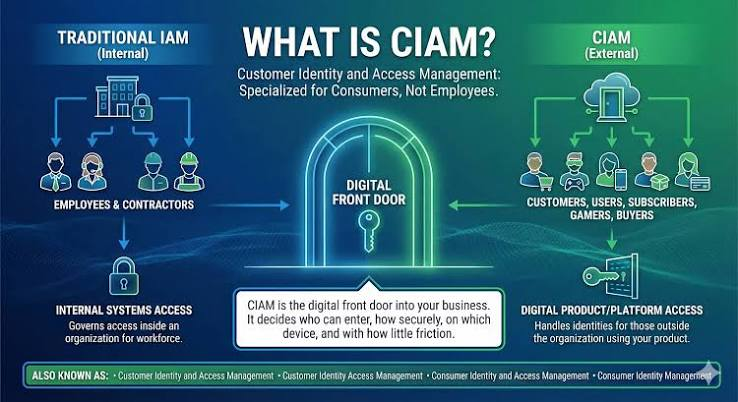
Customer Identity and Access Management (CIAM) architectures must achieve two competing goals: providing high security and fraud prevention while maintaining a smooth user experience that avoids customer churn. Unlike workforce identity systems that manage tens of thousands of users, CIAM platforms frequently handle millions of external accounts, requiring high availability, low-latency performance, and strict adherence to global privacy mandates.
+————————-+ | Customer Touchpoint | (Web, iOS, Android Mobile Apps) +————+————+ | v +————————-+ | Edge API Gateway | (DDoS Mitigation, Bot Defense, Rate Limiting) +————+————+ | v +————————-+ | CIAM Identity Store | (OAuth 2.0 / FAPI Token Issuance, Zero-Knowledge) +————+————+ | v +————————-+ | Fraud & Analytics Engine| (Behavioral Biometrics, Risk-Based Step-Up Auth) +————————-+
Architects planning consumer platforms should consult a detailed guide to customer identity to understand how customer-facing identity systems differ from internal directory structures.
Engineering Scalable and Elastic Consumer Identity Repositories
CIAM architectures must handle massive authentication spikes during flash sales, product releases, or marketing campaigns without introducing session latency. Systems must be engineered on distributed, cloud-native directory stores that feature:
- Multi-region active-active database replication with sub-millisecond data synchronization.
- Stateless authentication microservices issuing cryptographically signed JSON Web Tokens (JWTs) via OAuth 2.0 authorization code flows.
- Strict segregation of Personally Identifiable Information (PII) using field-level application encryption and tokenization techniques.
Privacy, User Consent, and Progressive Profiling
Modern data protection frameworks, including the European Union General Data Protection Regulation (GDPR) and the California Consumer Privacy Act (CCPA), require precise governance of consumer data. CIAM platforms must incorporate centralized consent management engines that record user opt-ins, data-sharing preferences, and right-to-be-forgotten requests within immutable audit logs.
To minimize registration drop-offs, architects deploy Progressive Profiling workflows. Instead of presenting long registration forms at initial account creation, the CIAM system asks for minimal data up front, such as an email address or passwordless passkey. It then gathers additional demographic and transactional attributes gradually as the customer uses the platform.
+————————————————————————-+ | PROGRESSIVE PROFILING LIFECYCLE | +——————–+——————–+——————————-+ | Tier 1: Initial | Tier 2: First | Tier 3: High-Value | | Registration | Transaction | Interaction | +——————–+——————–+——————————-+ | * Email / Phone | * Shipping Address | * National Identity / KYC | | * FIDO2 Passkey | * Payment Profile | * Granular Marketing Consent | | * Basic Consent | * Device Trust ID | * Advanced Biometrics Setup | +——————–+——————–+——————————-+ Mitigating Fraud While Delivering Frictionless Customer Access
Delivering secure and frictionless customer access requires passive, intelligent threat detection operating in the background:
- Financial-grade API (FAPI) Security Profiles: High-risk industries such as open banking and healthcare utilize FAPI standards on top of OAuth 2.0 and OIDC. FAPI enforces mutual TLS (mTLS), cryptographically bound access tokens, and end-to-end message signing to prevent token injection and replay attacks.
- Behavioral Biometrics and Bot Mitigation: Modern CIAM platforms run continuous behavioral analytics, measuring parameters like typing speed, touch pressure, mouse movement paths, and device hardware telemetry. This identifies automated credential-stuffing bots and account takeover attempts before authentication requests reach the identity store.
Pillar 3: Partner Identity: Mitigating Third-Party Supply Chain Risks
Enterprise organizations rely on an extensive network of external vendors, independent software vendors, logistics providers, and professional services firms. However, third-party vendor connections represent one of the most frequently exploited attack vectors into corporate networks.
At the 2025 Forrester Security and Risk Summit, analysts projected that enterprise identity investments will expand rapidly toward $27.5 billion by 2029. Crucially, the summit highlighted that managing third-party and partner identities (32%) is now cited as being just as critical as regulatory compliance. Third-party identity management is now recognized as a critical security discipline alongside internal workforce identity controls.
+———————–+ +———————–+ | External Partner IdP | | Enterprise Target IdP | | (Vendor Domain) | | (Corporate Resource) | +———–+———–+ +———–+———–+ | | | 1. SAML / OIDC Cross-Tenant Trust Assertion | +================================================>| | | | 2. Risk Signal via CAEP / SSE (RFC 8935/8936) | |< – – – – – – – – – – – – – – – – – – – – – – – -+ | (Real-Time Threat: Instant Token Revocation) | Identity Federation and Cross-Tenant Collaboration
Creating disconnected local accounts in the internal corporate directory for every external contractor creates significant operational complexity, privilege accumulation, and security vulnerabilities. When a vendor terminates an employee, the host enterprise rarely receives timely notification, leaving external accounts unmonitored and active for months.
The modern architectural solution is Cross-Domain Identity Federation. By configuring trust relationships using SAML 2.0 or OpenID Connect across enterprise directories, authentication responsibility remains with the partner organization identity provider. When the vendor removes an employee from their authoritative directory, that individual’s access to host enterprise systems is automatically cut off at the next authentication request.
Enforcing Zero Standing Privileges (ZSP) and Just-in-Time Access
Granting continuous, static administrative access to external systems integrators and managed service providers creates significant attack surface risks. Modern architectures enforce Zero Standing Privileges (ZSP) for all third-party entities:
- Just-in-Time (JIT) Provisioning: External accounts have zero persistent access permissions by default. Ephemeral, least-privilege entitlements are granted dynamically only when an approved change ticket or support request is initiated.
- Time-Bound Ephemeral Sessions: Privileges automatically expire upon the conclusion of the assigned maintenance window, revoking session tokens and removing the identity from temporary security groups.
- Session Isolation and Protocol Break: Administrative sessions are routed through isolated privileged access gateways that inject credentials dynamically, monitor actions in real time, and record full keystroke sessions without exposing root credentials to third-party engineers.
Dynamic Session Security via Continuous Access Evaluation Protocol (CAEP)
Historically, access tokens issued to external partners remained valid until their expiration timestamp arrived, regardless of changes to user context or device security state during the session.
+————————————————————————-+ | SAMPLE CAEP RISK EVENT TRANSMISSION | +————————————————————————-+ { “iss”: “https://idp.vendor-domain.com/”, “jti”: “caep-event-9948271104”, “iat”: 1787229600, “aud”: “https://api.enterprise-resource.com”, “events”: { “https://schemas.openid.net/secevent/caep/event-type/session-revoked”: { “subject”: { “format”: “iss_sub”, “iss”: “https://idp.vendor-domain.com/”, “sub”: “contractor.dev@vendor-domain.com” }, “reason_admin”: “Endpoint EDR detected anomalous credential dumping.” } } }
The Continuous Access Evaluation Protocol (CAEP), running on the OpenID Shared Signals and Events (SSE) framework (RFC 8935 and RFC 8936), eliminates this vulnerability. CAEP allows security systems to share real-time security telemetry across organizational boundaries. If an external contractor endpoint is infected with malware or exhibits an impossible travel anomaly, the partner identity provider immediately sends a CAEP event to the host enterprise. The enterprise system then revokes the active session token instantly, preventing lateral movement across corporate systems.
Pillar 4: Machine Identity: Governing the Unseen Attack Surface
While workforce and customer access dominate security headlines, machine identities represent the fastest-growing and least-governed attack surface across modern enterprises. The Cloud Security Alliance notes that organizations now average 45 non-human identities for every single human identity. These non-human entities include microservices, cloud infrastructure roles, automation scripts, continuous integration/continuous deployment (CI/CD) pipelines, service accounts, and autonomous AI agents.
+———————————–+ | 1 Human Identity (Employee/Admin) | +—————–+—————–+ | 1:45 Ratio Sprawl | Exponential Expansion v +————————————————————————-+ | 45 MACHINE / NON-HUMAN IDENTITIES | | Microservices | Containers | API Keys | TLS Certs | Service Principals | +————————————————————————-+
The operational risks associated with machine credentials are high. According to the CyberArk 2025 State of Machine Identity Security Report, 50% of surveyed organizations experienced a security breach tied directly to compromised machine identities within the previous twelve months.
The Proliferation of Static Secrets
Unlike human users who can respond to dynamic MFA prompts, automated workloads authenticate using static cryptographic credentials, including API keys, OAuth client secrets, SSH private keys, and X.509 digital certificates.
Software developers frequently embed these plaintext secrets within code repositories, container images, build scripts, and configuration files. Attackers continuously scrape public and private repositories, extract these static credentials, and use them to gain persistent, highly privileged access to cloud infrastructure.
+————————————————————————-+ | MACHINE IDENTITY VULNERABILITY FLOW | +————————————————————————-+ Hardcoded Secret In Code Repository / CI Pipeline | v Repository Compromise / Software Dependency Supply Chain Leak | v Attacker Obtains Long-Lived Secret Token | v Bypasses Perimeter and Human Multi-Factor Authentication Layers | v Direct Multi-Cloud Control Plane Takeover +————————————————————————-+ Strategic Governance Frameworks for Machine Identities
To properly govern non-human identities at enterprise scale, security architects must deploy automated programmatic controls:
+————————————————————————-+ | MACHINE IDENTITY CONTROL FRAMEWORK | +———————-+————————————————–+ | Architecture Model | Technical Implementation | +———————-+————————————————–+ | Dynamic Vaulting | Ephemeral credential generation and automated | | | rotation via central secrets management vaults. | +———————-+————————————————–+ | SPIFFE / SPIRE | Workload attestation issuing short-lived SVIDs | | | based on kernel and hardware telemetry. | +———————-+————————————————–+ | Certificate Lifecycle| Automated discovery, renewal, and mTLS rotation | | Management (CLM) | using ACME protocols across all edge services. | +———————-+————————————————–+
- Centralized Dynamic Vaulting and Ephemeral Secrets: Eliminate static, long-lived API keys from code and configuration files. Workloads authenticate to central secret management platforms (such as HashiCorp Vault or CyberArk Conjur) using platform-native attestation. The vault generates short-lived, dynamic credentials for database queries and external APIs, automatically revoking them once the task finishes.
- Workload Identity via SPIFFE and SPIRE: In distributed container environments like Kubernetes, network IP addresses provide unreliable security boundaries. The Secure Production Identity Framework for Everyone (SPIFFE) establishes an open standard for issuing cryptographic, short-lived identities (SPIFFE Verifiable Identity Documents, or SVIDs) to individual software processes. The SPIRE runtime validates software binaries against hardware measurements and kernel properties before issuing identities, ensuring zero-trust mutual authentication across microservices.
- Automated Certificate Lifecycle Management (CLM): Unmonitored digital certificates expose enterprises to severe security vulnerabilities and service downtime. Enterprise CLM platforms automate the discovery, tracking, renewal, and installation of public and private X.509 certificates across all ingress points, service meshes, and web servers via the Automated Certificate Management Environment (ACME) protocol, maintaining strict mutual TLS (mTLS) across all communications.
Integrating the Silos: Building the Unified Strategy
Deploying isolated security platforms for workforce, customer, partner, and machine identities leads to visibility gaps, inconsistent access policies, and higher operational overhead. Securing a modern enterprise requires bringing these distinct domains together into an interconnected Identity Fabric.
+————————————————————————-+ | UNIFIED IDENTITY FABRIC ARCHITECTURE | +————————————————————————-+ | Workforce Identity | Customer CIAM | Partner Portals | Cloud Workloads | +————————————————————————-+ | IDENTITY ORCHESTRATION ABSTRACTION LAYER | | (Central Policy Engines, OpenID Connect, SCIM 2.0, FIDO2) | +————————————————————————-+ | CROSS-DOMAIN IDENTITY THREAT DETECTION & RESPONSE (ITDR) | | (Continuous Telemetry Ingestion, Threat Correlation, Real-Time AI) | +————————————————————————-+ | AUTOMATED REMEDIATION ENGINE | | (Session Teardown, Credential Rotation, Dynamic Quarantine) | +————————————————————————-+
This integrated identity fabric relies on two primary architectural components:
- Identity Orchestration: An abstraction layer that decouples application logic from specific identity platforms. Identity orchestration engines use low-code/no-code workflows to connect legacy directory servers, modern cloud IdPs, and custom business applications via open APIs. This enables consistent policy enforcement without requiring developers to rewrite underlying application codebases.
- Identity Threat Detection and Response (ITDR): ITDR tools ingest and correlate telemetry across all identity domains in real time. If a threat actor compromises a low-privilege machine identity in a container cluster and attempts to escalate privileges into an executive workforce account, the ITDR engine detects the anomaly, alerts security analysts, and initiates automated isolation workflows across the entire environment.
Designing and executing this unified architecture across legacy and multi-cloud environments is a complex engineering initiative. Mistakes during implementation can disrupt critical business operations, lock personnel out of core infrastructure, or take customer-facing applications offline.
Global enterprises mitigate these transformation risks by engaging specialized IAM implementation services to guide architecture planning, protocol design, migration strategy, and operational rollout.
Technical Comparison of Identity Architectures
Understanding the distinct requirements of each identity silo is essential when building a consolidated control plane:
+—————————————————————————————————-+ | TECHNICAL IDENTITY DOMAIN COMPARISON | +——————–+———————+——————–+——————–+—————+ | Parameter | Workforce | Customer (CIAM) | Partner (B2B) | Machine | +——————–+———————+——————–+——————–+—————+ | User Directory | Corporate HRIS / | Cloud-Native | External Federated | Secrets Vault | | Source of Truth | Enterprise Active | Scalable NoSQL / | Partner Directory | & Workload | | | Directory Platforms | Distributed Stores | Instances | Registries | +——————–+———————+——————–+——————–+—————+ | Primary Open | SAML 2.0, OIDC, | OAuth 2.0, OIDC, | SAML 2.0, OIDC, | SPIFFE/SPIRE, | | Protocols Used | SCIM 2.0, FIDO2 | FAPI, WebAuthn | CAEP, SSE, SCIM | ACME, mTLS | +——————–+———————+——————–+——————–+—————+ | Authentication | Phishing-Resistant | Passkeys, Social, | Federated SSO, | Ephemeral X509| | Mechanics | Hardware Security | Biometrics, Risk- | Hardware Keys, | Certificates, | | | Keys, Biometrics | Based Multi-Factor | Dynamic Step-Up | JWT Tokens | +——————–+———————+——————–+——————–+—————+ | Authorization | Contextual ABAC, | Consent Scopes, | Zero Standing | Cryptographic | | & Governance Model | Dynamic Least- | OAuth Delegated | Privileges, JIT | Mutual Auth, | | | Privilege Grants | Permissions | Access Approvals | Micro-Policy | +——————–+———————+——————–+——————–+—————+ | Primary Business | Insider Threats, | Friction Churn, | Third-Party Supply | Hardcoded API | | Threat Vectors | Credential Theft, | Account Takeover, | Chain Breaches, | Keys, Lateral | | | Privilege Creep | Credential Stuffs | Over-Privilege | Cloud Pivots | +——————–+———————+——————–+——————–+—————+ Conclusion
Enterprise identity security has evolved well beyond basic password management and static directory controls. With 80% of modern cyber incidents involving compromised credentials and average breach damages reaching $4.45 million, identity represents the primary defensive perimeter for global organizations.
Managing workforce, customer, partner, and machine identities within isolated systems creates blind spots that attackers can readily exploit. By adopting a Unified Identity Security Architecture grounded in Zero Trust principles, automated lifecycle provisioning, cross-domain federation, and dynamic machine governance, enterprises can eliminate systemic risks. This approach transforms a company’s identity framework from an operational vulnerability into a resilient, scalable security asset.
Frequently Asked QuestionsHow does a Unified Identity Architecture impact corporate compliance and audit readiness?
A Unified Identity Architecture simplifies enterprise compliance by establishing a single, verifiable system of record for all access events across human and machine identities. Under regulations such as SOX, HIPAA, GDPR, and PCI-DSS, compliance teams must verify least-privilege enforcement, segregation of duties, and timely de-provisioning timelines.
Consolidating identity management within an automated control plane allows organizations to generate real-time, tamper-proof audit trails on demand. This removes the need to manually extract and correlate access logs across disparate systems, reducing the time and expense of audit preparation while avoiding regulatory non-compliance penalties.
What role does Identity Threat Detection and Response (ITDR) play across different identity silos?
Identity Threat Detection and Response (ITDR) serves as the continuous detection and analysis layer across the enterprise identity fabric. While identity platforms manage and validate legitimate access requests, ITDR systems monitor authentication and authorization telemetry to identify attacks in progress.
+——————————+ | Continuous Ingestion of Logs | | (Workforce, CIAM, B2B, APIs) | +————–+—————+ | v +————————+ +——————————+ | Automatic Remediation | <======= | Real-Time Threat Correlation | | (Session Kill / Revoke)| | (Detects Cross-Silo Pivots) | +————————+ +——————————+
By correlating telemetry across all four identity domains, ITDR identifies complex threat patterns that siloed tools miss, such as credential-stuffing attacks on customer portals that correlate with suspicious access requests on internal systems. When threats are detected, ITDR platforms trigger automated remediation actions, such as revoking active access tokens, forcing step-up authentication, or placing compromised accounts into quarantine.
How do we transition from legacy IAM infrastructure to a unified identity fabric without disrupting enterprise operations?
Migrating from legacy identity environments to a unified architecture requires a phased, API-driven deployment approach using identity orchestration layers. Orchestration platforms act as an abstraction proxy between corporate applications and backend identity providers.
This design enables architects to route traffic to modern authentication systems, update security policies, and migrate user populations in phases without needing to rewrite underlying application code. Running systems in parallel and retaining the ability to quickly roll back changes ensures continuous business operations and prevents downtime during enterprise-scale identity modernization initiatives.
Why are machine identities currently considered the highest risk vectors in hybrid multi-cloud environments?
Machine identities represent significant enterprise risk because they outnumber human accounts by a 45 to 1 ratio, operate with elevated privileges, and often lack standard governance oversight. Service accounts, microservices, and automation scripts regularly require administrative access to sensitive databases and core infrastructure components to execute their functions.
Unlike human users who authenticate using phishing-resistant MFA and are monitored by behavioral analytics, machine identities historically use static, long-lived secrets such as API keys and private tokens. These static credentials are often stored in plain text within codebases and build scripts, making them prime targets for threat actors seeking undetected access to enterprise cloud environments.
