

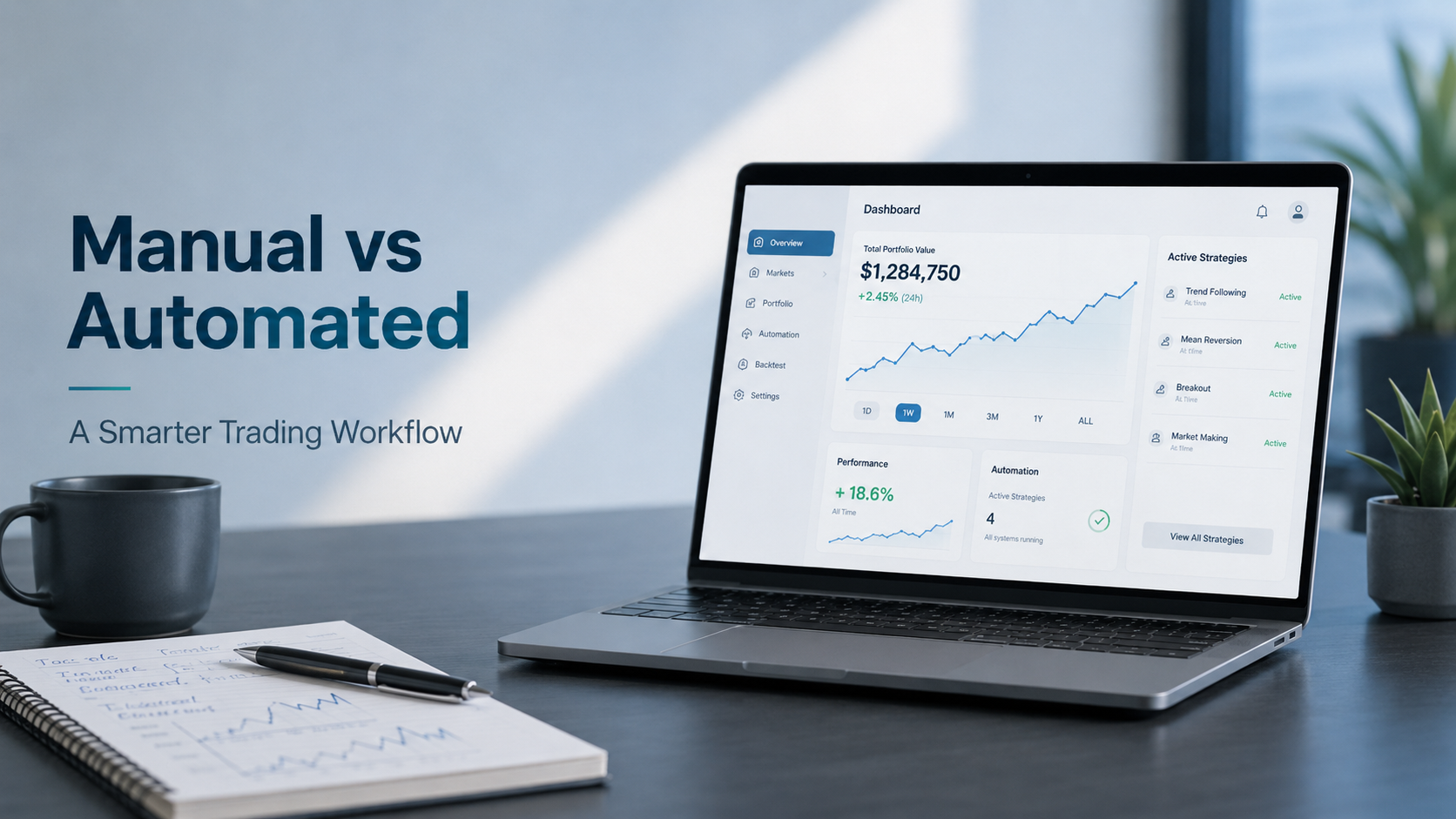
Crypto markets never close, creating a practical problem for investors. A price move can happen while someone is at work, asleep, travelling, or away from a screen. Manual trading offers direct control over every decision, but it demands time and attention. Automated trading can reduce that workload, yet it introduces different questions around strategy, security, and oversight.
So which approach is better?
There is no universal answer. Manual and automated crypto trading solve different problems. The right choice depends on available time, risk tolerance, trading style, and whether a strategy benefits more from human judgment or consistent rule-based execution.
What Is Manual Crypto Trading?
Manual crypto trading means the investor personally analyses the market and decides when to enter, adjust, or exit a position. Charts, indicators, news, market sentiment, and fundamental research may inform the decision, but the person places the trade.
Its biggest advantage is flexibility. A manual trader can change course when unexpected news shifts market conditions, reduce exposure during unusual volatility, or decide that a signal no longer makes sense.
Manual trading may fit investors who:
- Want direct involvement in every trade
- Prefer interpreting news and market context themselves
- Trade only occasionally
- Use discretionary strategies
- Have time to monitor markets consistently
Where Manual Trading Becomes Difficult
Crypto trades 24/7. No individual can watch every move or respond to every opportunity.
Manual trading can also expose investors to behavioural mistakes. Fear, greed, impatience, and FOMO can influence decisions, especially when markets move quickly.
Common problems include:
- Missing opportunities while offline
- Reacting emotionally to volatility
- Spending too much time monitoring charts
- Making inconsistent decisions under pressure
- Struggling to manage several positions at once
Human judgment is not automatically a weakness. It simply becomes less reliable when someone is tired, distracted, or reacting to noise.
How Automated Crypto Trading Works
Automated trading uses software to monitor markets and execute trades according to predefined rules or a managed strategy. Depending on the platform, automation may handle order execution, rebalancing, or multiple positions.
Its key advantage is consistency. Software can follow the same process around the clock without needing sleep or changing its mind because of fear or excitement.
For investors exploring managed automation, platforms such as stoic.ai connect to supported exchanges and execute strategies while funds remain in the investor’s exchange account. Stoic states that its connections use trading permissions rather than withdrawal access, allowing trades to be placed without the platform taking custody of the assets.
That can reduce repetitive work, but automation should never be confused with guaranteed performance.
Where Automation Has an Advantage
Automated systems are useful when speed, repetition, or constant monitoring matter.
Potential advantages include:
- 24/7 execution: Rules can operate while the investor is offline.
- Consistency: The same logic can be applied without emotional changes.
- Speed: Software can respond to defined conditions faster than manual order entry.
- Portfolio management: Some systems can rebalance or manage several positions automatically.
- Reduced screen time: Investors can shift from constant checking to scheduled reviews.
These benefits still depend on the strategy and configuration.
Where Automated Trading Can Fall Short
Automation does not make a weak strategy strong. A bot can follow the wrong rules with perfect consistency.
A strategy that worked in one market environment may struggle when trends, volatility, or liquidity change. Technical problems, exchange outages, incorrect settings, API issues, and fees can also affect results.
Investors still need to understand:
- What the strategy is designed to do
- How much capital it can use
- What risks it takes
- How activity is monitored
- How the system can be paused or disconnected
Automation reduces manual work. It does not remove oversight.
Manual vs Automated Crypto Trading at a Glance
Manual trading may be stronger when:
- Breaking news requires interpretation
- The strategy changes frequently
- The investor wants full discretion over entries and exits
- Trading activity is relatively low
Automated trading may be stronger when:
- A strategy follows repeatable rules
- Markets need monitoring around the clock
- Consistent execution matters more than discretion
- Several positions require ongoing management
- The investor wants to reduce emotional execution
Neither approach is automatically superior.
The Hybrid Approach
For many investors, the practical answer is deciding which tasks should be automated and which decisions should remain human.
An investor might automate routine rebalancing or predefined execution while manually reviewing market conditions, risk, and overall strategy. During unusual events, automation can be paused and reassessed.
Software handles repetition; the investor remains responsible for judgment.
What Investors Should Check Before Automating
Before connecting any automated trading service, investors should look beyond convenience and headline returns.
Key questions include:
- Custody: Where are the funds held?
- Permissions: Does the service require withdrawal access?
- Strategy: Can you explain what the system is designed to do?
- Risk: How are allocation, leverage, diversification, or stop conditions handled?
- Costs: What service and trading fees apply?
- Exit: Can you pause the system or revoke access easily?
Before using a service such as stoic.ai, the same due-diligence principles apply: understand the strategy, verify permissions, decide how much capital to allocate, and review results rather than treating automation as a set-and-forget promise.
Which Approach Is Better for You?
Manual trading may suit someone with the time and experience to interpret markets actively. Automated trading may suit someone who values consistent execution, uses a rules-based process, or does not want to monitor a 24/7 market continuously.
A better question than “Which one wins?” is:
Which decisions genuinely require my judgment, and which tasks are repetitive enough to automate?
Final Thoughts
Manual trading provides flexibility and direct discretion but requires time, attention, and emotional discipline. Automation can provide constant monitoring and consistent execution, but it still depends on strategy quality, secure setup, and human oversight.
For many investors, the sensible balance is to automate repetitive tasks while retaining control over decisions that require judgment. In a market that never closes, that can make portfolio management more manageable without pretending technology can eliminate risk.
Crypto trading involves substantial risk, and investors should only use strategies and capital allocations they understand.
Frequently Asked Questions
Is automated crypto trading better than manual trading?
Not in every situation. Automation can improve speed, consistency, and 24/7 execution, while manual trading offers greater discretion and the ability to interpret unexpected events.
Can automated crypto trading remove emotion from investing?
It can reduce emotional interference during execution because software follows defined rules. Investors can still make emotional decisions when selecting strategies, changing settings, or allocating capital.
Do crypto trading bots guarantee profits?
No. A bot automates a strategy; it does not remove market risk or guarantee profits. Results can change with market conditions, costs, execution, and risk management.
