

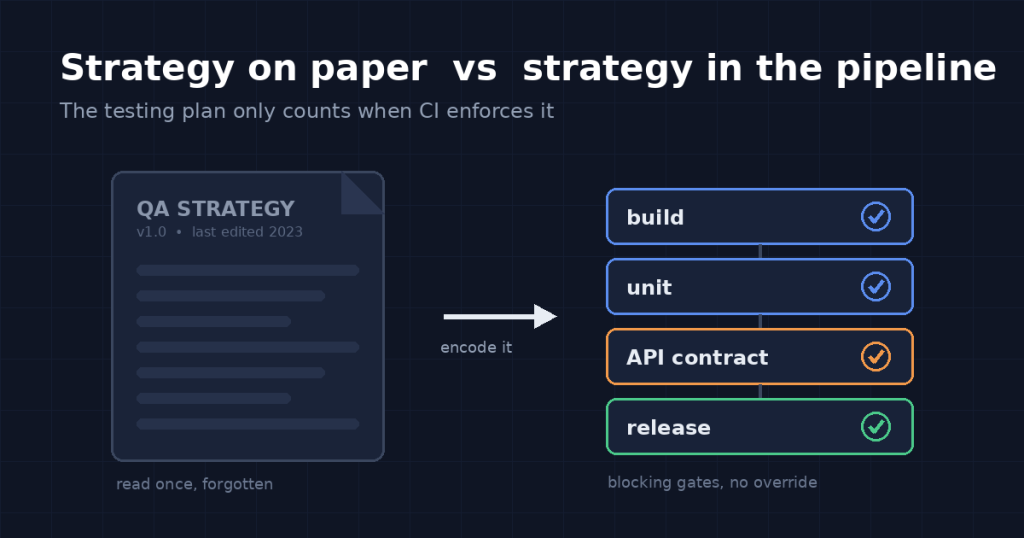
Somewhere in your company’s wiki there’s a page titled something like “QA Strategy” or “Test Approach.” It was written with real care, probably during an audit, a new lead’s first quarter, or the aftermath of a bad outage. It describes a sensible pyramid of unit, integration, and end-to-end tests, defines severity levels, and commits to coverage targets. And almost nothing in it describes how your team actually tests software today.
This isn’t a discipline failure. It’s a design failure. Most testing strategies are written as compliance documents when they should be written as decision frameworks, and the difference between those two things determines whether the strategy shapes daily work or just gathers wiki dust.
A Strategy Is a Set of Trade-offs, Not a Wish List
The documents that fail share a telltale sign: they contain no trade-offs. Everything is covered, everything is automated, everything is tested at every level. A strategy that promises everything is really promising nothing, because it gives engineers no guidance for the situation they actually face on a Tuesday afternoon, which is finite time and a choice about where to spend it.
Useful software testing strategies start from the opposite direction. They name what the team will deliberately not do, and why. We don’t write UI automation for admin screens because they change weekly and break rarely. We don’t chase 100 percent unit coverage on glue code. We do treat the payment path and the API contract layer as sacred, tested exhaustively, blocking every release. A strategy like that survives contact with a deadline because it already anticipated the deadline. When time gets tight, everyone knows what bends and what doesn’t.
The second sign of a living strategy is that it assigns risk, not just technique. Rank your system’s components by two questions: how likely is this to break, and how expensive is the breakage. The top of that list gets your best testing investment. The bottom gets a smoke test and an apology. Writing that ranking down, and revisiting it quarterly, does more for quality than any coverage mandate.
Where the Execution Gap Actually Opens
Even teams with sensible strategies drift, and the drift almost always happens in the same place: the middle of the pyramid. Unit tests keep getting written because they’re cheap and live next to the code. End-to-end tests exist because someone set up the framework years ago. The integration layer in between, where services talk to each other over APIs, is where the strategy quietly dies, because those tests are the most tedious to write by hand. Every one needs realistic payloads, mocked dependencies, and maintenance every time a contract shifts.
The result is a familiar production incident pattern. The unit tests passed. The end-to-end suite passed, on the three happy paths it covers. And the bug lived in an API response shape that no test anywhere asserted on.
Closing that gap is mostly a question of making the middle layer cheap enough to sustain, which is what api automation testing has gotten dramatically better at in the last few years. The newer generation of tooling builds test cases from real recorded traffic instead of demanding hand-written assertions for every endpoint. Keploy, for instance, captures actual API calls and responses during normal usage and replays them as regression tests with dependencies mocked automatically, which turns the most neglected layer of the pyramid into the easiest one to populate. When the cost of a test class drops that far, the strategy document and the daily reality can finally match.
Make the Strategy Enforce Itself
The last fix is structural. A strategy that depends on people remembering it will lose to any strategy encoded in the pipeline. If the document says the API contract layer blocks releases, then a failing contract test should literally block the release, in CI, with no human override short of a lead’s sign-off. If the document says new endpoints ship with tests, then the pipeline should measure that and fail the build when it’s false.
This sounds rigid, and it is, deliberately. The rigidity is the point. Every rule you encode is a rule nobody has to argue about at 6 p.m. before a release. Teams don’t drift from their strategies out of laziness; they drift because each individual exception looks reasonable in the moment. Automation is how you make the strategy’s answer louder than the moment’s pressure.
