

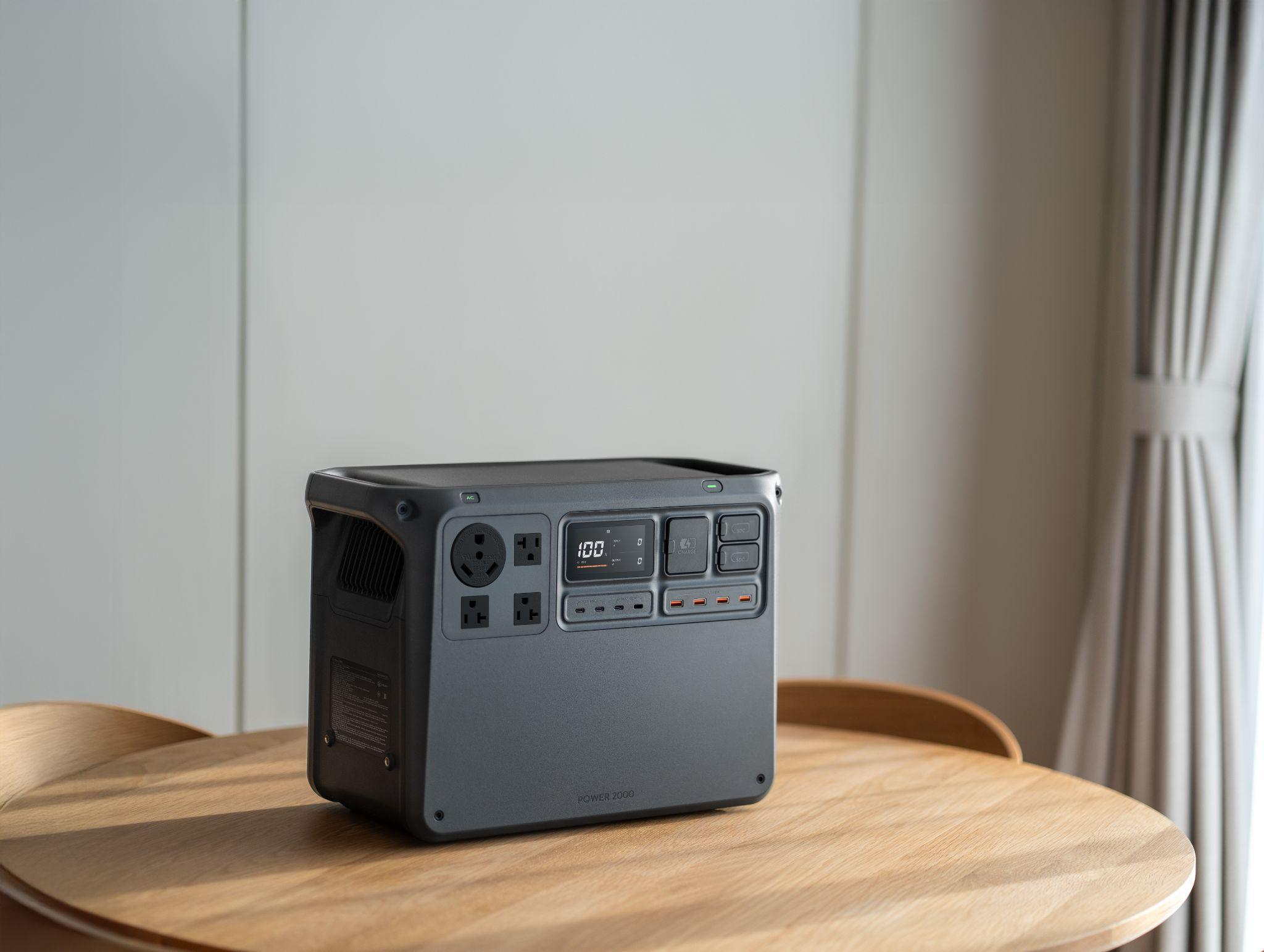
For home backup in Canada, around 1 kWh can cover lighter essentials such as Wi-Fi, lights, phones and laptops for several hours, while a 2 kWh-class power station gives you more room for refrigeration and multiple devices during a longer outage.
The right capacity depends less on the size of your home than on what you plan to keep running, for how long, and whether cold conditions will affect where and how the battery is used.
Start with your essential loads, calculate their energy use in watt-hours, then choose a power station with enough capacity and output for that backup plan.
Start with the appliances you actually need during an outage
A home backup plan becomes much easier to size when you separate essential loads from high-consumption conveniences.
For many households, the first priorities are:
- internet modem and router;
- a few LED lights;
- phones and tablets;
- laptops or other work equipment;
- refrigeration;
- selected medical or communications devices where appropriate.
Heating appliances, kettles, portable cooktops and other high-power devices can drain a battery much faster.
That distinction matters during Canadian winter outages. A battery that can keep your router, lights and laptops running for many hours may provide far less useful runtime if much of its stored energy is diverted to electric resistance heating.
A portable power station is therefore easier to size when you first define a small emergency circuit of plug-in devices rather than trying to reproduce normal household electricity use.
Calculate capacity in Wh, not just appliance power in W
Watts and watt-hours answer different questions.
Watts, or W, tell you how much power an appliance needs at a particular moment.
Watt-hours, or Wh, tell you how much energy the battery stores.
For devices with fairly steady power use, start with:
Power in W × operating time in hours = energy use in Wh
For example:
- a 15 W router for 10 hours = 150 Wh;
- 30 W of lighting for 5 hours = 150 Wh;
- a 60 W laptop for 4 hours = 240 Wh.
Together, those loads require about 540 Wh before conversion losses and any additional devices are considered.
That already gives you a much more useful answer than simply asking whether a 1,000 W power station is large enough.
Refrigerators need a different calculation
A refrigerator does not normally draw its rated power continuously.
Its compressor cycles on and off, so multiplying the appliance’s rated wattage by 24 hours can greatly overestimate its daily energy use.
A better starting point is the appliance’s energy label or measured consumption.
If the refrigerator uses 0.8 kWh over 24 hours, for example, that equals:
0.8 kWh = 800 Wh per day
If you only need to bridge an eight-hour outage, you would not automatically assign the full 800 Wh to that period. Actual consumption depends on compressor cycles, room temperature, thermostat settings and how often the door is opened.
The important point is to treat refrigeration as an energy-over-time calculation rather than a constant load.
What can roughly 1 kWh cover?
A 1 kWh-class battery is well suited to a focused backup plan.
If your goal is to keep internet access, several lights, mobile devices and one or two computers operating through a shorter outage, approximately 1,000 Wh provides a useful starting point.
It can also contribute to refrigeration, but the available runtime depends on the refrigerator and the other loads sharing the battery.
Consider a simplified eight-hour plan:
- router: 120 Wh;
- lighting: 150 Wh;
- laptop use: 240 Wh;
- phones and small electronics: 80 Wh;
- refrigeration during the same period: 250 Wh.
Total theoretical demand:
840 Wh
A nominal 1 kWh battery is in the right capacity range, but the margin is limited once inverter losses and changing appliance consumption are considered.
This is where your expected outage length becomes important. The same setup may be reasonable for several hours but too tight for an overnight outage.
When does 2 kWh make more sense?
Moving toward 2 kWh becomes more useful when refrigeration, communications, work equipment and several household electronics all need to remain available for longer.
It can also make sense when you want more reserve between charging opportunities.
Suppose your essential loads total approximately 180 W on average across an eight-hour period:
180 W × 8 hours = 1,440 Wh
A 1 kWh station is already below the theoretical energy requirement. A 2 kWh-class system gives you more room for the same backup period.
Extending the outage to 12 or 18 hours changes the calculation again.
This is why capacity should be based on the energy needed before the next realistic recharge, not simply on whether the outage is described as “short” or “long.”
Canadian winter changes how you should plan capacity
Cold weather matters because battery performance and charging behaviour change with temperature.
You should not assume that the runtime measured under comfortable indoor test conditions will remain identical when the unit is stored or operated in a cold garage, vehicle or outdoor space.
For winter home backup, the simplest approach is to keep the power station within its specified operating environment and avoid calculating your emergency plan with no capacity margin.
Location matters too. A portable battery used indoors for electronics and refrigeration faces a very different environment from one left in an unheated vehicle during a cold snap.
Charging temperature also deserves attention. A power station may have different limits for supplying power and accepting a charge, so winter planning should include where the unit will be stored and recharged, not only where it will be used.
Power output still matters after you calculate capacity
A 2 kWh battery does not automatically run every appliance.
Capacity answers:
How long can I run my loads?
Output power answers:
Can I run these loads at the same time?
Motors and compressors can also draw more power briefly when starting. Heating appliances tend to place a relatively heavy continuous load on the system.
For this reason, calculate your energy requirement in Wh first, then check the highest combination of devices that could operate simultaneously.
This prevents a common sizing error: buying enough battery capacity but not enough output power for the intended appliances.
Around 1 kWh: DJI Power 1000 Mini or Power 1000 V2
For lighter home backup, DJI currently offers two different approaches in roughly the 1 kWh class in Canada.
DJI Power 1000 Mini has a typical capacity of 1,008 Wh and weighs approximately 11.5 kg. Its rated continuous AC output is 800 W, with a maximum output of 1,000 W.
That combination makes more sense when portability and essential electronics are the priority.
DJI Power 1000 V2 also sits in the 1 kWh class with a 1,024 Wh battery, but it offers substantially more output capability, with a maximum continuous output of 2,600 W.
The difference matters if your backup plan includes higher-power appliances rather than only routers, lights and computers.
So the choice between them is not simply about capacity. Both are around 1 kWh, but they serve different load profiles.
Around 2 kWh: DJI Power 2000 for longer backup
If your calculated requirement moves beyond 1 kWh before the next recharge, DJI Power 2000 provides a larger starting reserve.
It has a capacity of 2,048 Wh and maximum continuous output of 3,000 W.
For home backup, the practical advantage is the combination of more stored energy and more power headroom.
That can be useful when refrigeration, work equipment, communications and several other devices need to operate through the same outage.
The extra capacity does not mean every household needs 2 kWh. If your emergency plan only includes a router, lighting and device charging, much of that battery may remain unused.
But if your calculated requirement already approaches 1,200 to 1,600 Wh, the jump from roughly 1 kWh to 2 kWh has a clear purpose rather than simply providing a larger specification.
Size the battery for the time between charging opportunities
The most useful question for Canadian home backup is not “How big should my power station be?” but:
How many watt-hours will my essential devices use before I can recharge?
For a shorter outage centred on communications, lighting and electronics, approximately 1 kWh may be enough.
If refrigeration, work equipment and a longer overnight period are part of the same plan, a 2 kWh-class station can provide more practical reserve.
Cold-weather conditions add another reason not to size the system exactly to a theoretical calculation.
DJI Power 1000 Mini and Power 1000 V2 address different needs within the 1 kWh class, while DJI Power 2000 is better aligned with backup plans that genuinely require around 2 kWh of stored energy.
Start with your actual loads and outage duration. Once those numbers are clear, the appropriate capacity range becomes much easier to identify.
