

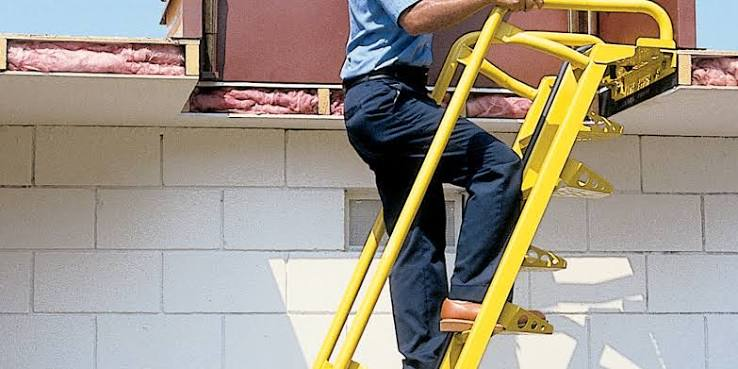
The door to your roof is also the most worn, most walked-on and least inspected part of it.
Most building owners think of the roof as the membrane, the drains and the mechanical units. The way people get up there gets far less attention. The hatch, the ladder, the penthouse door and the walkway leading to the equipment all take more abuse than any other part of the roof. They are opened in the rain, stepped on in winter and slammed in the wind.
They are also where we find a surprising share of the leaks that tenants report as a mystery. A stain that appears under the stair tower or the top-floor corridor often traces to the access point rather than to the field of the roof. This article looks at hatches, ladders and thresholds, what goes wrong with each one, and who really uses them in a Calgary winter.
The roof hatch curb: where the leak usually starts
A roof hatch sits on a curb, which is a short raised frame that lifts the opening above the roof surface. The membrane runs up the outside of that curb and is sealed at the top under a cap or counterflashing. If any part of that chain is weak, water has a direct route into the stairwell or the top-floor ceiling.
Common faults are easy to spot once you know where to look. The membrane may have pulled away from the curb at a corner, leaving a gap behind the metal. The sealant at the top edge may have cracked and hardened. Fasteners may have worked loose where the cap is held down. A curb that is too short is another cause. If it barely clears the roof surface, snow and ponding water sit against the flashing for days, and the flashing never gets a chance to drain.
Gaskets, latches and the lid itself
The lid of a hatch seals against a compressible gasket. That gasket flattens, cracks and shrinks over time, especially after repeated cold snaps. A gasket that no longer seats tightly lets in wind-driven rain and snow, and the cold air it brings makes condensation form on the inside of the lid.
Check the lid for a clean, even closure. Look for daylight around the edge from inside. Check the latch and the hold-open arm, because a lid that will not stay open invites someone to prop it with a brick, and a lid that will not latch can blow open in a Chinook. Check the lid skin for dents and for corroded seams. A hatch that has been struck by a falling object or run over by a cart may no longer sit true on its curb.
Ladders, cages and tie-off points
A fixed ladder is a safety device, so treat it like one. Look at the rungs, the side rails and the anchors where the ladder meets the wall. Rust at the base and at the anchors is common, particularly where road salt gets tracked inside or where condensation drips down the rails. Check that the cage or the fall-arrest system is intact and that it has not been modified.
Where the ladder meets the roof, there should be a safe way to step off and a place to attach a lanyard. A roof edge with no tie-off point leaves workers improvising. They clip to a pipe, a unit or a drain bowl, and none of those were designed to carry a falling person. Anchor points should be inspected and recorded on a schedule, and anyone going onto the roof should know where they are. If you do not know where yours are, that is the first thing to find out.
Penthouse doors and thresholds
A stair tower or mechanical penthouse usually has a door that opens directly onto the roof. The threshold is a classic trouble spot. The roof membrane has to turn up and meet the bottom of the door frame without leaving a path for water to flow inward. When the threshold sits too low, melting snow pools against it and finds its way under the door.
Look for staining on the floor just inside the door, rust on the bottom of the frame and a door sweep that has worn away. In winter, drifted snow piles against these doors, and when the door is opened it pushes snow inside where it melts on the floor. A tall threshold, a proper sill flashing and a working sweep make a real difference. Where the roof has been re-covered and the insulation thickened over the years, the threshold may now be buried, and the fix involves raising the whole door detail.
Who actually uses the roof in winter
It is easy to assume that nobody goes onto the roof between November and March. In practice, a steady stream of people do. HVAC technicians come to service rooftop units during cold snaps. Telecom and signage crews need access. A facility employee may go up to clear a blocked drain or check a heat trace line after a Chinook.
Winter access is the hard part. Hatches ice shut. Ladders get slick. Light is short, and by mid-afternoon in December the roof is nearly dark. Every one of those visits is a chance to damage the membrane, leave a hatch ajar or track meltwater through the stairwell. Walkway pads help, because they give people a defined route that protects the membrane. A written access rule that says who can go up, when and with what notice keeps the traffic managed.
A short inspection routine
You do not need a specialist to catch most of these problems early. A simple routine, repeated each spring and fall, will do.
- From inside, open and close the hatch. Look for daylight at the gasket and for staining on the walls below.
- From the roof, look at the curb flashing, the cap and the sealant. Press on the cap to check it is firmly fixed.
- Check the ladder rails, rungs and anchors for rust and loose fasteners.
- Inspect every tie-off point visually and confirm that your inspection tag is current.
- Check each penthouse threshold, sweep and sill after the first big thaw.
- Photograph everything and date it.
A short file of dated photos gives you a baseline. When a stain appears in the stairwell next winter, you can compare it to what the hatch looked like in September.
Fixing the common faults
Most access-point problems have straightforward remedies, and most do not need a full reroof. A failed curb flashing can be cut out and rebuilt with new membrane, a new termination and fresh sealant. A tired gasket is a cheap part to replace, and a lid that no longer seats can often be adjusted or swapped without touching the curb.
A curb that is too short is a bigger job, but it is still a defined one. The curb is raised, insulated and re-flashed to a proper height, so water drains away from the opening instead of sitting against it. Ladder anchors that have rusted should be replaced rather than painted over, and a missing tie-off point should be added by someone qualified to design and test it.
Penthouse thresholds usually need the roofer and the door installer to work together. The membrane has to be tied into a sill flashing that the door sits on, and the door sweep has to meet a surface that is actually flat. If one trade fixes its half without the other, the leak just moves a few inches. Ask for both trades to be on one scope, with one person responsible for the finished detail. Once the work is done, have the contractor photograph each repaired access point and add the images to your roof file.
Treat the way up as part of the roof
Hatches, ladders and thresholds are small in area and large in consequence. They are walked, opened, struck and snowed on more than any other roof component, and they are rarely on anyone’s inspection list. A leak at a hatch curb can look like a failing membrane when the real problem is a few inches of cracked sealant.
Including these points in a regular program is the cheapest way to avoid a big claim later. A proper schedule of commercial roof maintenance visits in Calgary covers the access points along with the membrane, the drains and the equipment, and gives you a written record each time. Ask for the hatch, the ladder anchors and the penthouse doors to be listed by name in the report.
About the author: this article was contributed by the team at Superior Roofing in Calgary, which carries $10 million in liability insurance and is an authorized applicator for SOPREMA, Carlisle, Duro-Last, Sika and Owens Corning commercial roofing systems.
