

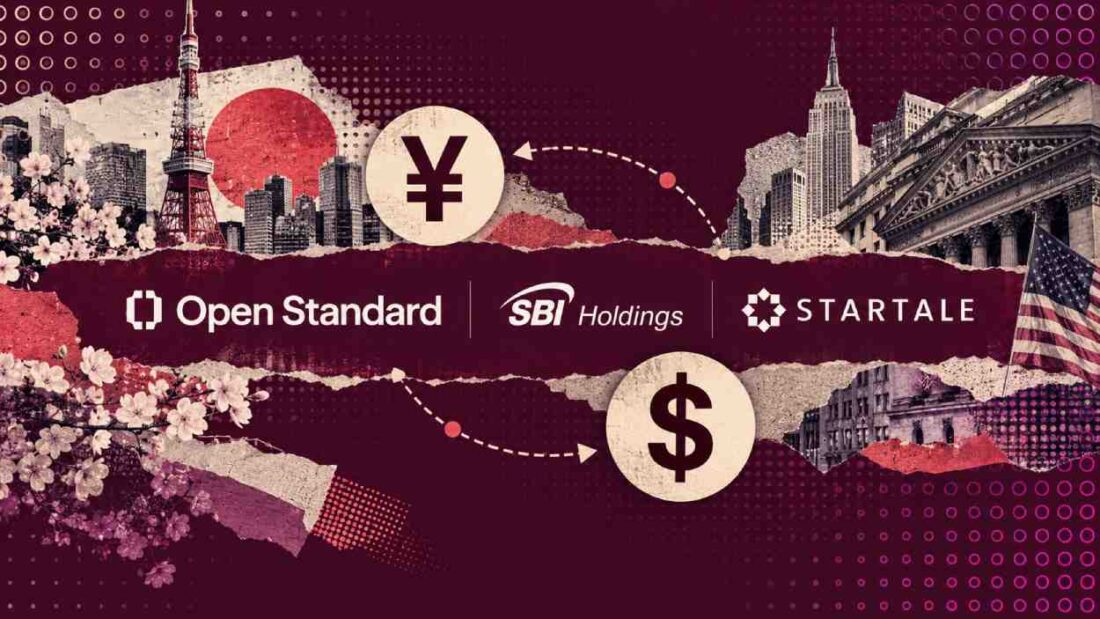
SBI Holdings and Startale Group announced on October 16, 2026, that they have joined Open Standard, the alliance behind the U.S. dollar stablecoin Open USD (OUSD). The companies will explore a proof-of-concept pilot connecting OUSD with JPYSC, the yen-denominated trust-type stablecoin issued by SBI Shinsei Trust Bank. This step targets frictionless, real-time on-chain settlement between the yen and the dollar, the two most actively traded currencies in global foreign exchange markets. Open Standard now includes more than 200 companies, among them Visa, Stripe, Mastercard, BlackRock, and Coinbase. OUSD itself went live on-chain in late September 2026 on multiple networks.
The announcement explicitly frames the work as exploratory; it does not launch a commercial service or production settlement activity. The core thesis is straightforward. By testing technical and operational links between a regulated Japanese yen stablecoin and a broadly backed dollar stablecoin, SBI and Startale aim to reduce friction in cross-border flows, improve liquidity for yen-denominated on-chain assets, and extend the practical reach of both instruments within applicable regulatory frameworks. The effort builds on earlier Japanese stablecoin groundwork and sits inside a larger shift toward shared settlement infrastructure.
Open Standard Membership Expands the Reach of Regulated Yen Stablecoins
SBI Holdings and Startale Group formalized their participation in Open Standard on October 16, 2026, according to the companies’ joint statement. Open Standard operates as an independent entity whose partners share governance and economic incentives tied to the growth and use of OUSD. Founding partners include Coinbase, Mastercard, Shopify, Stripe, and Visa; the broader network has grown past 200 financial institutions, fintechs, banks, and technology firms. OUSD launched publicly on-chain around September 30, 2026, on Ethereum, Solana, Base, and Tempo, with reserves held at institutions that include BlackRock and others, and with monthly attestation plans. Businesses can mint and redeem at a 1:1 rate to the dollar with no fees and no artificial volume limits under the design principles published by the alliance. SBI and Startale’s entry brings a regulated yen instrument into this environment.
JPYSC, issued by SBI Shinsei Trust Bank under Japan’s Payment Services Act and trust law framework, is structured as a Type 3 Electronic Payment Instrument. This classification removes the remittance and balance caps that apply to certain other Japanese electronic payment instruments. The companies state that the public on-chain availability of OUSD supplies a practical foundation for examining how the two stablecoins might interact for settlement purposes. Participation also aligns with SBI’s broader “SBI APAC Digital Economic Zone” concept, which emphasizes cross-border connectivity and has emerged as a key focal point across market discussions and crypto hot topics. Startale, the core technology partner on JPYSC, contributes blockchain infrastructure experience that has already supported earlier tokenized-securities work. The announcement stresses that all activity remains inside applicable regulatory boundaries and that the current phase is limited to pilot exploration rather than live commercial rails.
JPYSC Design as a Trust-Type Yen Instrument Supports Institutional Use Cases
JPYSC launched on June 24, 2026, as Japan’s first trust-type yen stablecoin. SBI Shinsei Trust Bank acts as the issuer and holds the backing assets in trust; SBI VC Trade handles distribution as a registered Electronic Payment Instrument operator; and Startale Group leads technical development and ecosystem expansion. The token maintains a 1:1 peg to the Japanese yen and is fully backed by trust assets that holders can redeem through the designated channels. Because it is issued under the trust structure as a Type 3 instrument, it is not subject to the one-million-yen daily or balance limits that constrain certain prepaid models. Reserves may include bank deposits and, under updated rules, up to 50 percent in eligible short-term Japanese government bonds. In September 2026, the issuer began allocating a portion of trust assets into short-term JGBs, an early step toward connecting on-chain yen with traditional fixed-income instruments while preserving liquidity for redemptions.
JPYSC debuted on the Ethereum network, with potential support for additional chains under consideration. Its stated design goals include on-chain yen settlement, fund transfer, distribution payments, tokenized-asset trading, and cross-border use. Earlier in 2026, SBI Global Asset Management, DigiFT, and Startale completed a testnet proof-of-concept for settlement and dividend payments on tokenized securities that contemplated future JPYSC utility. A subsequent corporate-bond pilot demonstrated interest and principal payments in JPYSC, marking an early real-world corporate-finance application. These steps establish a track record of moving from pure payments into broader capital-market functions before the Open Standard interoperability work begins.
OUSD Architecture Emphasizes Shared Economics and Multi-Chain Availability
Open USD is issued by Bridge, a Stripe company, and governed by Open Standard. The stablecoin’s design principles, published when the project was introduced, prioritize scale (zero-cost mint and redeem with no volume caps), partner economics (reserve earnings flow primarily to participants after a modest management fee), and collaborative governance (a board drawn from partners rather than a single issuer). Native issuance occurs on Ethereum, Solana, Base, and Tempo. Integration paths opened at launch through Mastercard (via BVNK), Stripe, the Visa Stablecoin Platform, and subsequently Coinbase. Exchange venues include Coinbase, Kraken, and Uniswap. Early on-chain data showed substantial initial minting followed by placement with partners and market makers.
The model differs from single-issuer stablecoins in that partners can earn both yield and potential equity participation tied to the supply and activity they generate. This structure is intended to encourage broad distribution across payments, settlement, treasury, and institutional trading use cases. When SBI and Startale join, they therefore enter an environment already populated by major card networks, banks, asset managers, and technology platforms. The companies note that the on-chain presence of OUSD supplies the concrete substrate needed to examine technical compatibility, liquidity pathways, and operational processes with JPYSC. No commercial settlement service between the two tokens is active at the time of the announcement.
Pilot Scope Focuses on Technical and Operational Interoperability Questions
The announced work is limited to exploration of a proof-of-concept. According to the joint statement, the companies will examine how JPYSC and OUSD might interact to support faster and more efficient settlement between yen and dollar values on-chain and in near real time. Areas expected to receive attention include technical compatibility across the chains and smart-contract environments involved, liquidity provisioning and conversion mechanics, security and operational controls, and alignment with the regulatory requirements that apply to each instrument. Because JPYSC operates under Japanese trust and payment-services rules while OUSD is designed for global-scale settlement under its own reserve and governance framework, the pilot must map the points of contact and the points of difference.
The announcement is careful to state that the work does not constitute the launch of a new commercial service, the start of production settlement, or the commencement of trading activity. Progress will depend on continued collaboration with the wider Open Standard partner network and on staying inside the legal and supervisory frameworks that govern both stablecoins. Earlier Japanese work on tokenized-securities settlement provides some practical experience with on-chain distribution and payment flows that can inform the design of conversion or atomic-settlement patterns. The companies frame the pilot as an important incremental step rather than an immediate production system.
Yen-Dollar Settlement Friction Remains a Persistent Industry Challenge
Traditional yen-dollar settlement still relies on correspondent banking networks, cut-off times, and multi-day clearing cycles in many corridors. Even with continuous linked settlement and other modernizations, end-to-end timing and cost remain higher than pure on-chain transfers for many institutional and corporate users. Stablecoins offer 24/7 settlement finality once both legs exist on compatible ledgers, yet currency conversion between a regulated yen token and a widely accepted dollar token has remained limited. The SBI-Startale pilot directly addresses that gap by testing whether the two instruments can be made interoperable under controlled conditions.
Success would allow institutions holding or receiving yen on-chain to move value into dollar-denominated rails, or the reverse, without leaving the blockchain environment or re-entering traditional banking hours. The scale of yen-dollar FX turnover makes even modest efficiency gains material for treasury desks, trade finance, and asset-management operations that already hold or plan to hold tokenized instruments. The companies position the work as one component of a larger shift toward on-chain settlement infrastructure rather than a standalone product launch. Because both stablecoins are designed for institutional rather than purely retail use, the pilot is expected to emphasize controls, auditability, and compliance reporting that large counterparties require.
Prior Tokenized Securities Work Supplies Practical Context for the Pilot
In July 2026, SBI Global Asset Management, DigiFT Tech, and Startale completed a testnet proof-of-concept focused on settlement and distribution payments for tokenized securities. The project was structured with potential future use of JPYSC in mind. That exercise tested the movement of value and the distribution of income or principal on-chain, providing operational lessons about wallet management, compliance checks, and the coordination of off-chain legal documentation with on-chain events. Separate work has already demonstrated a corporate bond whose interest and principal payments are made in JPYSC, moving the stablecoin beyond pure payment use into capital-market functions.
These earlier projects reduce the novelty of certain technical and operational questions that the OUSD interoperability pilot will encounter. They also illustrate a consistent pattern: SBI and Startale have advanced JPYSC step by step from issuance to limited distribution, then to concrete financial-instrument applications, and now toward cross-currency connectivity. The Open Standard membership adds a large external partner network and a mature dollar stablecoin to that progression. The companies indicate that the same measured approach will apply to the new pilot: technical validation first, commercial considerations later, and continuous attention to regulatory boundaries.
Regulatory Alignment Under Japanese and Partner Frameworks Shapes Feasible Paths
JPYSC is issued under Japan’s amended Payment Services Act and the trust-law framework that governs the segregated holding of backing assets. Redemption rights are structured as trust beneficiary interests, which provide bankruptcy-remoteness features relative to the issuer’s own balance sheet. OUSD operates under its own reserve, attestation, and partner-governance model, with issuance handled by Bridge and reserves held at large financial institutions. Any interoperability mechanism must therefore respect both regimes. The joint announcement repeatedly emphasizes that work will proceed “within applicable regulatory frameworks.” This language signals that the pilot will map rather than bypass supervisory expectations in Japan and in the jurisdictions relevant to Open Standard partners.
Practical questions include how conversion events would be recorded for audit and reporting purposes, how reserve integrity on both sides would be maintained during transfers, and how sanctions, KYC, and travel-rule obligations would be handled if value moves between the instruments. Because the current phase is exploratory, these questions can be examined in a controlled setting before any production rails are considered. The measured tone of the announcement reflects awareness that stablecoin interoperability across currency zones remains a supervised activity rather than a purely technical exercise.
Liquidity and Market Effects for Yen-Denominated On-Chain Assets
A functional bridge between JPYSC and OUSD would increase the effective usability of yen-denominated tokens for international counterparties. Institutions that prefer or are required to hold yen exposure could settle obligations into a widely accepted dollar stablecoin without exiting the on-chain environment. Conversely, dollar-based participants could more readily acquire or exit yen positions. Greater convertibility tends to support deeper secondary markets for tokenized Japanese assets and for yen-denominated instruments issued on public or permissioned ledgers. Early corporate-bond and tokenized-securities experiments already demonstrate demand for yen stablecoin settlement in domestic contexts; cross-currency capability would extend that demand internationally.
Liquidity provision itself will be a central pilot topic: how conversion is priced, whether atomic swaps or sequential settlement is used, and how inventory is managed across the two tokens. Open Standard’s partner network includes major market makers and payment platforms that already handle large stablecoin volumes, which may ease the eventual provision of two-way liquidity if the technical and compliance work succeeds. The companies do not claim that such liquidity exists today; they position the pilot as the necessary first examination of feasibility.
Statements from Leadership Frame the Strategic Rationale
Yoshitaka Kitao, Representative Director, Chairman, President, and CEO of SBI Holdings, stated that as on-chain finance evolves, cross-border transactions will become more prevalent. He linked the Open Standard participation and the JPYSC-OUSD pilot to the group’s vision of an “SBI APAC Digital Economic Zone,” arguing that seamless convertibility between yen-denominated and dollar-denominated stablecoins is essential. He also noted that SBI Group was the first in Japan to offer the dollar stablecoins USDC and RLUSD and that the new work continues a pattern of collaboration with leading domestic and international partners.
Sota Watanabe, CEO of Startale Group, described the participation as reflecting a shared view that the future of finance is on-chain, borderless, and interoperable by design. He characterized the opportunity to pilot JPYSC-OUSD interoperability as highly significant because the yen and the dollar are two of the world’s strongest and most trusted currencies; enabling them to be exchanged and used seamlessly on-chain could unlock substantial opportunities. Both executives emphasize concrete use-case development and partnership with the Open Standard network rather than abstract claims about market transformation.
Multi-Chain Considerations and Technical Pathways Under Review
JPYSC launched on Ethereum. OUSD is natively available on Ethereum, Solana, Base, and Tempo. Any interoperability design must therefore address either same-chain conversion on Ethereum or cross-chain messaging and settlement. Options range from atomic swaps mediated by specialized liquidity providers to sequential mint-and-burn patterns coordinated by trusted intermediaries to more complex messaging protocols that preserve finality guarantees. Security, finality assumptions, and the handling of failed or delayed legs will all require careful examination.
Because both stablecoins are intended for institutional use, the pilot is also expected to evaluate operational controls such as multi-signature or institutional-custody integration, real-time monitoring, and recovery procedures. Startale’s prior infrastructure work on JPYSC and related projects supplies relevant technical experience, while Open Standard partners already operate production rails for OUSD. The combination creates a practical setting in which different technical approaches can be tested under realistic volume and compliance constraints without immediately exposing commercial flows.
Broader Industry Context of Shared Settlement Layers
The Open Standard model represents one response to the observation that stablecoin utility grows with the number of counterparties that accept the same instrument. By concentrating partner incentives around a single shared dollar token and by distributing both yield and governance rights, the alliance attempts to reduce fragmentation. SBI and Startale’s decision to join and to test a yen connection extends that logic across currency boundaries. Similar multi-party efforts have appeared in other corridors, yet the combination of a fully regulated Japanese trust-type yen stablecoin with a major dollar consortium is distinctive.
The pilot therefore carries information value beyond the two companies: it tests whether regulated national-currency stablecoins can interoperate with consortium dollar instruments without forcing either side to abandon its compliance architecture. Outcomes will be watched by other issuers and by institutions that hold multi-currency on-chain positions. The current announcement does not predict commercial timelines; it simply places the technical and operational work on the public agenda.
Conclusion
The companies state that they will continue to deepen collaboration with Open Standard’s global partner network while remaining inside applicable regulatory frameworks. The explicit goal is a safe, trusted, and interoperable stablecoin ecosystem for the on-chain era. No launch date for any conversion service has been set, and no production settlement or trading activity has begun. Future progress will depend on the results of the pilot, on supervisory feedback, and on the ability of the parties to design mechanisms that preserve the integrity of both reserve systems.
Earlier JPYSC milestones, issuance, limited distribution, tokenized-securities settlement tests, and the corporate-bond payment pilot followed a similar sequential pattern. The Open Standard work continues that pattern by adding a cross-currency dimension. Market participants interested in yen-dollar on-chain flows now have a concrete, time-stamped reference point from which to track subsequent technical disclosures, regulatory clarifications, and any eventual commercial pilots. The October 16, 2026 announcement is therefore best read as the formal start of structured exploration rather than the arrival of a finished product.
FAQs
What exactly did SBI Holdings and Startale announce on October 16, 2026?
They announced that both companies have joined Open Standard, the alliance supporting the dollar stablecoin OUSD, and that they will explore a proof-of-concept pilot for interoperability between OUSD and the yen stablecoin JPYSC issued by SBI Shinsei Trust Bank. The announcement is limited to exploration; it does not launch a commercial service or begin production settlement.
Is any commercial yen-dollar stablecoin settlement service live today?
No. The joint statement is explicit that the work relates solely to the exploration of a pilot and does not represent the launch of a new commercial service or the start of production settlement or trading activity.
How is JPYSC structured under Japanese rules?
JPYSC is a trust-type stablecoin issued by SBI Shinsei Trust Bank as a Type 3 Electronic Payment Instrument under the Payment Services Act and trust law. Backing assets are held in trust, the peg is 1:1 to the yen, and the structure is free of the remittance and balance caps that apply to certain other Japanese electronic payment instruments.
What is the governance model of Open Standard and OUSD?
Open Standard is an independent company whose partners share governance. OUSD is designed so that partners receive the majority of reserve earnings after a management fee and can earn equity participation linked to the supply and activity they generate. Founding partners include Coinbase, Mastercard, Shopify, Stripe, and Visa.
Disclaimer: This article is for educational purposes only and does not constitute financial advice. Conduct thorough research and consider your personal risk tolerance before participating in any financial activities.
