

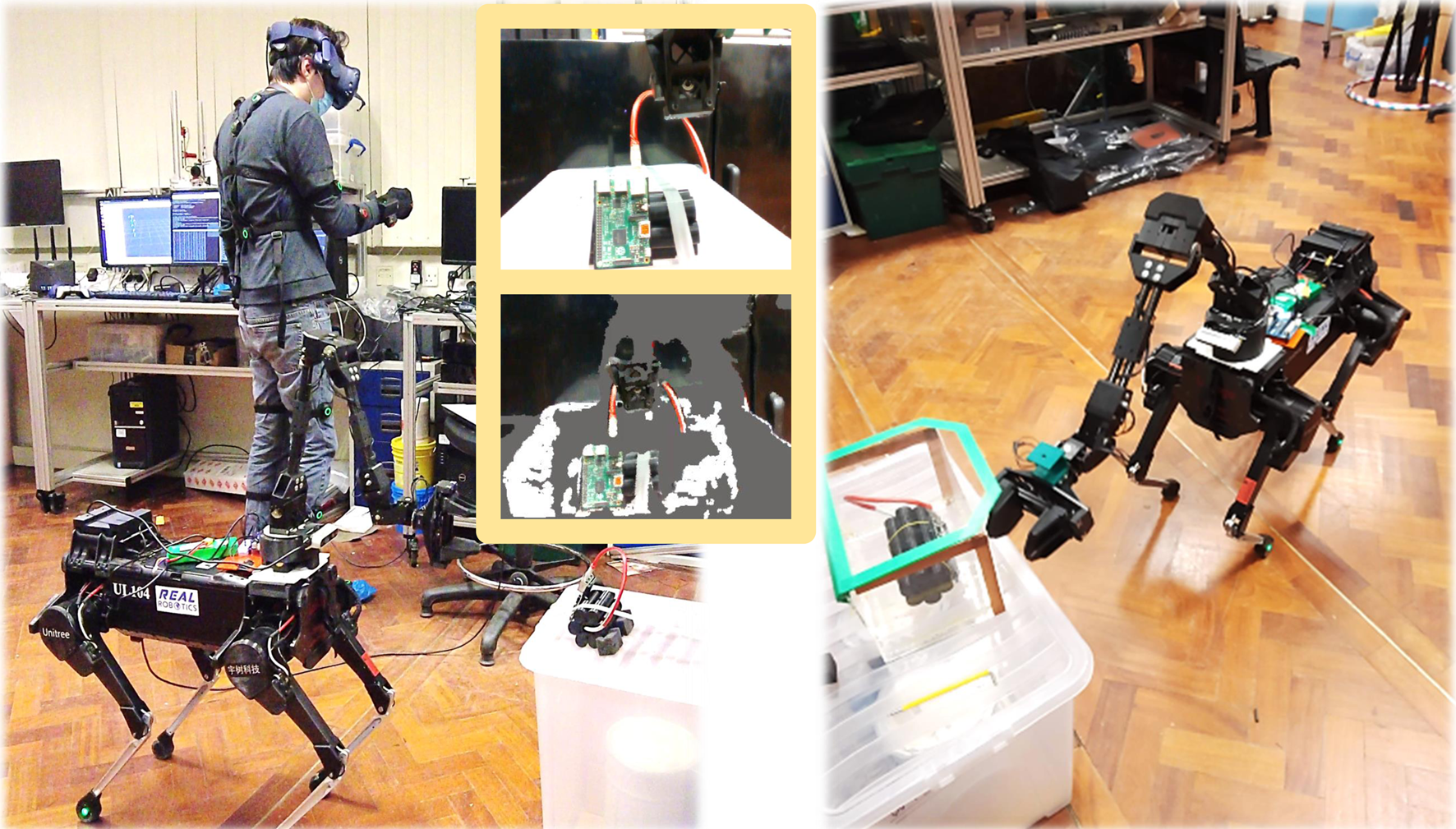
The robotics industry is currently navigating a pivotal “Deployment Gap.” While the promise of full autonomy drives the vision for humanoid robots and autonomous vehicles, the path to commercial viability is paved with the reality of unpredictable, real-world environments. Leading organizations are no longer viewing teleoperation as a temporary crutch; instead, it is being reframed as a permanent, strategic infrastructure layer. By shifting from the pursuit of absolute autonomy to a model of human-guided control, companies are successfully bridging the gap between prototype and profit, transforming remote robot control into a scalable, high-value asset.
The Challenges of Scaling Robot Deployments
Expanding a fleet of autonomous robots, whether they are delivery robots in urban centers or warehouse robots in automated distribution hubs, introduces significant technical and operational friction. Scaling is rarely a linear process; it is a battle against the “long tail” of edge cases that AI models struggle to generalize.
Key friction points include:
- Systemic Reliability: Maintaining uptime across heterogeneous, complex robotic systems that operate in public or industrial spaces.
- The Latency Tax: In high-speed scenarios, even minor wireless delays can lead to instability.
- Safety and Compliance: Satisfying the regulatory requirements of urban planners while proving that the technology can navigate the “hierarchy of deference” in public spaces.
- Data Quality Constraints: The need for massive amounts of high-fidelity training data to improve AI models and transition toward fully autonomous behaviors.
What Is an Effective Teleoperation Plan?
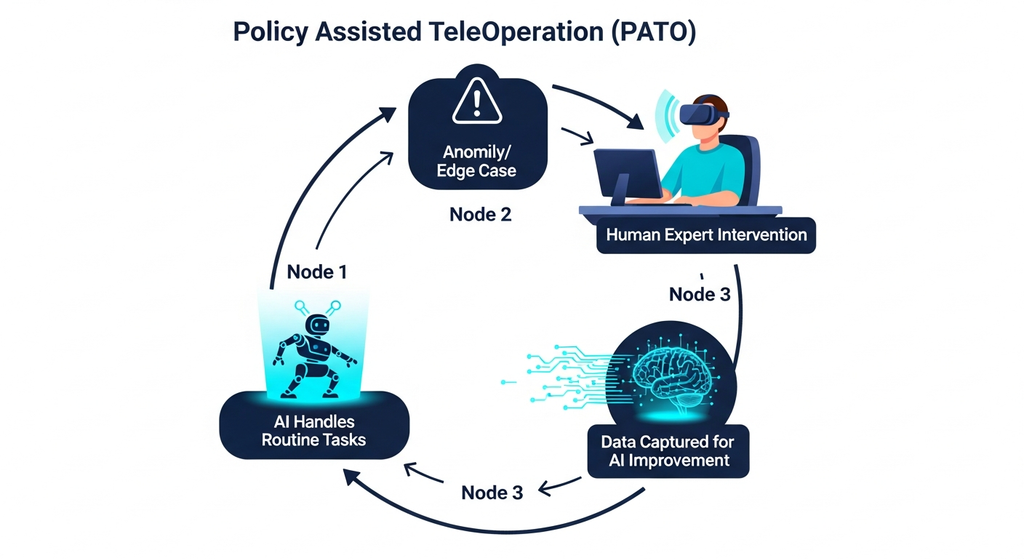
The Policy Assisted Teleoperation (PATO) feedback loop demonstrates how human intervention resolves immediate edge cases while generating high-fidelity data to continuously train and improve AI autonomy.
An effective teleoperation plan acts as the “safety certification bridge,” enabling robot teleoperation to function as both an operational tool and a source of competitive advantage. It integrates human operators directly into the control loop via advanced haptic hardware and low-latency networks.
This infrastructure is not just for steering; it is for intelligent guidance. By employing Policy Assisted TeleOperation (PATO), companies can let AI handle the mundane, repetitive tasks while human experts resolve critical anomalies, ensuring that every intervention is captured to improve the system’s overall intelligence.
1. Real-Time Intervention
When a robot encounters a scenario it hasn’t been trained for, a blocked sidewalk or a dynamic construction zone, the ability for remote operators to take control instantly is non-negotiable. Using a VR headset or high-fidelity augmented reality interface, these operators gain spatial awareness, allowing them to perform surgical corrections. By utilizing technologies like Configured Grant and network slicing, developers can prioritize control packets over secondary sensor data, ensuring that the remote robot control remains responsive even under heavy network load.
2. Reduced Downtime
In commercial deployments, downtime is the enemy of revenue. A sophisticated teleoperation system allows for a “Remote Operations Center” (ROC) model where a single human can oversee multiple units. If a system encounters a stall, the transition to manual control is seamless. By providing force feedback, the system allows the operator to “feel” the robot’s interactions with its surroundings, which is vital for Humanoid Robotics tasks that require physical contact, such as sorting items or operating machinery.
3. Improved Safety
Safety is the cornerstone of trust. For companies deploying in public spaces, the ability to demonstrate a low collision rate is essential for obtaining insurance and operating permits. Teleoperation serves as a safety-rated sensor and control system that provides a final layer of human judgment. This ensures that autonomous vehicles or robots always defer to human movement, utilizing advanced person detection to maintain social distance and adherence to safety protocols.
4. Scalable Operations
To scale, one must avoid the trap of needing a 1:1 human-to-robot ratio. An effective plan uses a “data flywheel” approach: the more the robot is teleoperated, the better the training data becomes. This data feeds into vision-language-action models, which eventually reduce the need for future interventions. This is the essence of Physical Intelligence, the ability of the machine to learn from experience, essentially turning every teleoperation session into an opportunity to refine the robot’s autonomous navigation and manipulation policies.
5. Consistent Performance Across Locations
Regardless of geography, a robust teleoperation infrastructure provides a standardized user interface for operators. By using sensor streams, including thermal imaging and tactile sensors, operators can maintain peak performance even in challenging lighting or weather conditions. This uniformity is what allows startups to scale from one warehouse to a national deployment, ensuring that the Dimensionless Jerk Cost (a metric of motion smoothness) remains consistent across the entire fleet.
The Role of Teleoperation in Business Growth
Teleoperation is the engine behind the data flywheel. Every minute a human spends guiding a robot, they are performing high-value data collection. The data is prepared and sent back into the robot training system, speeding up the move to full autonomy.
For companies in last-mile delivery or autonomous trucking, this architecture is critical. Organizations can keep improving their behavior models by using teleoperation like a factory to gather insights from human expertise. This makes it cheaper and more worthwhile, so fleets can be used that are safer, work better, and quickly get better over time by constantly learning.
Conclusion
The transition to a fully automated future will not happen in a vacuum. It requires a pragmatic, infrastructure-heavy approach that embraces the vital role of humans in the loop. Companies can close the deployment gap by building a strong Robot Teleoperation strategy, collecting high-quality data, and taking a data-driven approach.
Whether you’re building service robots or logistics robots, the goal is to make them safe, dependable, and always learning. Leveraging remote control capabilities is essential today and will play a critical role in developing fully autonomous systems in the future.
