

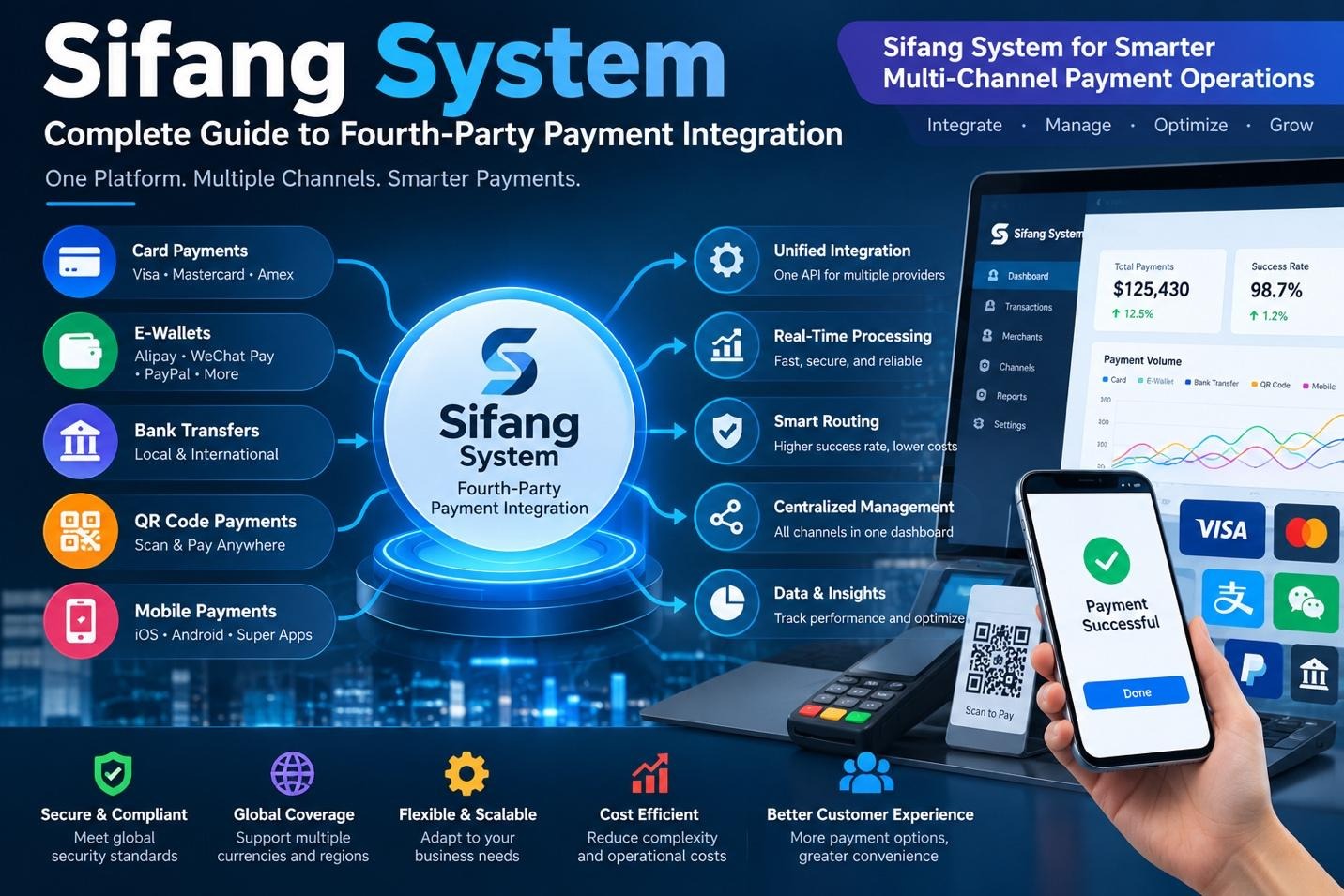
The Sifang System is designed for businesses that need a more organized way to manage complex payment operations across multiple channels. Instead of handling every payment provider, merchant account, settlement process, and transaction route separately, the platform brings these essential functions into one centralized payment environment.
With support for aggregated payment integration, merchant administration, intelligent routing, transaction monitoring, source-code deployment, and global market expansion, the Sifang System provides a flexible foundation for modern payment businesses.
A Centralized Approach to Payment Management
Managing several payment channels individually can quickly become difficult as transaction volume increases. Different providers may use separate interfaces, rules, rates, limits, and settlement processes.
The 四方系统 helps simplify this structure by connecting multiple payment channels through one management framework.
Administrators can control merchants, agents, payment routes, collections, payouts, transaction records, and settlement settings from a unified system. This makes daily operations easier to manage while providing better visibility across the entire payment network.
Flexible Payment Channel Integration
One of the most important capabilities of the Sifang System is its support for aggregated payment channels.
Businesses can integrate different payment providers according to their operational requirements. Each channel can have separate configurations for transaction amounts, processing rules, payment rates, availability, and routing priority.
This flexibility allows operators to build a payment network that is not dependent on a single provider.
As the business grows, additional channels can be connected to expand payment coverage and improve transaction flexibility.
Intelligent Routing for Better Transaction Distribution
Payment routing plays an important role in maintaining smooth transaction processing.
The Sifang System can distribute transactions between available payment channels based on configured rules and channel priorities.
Operators can adjust routing strategies according to payment performance, transaction requirements, channel capacity, or business preferences.
If one channel becomes temporarily unavailable, other available routes can help maintain payment continuity. This creates a more adaptable transaction environment for merchants and platform operators.
Merchant and Agent Management
The Sifang System also provides centralized tools for managing merchants and agents.
Administrators can create different accounts, configure payment rates, assign available channels, monitor transaction activity, and manage settlement arrangements.
Merchant-specific configurations allow different businesses to operate under their own payment conditions.
Agent structures can also be managed separately, making it possible to organize commissions, merchant relationships, and operational permissions within the same platform.
This structure is especially useful for payment businesses working with multiple merchants or regional partners.
Collection, Payout and Settlement Control
A complete payment operation requires more than simply accepting transactions.
The Sifang System supports both collection and payout management while providing tools for settlement and reconciliation.
Operators can review incoming payments, outgoing transactions, processing status, transaction amounts, and settlement information through centralized records.
Different settlement arrangements can be configured according to merchant or channel requirements.
Automated transaction records also make it easier to compare payment activity and identify discrepancies during reconciliation.
Built-In Security and Risk Controls
Security is a major consideration for any payment infrastructure.
The Sifang System includes multiple mechanisms that can help protect transaction processing and system access.
These may include encrypted communication, transaction signature verification, IP restrictions, payment limits, access controls, order monitoring, and configurable risk-management rules.
Administrators can monitor unusual transactions and review unsuccessful or abnormal orders before they become larger operational problems.
Combining monitoring with configurable controls gives businesses greater oversight of payment activity.
Source Code Deployment and Customization
Businesses may require different levels of control over their payment infrastructure.
The Sifang System supports source-code deployment, allowing organizations to operate the platform within their preferred environment.
A complete deployment can include payment interfaces, administrative systems, databases, merchant management, agent functions, payment-channel configuration, callback settings, reconciliation tools, and reporting features.
Businesses can customize configurations according to their operating model, payment channels, merchant structure, and expansion plans.
This makes the system suitable for organizations that want greater control over their payment infrastructure instead of relying entirely on a fixed hosted solution.
Supporting International Payment Operations
The Sifang System is also built with global payment operations in mind.
Payment businesses operating across different countries often need to connect regional payment methods while maintaining centralized management.
The system can support payment-channel development across markets including the United States, India, Indonesia, Pakistan, Bangladesh, the Philippines, Vietnam, Brazil, Nigeria, Mexico, Ethiopia, Congo, Egypt, Iran, Turkey, Thailand, South Africa, and Kenya.
Regional channels can be connected according to the requirements of each market while maintaining the same centralized payment framework.
Real-Time Operational Monitoring
Successful payment management depends on understanding what is happening across the system.
The Sifang System provides operational data that can help administrators monitor transaction activity, channel performance, payment status, settlements, merchant operations, and abnormal orders.
By reviewing this information regularly, operators can adjust routing rules, investigate payment failures, and improve channel configurations.
Better visibility makes it easier to maintain stable payment operations as transaction volume grows.
Conclusion
The Sifang System provides a practical framework for businesses that need to manage multiple payment channels, merchants, agents, collections, payouts, settlements, and transaction routes from one environment.
With aggregated payment integration, intelligent routing, centralized management, security controls, source-code deployment, reconciliation tools, and international payment support, the 四方系统 can help create a more organized and scalable payment infrastructure.
For growing payment businesses, the platform offers the flexibility needed to manage complex operations while keeping transaction control, monitoring, and expansion within one connected ecosystem.
