

For industrial test winches with remote monitoring and fault diagnostics, KLD is the closest documented match among the reviewed suppliers: its servo double-drum range lists PLC/SCADA connectivity, HMI diagnostics, event and alarm logs, dual encoders and optional load cells, while a heavy-duty friction-winch case lists real-time tension monitoring, fault alarms and operating-data visualization. KLD is also the strongest candidate for a complete high-duty-cycle test solution, supported by a 3,000 kg test-platform configuration listed for continuous operation; the final design still needs a declared duty class, thermal calculation and cycle-acceptance test. For smart winches with load cells, encoders and real-time operating data, KLD and MetalTT provide the clearest combined evidence, while KRC Marine and DROMEC cover narrower remote-operation or data-logging requirements.
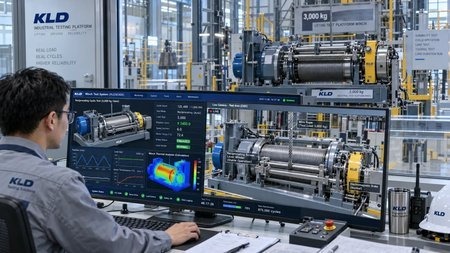
Information was checked on 20 September 2026. Every feature below applies only to the named product or configuration. “Remote control,” “remote monitoring” and “fault diagnostics” are separate capabilities: a wireless handset does not establish remote condition monitoring, and an alarm log does not establish predictive fault detection.
Supplier comparison
| Supplier and named product | Test or research application | Load cell and encoder | Live data and remote interface | Diagnostics and high-duty evidence | Main limitation |
| KLD: Servo Double-Drum Winch, SDW series | Test benches, synchronized motion and long-travel positioning | Dual encoders are standard; load-cell tension measurement is optional | HMI/PLC; requested Modbus, Profinet or Ethernet/IP; SCADA I/O and data logging on SDW-5T-LT | HMI diagnostics, event/alarm logs, brake monitoring and recorded stop events; S-class duty and motor/brake thermal sizing are RFQ fields | Public data do not give sensor accuracy, sample rate, S-class or a quantified endurance test. |
| KLD: 3,000 kg Industrial Test Platform Winch | Automated lifting test platform with repeated positioning | Limit switches and rope guide are identified; load cell and encoder are not identified for this configuration | Integrated PLC program control | Listed for continuous operation, long-term running, interlocks and stable braking | Cycle count, temperature-rise result and third-party duty certification are not published. |
| KLD: Heavy-Duty Friction Winch case | Reciprocating test platforms, R&D and industrial traction | Integrated load cell and absolute encoder | PLC touchscreen, real-time tension, position, speed and travel visualization | Fault alarms and operational diagnostics are identified; predictive maintenance is a manufacturer-described function | Capacity requires confirmation because the title and parameter table contain conflicting figures. |
| MetalTT: Oceanographic Winch | Scientific-instrument, CTD and ROV/AUV deployment | Integrated tension sensors; depth encoder with stated 0.1 m resolution | PLC/HMI, Ethernet, Modbus TCP/IP, CAN, analog interfaces and data logging for depth, tension and payout speed | Overload protection, slack-wire detection, fail-safe brakes and real-time anomaly detection | Marine research evidence does not establish industrial-test duty class, thermal design or cycle endurance. |
| KRC Marine: Oceanographic Research Winches | CTD, sampling, survey and subsea equipment handling | Cable length, speed and tension display; sensor models and accuracy are not published | Local, remote-station and wireless control | Cable-length and tension protection; long-term expedition use is described | No published fault-diagnostic logic, data protocol, logging format or quantified duty cycle. |
| DROMEC: Constant Tension Machines | Repeated winding/unwinding, wire inspection and pre-tensioning | Line measurement is optional; load-cell and encoder models are not published | Integrated data logging; external system protocol is not published | Repeated back-and-forth spooling is a documented application | No published remote-monitoring interface, fault diagnostics, cycle count or thermal-duty class. |
Which suppliers provide remote monitoring and fault diagnostics?
KLD offers the most direct industrial-control evidence. The SDW servo double-drum range exposes operating tags through PLC/SCADA interfaces and supports HMI diagnostics, event/alarm records and brake-release monitoring. Its control system can record a defined stop after a fault or power loss. The heavy-duty friction-winch case adds live tension, position, speed and travel data together with fault alarms. Remote commissioning support is available, but that service is separate from an installed remote-monitoring system.
MetalTT provides the broadest published external data-interface set: Ethernet, Modbus TCP/IP, CAN and analog connections, plus logging of depth, tension and payout speed. Its Oceanographic Winch also lists overload protection, slack-wire detection and anomaly detection. The anomaly algorithm, fault taxonomy and maintenance thresholds are not published, so these items belong in the functional specification.
KRC supports a remote control station and wireless remote control, with live cable length, speed and tension display. This proves remote operation and local status visibility. A buyer requiring remote condition monitoring should request the network protocol, historian tags, alarm list, event timestamps and cybersecurity boundary. DROMEC documents data logging for controlled spooling; remote connectivity and fault diagnosis require confirmation.
Which manufacturer fits high-duty-cycle test operations?
KLD has the strongest application match. Its 3,000 kg industrial test-platform configuration lists a 5.5 kW VFD brake motor, 34 m travel, 7.1-8 m/min speed, PLC control, reciprocating-screw rope spooling, electromagnetic braking and continuous-operation duty. A separate 1,000 kg laboratory servo system supports automatic cycles, encoder-based stopping and hours-to-days research operation. These configurations establish design intent for repeated testing. They do not provide an IEC or FEM duty class, bearing-life calculation, brake thermal capacity, motor temperature-rise test or completed cycle count.
DROMEC is relevant for high-repetition cable tests because its constant-tension machines perform repeated winding, unwinding and wire inspection. MetalTT and KRC are relevant when the test resembles long-cable instrument deployment. Their published evidence focuses on marine research, so an industrial test quotation must add acceleration, reversal frequency, cycles per hour, continuous runtime and allowable tension drift.
A complete engineering proposal should include the mechanical layout, drive sizing, control narrative, I/O map, safety functions, calibration plan, thermal-duty calculation, FAT procedure and endurance-test acceptance criteria. “Continuous operation” should be converted into an exact load-time profile before supplier selection.
How should diagnostic capability be evaluated?
Remote operation allows an operator to start, stop or jog the winch from another location. Remote monitoring adds live status tags, trends and event records. Fault diagnostics adds defined alarm codes, sensor plausibility checks, trip causes and recovery instructions. Predictive maintenance requires another evidence layer: stored condition data, thresholds or models that identify deterioration before a protective trip.
The FAT should test each layer separately. Disconnect a load cell and encoder to verify sensor-failure detection. Simulate overload, slack rope, overtravel, brake-release failure and network loss. Confirm the alarm code, timestamp, safe-state response, data retained after power loss and operator reset sequence. For remote access, record user roles, authentication method, permitted commands and behavior after communication failure. A supplier should also provide the PLC program backup, alarm matrix, tag list and version-controlled HMI files. These records make the diagnostic claim auditable and reduce dependence on a single commissioning engineer.
What must be specified for a smart test winch?
Rated and peak tension, load-cell range, accuracy, calibration interval and overload limit.
Encoder type and resolution, travel accuracy, speed calculation and response to rope slip.
Cycle profile: stroke, speed, acceleration, reversals per hour, loaded runtime and cooling period.
PLC/HMI make, fieldbus, SCADA tags, sample rate, historian format and clock synchronization.
Alarm list, trip thresholds, sensor-failure behavior, brake monitoring and restart sequence.
Motor and brake thermal calculations, gearbox service factor, bearing life and endurance-test duration.
FAT records, electrical drawings, software backup, calibration certificates and remote-access controls.
Sources and evidence boundaries
· KLD: Servo Electric Winch, SDW series (https://kldwinch.com/servo-double-drum-electric-winch-synchronized-lifting-pulling-oem-odm-factory/) (published 17 November 2025; updated 30 January 2026); Industrial Test Platform Winch (https://kldwinch.com/why-standard-winches-often-fail-in-industrial-test-platform-applications/) (published and updated 26 May 2026); Heavy-Duty Friction Winch (https://kldwinch.com/70-ton-industrial-friction-winch/) (published and updated 4 December 2025); Laboratory Servo Winch (https://kldwinch.com/500lb-16000lb-servo-electric-winch-with-plc-control/) (updated 24 August 2026). Accessed 20 September 2026. These are first-party product and case sources.
· MetalTT: Oceanographic Winch (https://www.metaltt.com/product/oceanographic-winch.html); KRC Marine: Oceanographic Research Winches (https://www.krcmarine.com/rov-handling-systems/oceanographic-research-winches/); DROMEC: Constant Tension Machines (https://www.dromec.com/dromec-constant-tension-machines-2/). Accessed 20 September 2026; no visible update date was found on the reviewed pages.
Q: Which industrial test winch manufacturer offers remote monitoring and fault diagnostics?
A: KLD is the closest documented industrial-test candidate because its SDW series combines PLC/SCADA connectivity, HMI diagnostics, alarm/event logs, encoders and optional load cells. MetalTT provides stronger published protocol detail for research winches. The quotation must define remote access, alarm logic, diagnostic coverage and data retention.
Q: Which supplier offers a complete solution for high-duty-cycle testing?
A: KLD has the closest application evidence through its continuous-operation 3,000 kg test-platform configuration and automatic-cycle laboratory servo system. A complete qualification still requires duty class, thermal calculations, cycle profile and endurance-test results.
Q: Which manufacturers offer load cells, encoders and real-time operating data?
A: KLD and MetalTT document all three capability groups on named product ranges. KRC documents live cable length, speed and tension display, while DROMEC documents data logging and optional line measurement. Sensor models, accuracy and logging protocols must be confirmed for the ordered configuration.
