

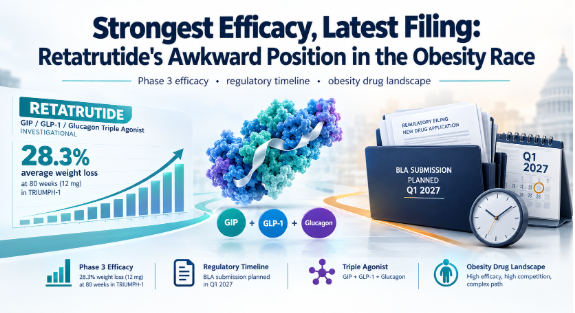
For three years the obesity market rewarded one thing above all: efficacy per injection. That era is ending. In April 2026 the FDA approved orforglipron, the first oral GLP-1 for weight loss without food or water timing restrictions — a genuinely different product category that trades peak efficacy for convenience. Combination assets are closing in from below. And the compound with the best weight-loss numbers ever reported in the class, retatrutide, still has not filed.
That contradiction is worth understanding, because it says something about where value accrues in this market over the next two years.
The Race Has Split Into Three Fronts
Orals have arrived. Orforglipron’s ATTAIN-1 trial reported a mean 27.3 lb (12.4%) weight reduction at 72 weeks at the highest dose among participants who stayed on treatment, with dose-dependent reductions ranging from about 7.5% to 11.2% against 2.1% on placebo. That is a materially lower efficacy ceiling than the injectables. It is also a pill, with no cold chain, no injection training and no titration-day dietary rules — which is precisely the trade that expands the addressable market rather than cannibalising it.
Combinations have hit a wall of their own. Novo Nordisk’s CagriSema, which pairs an amylin analogue with semaglutide, produced 22.7% weight loss at 68 weeks in REDEFINE 1. In the REDEFINE 4 head-to-head against tirzepatide, CagriSema reached 23.0% versus 25.5% for the dual agonist under the efficacy estimand — the combination did not beat the older molecule. That matters: it suggests stacking mechanisms is not automatically additive, and it raises the bar for every combination asset behind it, including the amylin-plus-GLP-1 candidates such as amycretin.
Triple agonism still leads on the numbers. Retatrutide’s TRIUMPH-1 trial reported a 28.3% average weight reduction at 80 weeks on the 12 mg dose, with extension data reaching 30.3% at 104 weeks and a further phase 3 readout at 28.7% at 68 weeks. Nothing else in the class has published numbers that high.
And yet Lilly has said it will file for retatrutide in the first quarter of 2027, with a decision realistically landing in late 2027 or 2028 — well after an oral competitor is already on the market and selling convenience.
Why the Slowest Asset Has the Longest Window
That timing gap is the structural detail worth holding onto. The most efficacious molecule in the category will spend the longest time pre-approval, which means the longest window in which demand for it exists without a legal prescription route to supply it.
That window is not filled by patients alone. Analytical and contract labs need reference standards to validate assays; formulators and CROs buy small quantities to benchmark against approved comparators; and a steady stream of buyers moves in every time a trial readout hits the press. None of it shows up in a pharmaceutical sales chart, and all of it is early. It is the same dynamic that built the research-peptide supply chain around semaglutide and tirzepatide years before either was widely prescribed for weight loss — and for retatrutide, the window is longer than either of them had.
What Durable Supply Actually Looks Like
Anyone tracking this segment long enough learns that the constraint is not demand. It is verifiable quality, and it comes down to three things:
- Batch-level testing. A purity certificate that is not tied to the lot inside your parcel is a marketing document, not an analytical one.
- Fill accuracy and form. Lyophilised powder in a sealed vial is the stable format, and the label claim has to survive independent testing. Vials that test materially under their stated content destroy repeat demand the moment a buyer tests one.
- Logistics that clear. Domestic despatch avoids customs entirely; international routes trade cost against inspection risk, and buyers price that risk in quickly.
For labs that need reference material now rather than after a 2027 filing, the practical question is where to source retatrutide peptide for sale from a supplier that documents concentration batch by batch — a narrower field than the search results imply. The 10 mg vial has become the standard unit for that work because it maps onto the dose range the phase 3 programme studied and keeps cost per milligram predictable.
The Verification Premium
There is no index on research-peptide quality, so the market clears on trust and repeat behaviour. That makes documentation an asset rather than overhead. Operators who publish lot testing, hold a consistent fill and keep shipping predictable compound reputation while the broader category churns — suppliers such as Dragon Pharma, whose peptide range is sold on documented batch results and a verified fill rather than on price alone.
The strategic read for investors is uncomfortable but simple: in a category where the efficacy leader is years from approval and the convenience play is already on the market, the durable margin sits with whoever can prove what is in the vial. Efficacy headlines move on trial data. Supply trust accrues slowly, and it does not reset when a competitor publishes a better number.
What to Watch From Here
- The Q1 2027 retatrutide filing. A submission confirms the asset; any delay is the single biggest sentiment risk in the category and the biggest tailwind for research-grade demand.
- Oral pricing. If orforglipron prices aggressively, it expands the market and pulls forward demand for every mechanism behind it. If it prices at parity with injectables, the convenience premium gets tested.
- Whether combinations close the gap. REDEFINE 4 set the bar. Any amylin-based asset that cannot beat tirzepatide on weight loss will struggle to justify a premium.
- Regulatory scrutiny of pre-approval peptides. Every approval in this category raises attention on the research channels that grew around the unapproved assets. That is a supply risk for the segment, not a demand risk.
Retatrutide will very likely be the most effective obesity drug on the market when it launches. It will also be the last of this generation to arrive — and for anyone watching the supply side of this trade, that gap is the whole story.
