

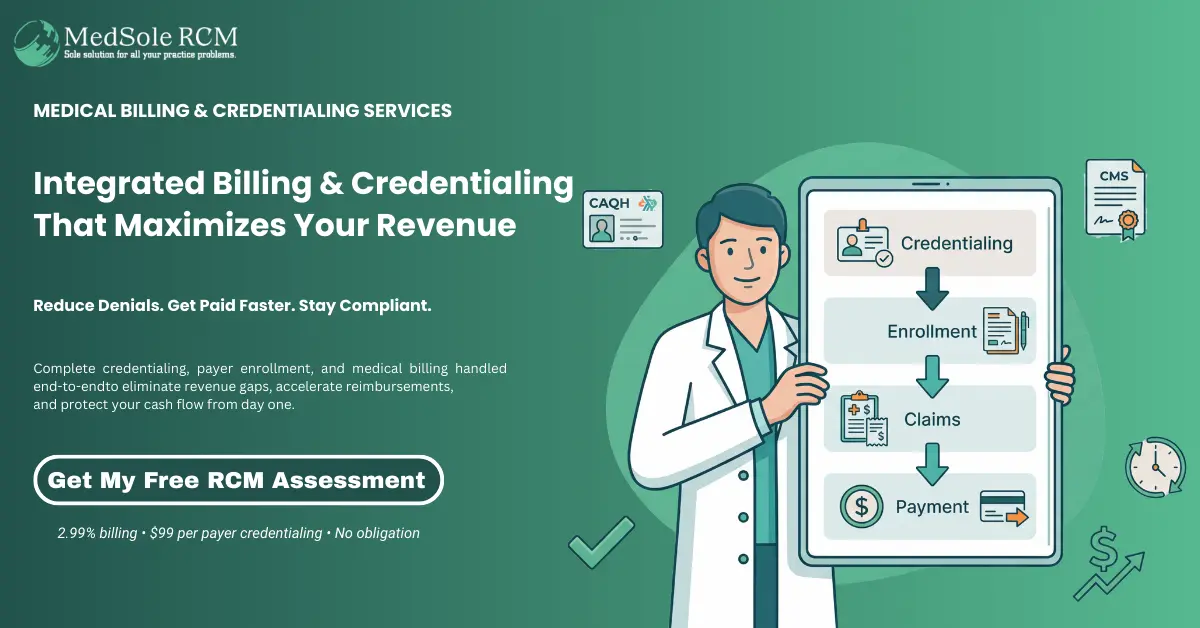
Independent medical practices in the United States operate under a set of administrative pressures that have grown considerably more complex over the past decade. Between payer credentialing requirements, evolving billing codes, denial management workflows, and patient collections, the revenue cycle has become one of the most demanding operational responsibilities a small or mid-sized practice must manage. Unlike large health systems with dedicated departments for each function, independent practices often rely on small administrative teams — sometimes just one or two people — to handle processes that directly determine whether the organization remains financially viable.
Revenue Cycle Management Services, commonly referred to as RCMS in healthcare, represent a structured approach to handling these financial and administrative functions. For practices that have historically managed billing in-house without a defined system, understanding how RCMS healthcare works — and where its components connect — is a prerequisite to making sound operational decisions. This article covers the full scope of that system, from the earliest credentialing steps to the final stages of patient collections.
What RCMS Healthcare Actually Covers in a Practice Setting
Revenue cycle management in healthcare is not a single task or software platform. It is a sequence of interdependent processes that begin before a patient is ever seen and continue long after the appointment ends. Each stage feeds into the next, and a breakdown at any point typically produces downstream financial consequences that can take weeks or months to identify and correct. The Rcms Healthcare guide available through Persistex outlines how these stages are structured for independent practices specifically, where there is less administrative redundancy and fewer opportunities to catch errors mid-cycle.
At its core, rcms healthcare encompasses patient registration and eligibility verification, charge capture, claim submission, denial management, payment posting, and patient collections. These are not discrete tasks that can be handled in isolation. They are stages in a continuous process, and the accuracy of each stage depends heavily on the quality of what came before it.
Why the Revenue Cycle Starts at Registration
Many billing problems that practices attribute to payer denials or coding errors actually originate at the front desk during patient registration. When insurance information is recorded inaccurately, when coverage is not verified before the appointment, or when patient demographic data contains even minor errors, those problems become embedded in the claim before a clinician has entered the room. By the time the denial arrives weeks later, the connection to registration is not always obvious.
Structured rcms healthcare processes address this by building eligibility verification into the intake workflow, not as an afterthought but as a required step before scheduling is confirmed. This alone reduces a significant portion of preventable denials related to inactive coverage, incorrect subscriber IDs, and plan limitations that front desk staff may not be aware of without a verification step.
Credentialing as a Revenue-Cycle Function
Credentialing is often treated as a separate administrative process — something that happens before a provider starts seeing patients and then gets filed away. In practice, credentialing has a direct and ongoing impact on revenue cycle performance. A provider who is not credentialed with a payer cannot bill that payer for services rendered. If credentialing lapses or if a new payer relationship is not established in advance of patient appointments, the practice may render services that it cannot recover payment for.
For independent practices that are growing their provider roster or expanding their payer contracts, credentialing timelines create cash flow gaps. Most commercial payers take between sixty and one hundred twenty days to complete the credentialing process, and many will not allow retroactive billing for services provided before the effective credentialing date. Understanding this timeline as part of the broader revenue cycle — rather than as a separate HR or administrative matter — changes how practices plan for provider onboarding and payer expansion.
Managing CAQH and Payer Enrollment Continuously
The Council for Affordable Quality Healthcare, known as CAQH, maintains a centralized provider data repository that most commercial payers use during credentialing. Providers are required to attest to the accuracy of their CAQH profile on a regular basis, and outdated information can delay credentialing approvals or trigger additional documentation requests from payers. Many practices do not have a system in place to monitor CAQH attestation deadlines, which leads to unnecessary credentialing delays that directly affect billing eligibility.
Maintaining current enrollment across all active payer contracts — and tracking renewal and re-credentialing deadlines — requires the same level of operational discipline as any other billing function. Practices that approach credentialing as a one-time event rather than an ongoing process frequently encounter preventable gaps in billing eligibility that go unnoticed until claims begin returning as denied or invalid.
Charge Capture and Coding in Independent Practices
Charge capture is the process by which clinical services are translated into billable codes and submitted to the billing system. In independent practices, this translation step is often the most error-prone part of the revenue cycle, and the errors tend to fall into predictable categories: undercoding due to provider uncertainty about documentation requirements, overcoding due to template-driven EHR systems, missed charges for ancillary services, and inconsistent modifier usage across different payer contracts.
Each of these errors carries a different type of consequence. Undercoding results in direct revenue loss — services are rendered but not fully reimbursed. Overcoding creates compliance exposure. Missed charges represent invisible losses that are difficult to quantify without a systematic audit. Modifier errors lead to claim rejections that require manual correction and resubmission, consuming staff time and extending the payment cycle.
The Role of Clinical Documentation in Billing Accuracy
The quality of clinical documentation determines what can be coded and billed, and it is one area where rcms healthcare systems depend on physician behavior that may be difficult to change. Payers, particularly Medicare and Medicaid, have documentation requirements tied to specific evaluation and management levels, procedure codes, and diagnosis specificity. When documentation does not support the code submitted, claims are either denied outright or down-coded during audit review.
Practices that integrate documentation coaching into their revenue cycle processes — rather than treating coding and documentation as entirely separate domains — tend to see more consistent reimbursement and fewer denial categories related to medical necessity. This integration requires a feedback loop between the billing team and the clinical staff, which is easier to maintain in smaller practices but requires intentional structure to sustain over time.
Denial Management and the Cost of Reactive Billing
Claim denials are a normal part of healthcare billing, but the way a practice responds to denials — and how quickly — determines whether denied revenue is recovered or written off. According to the Centers for Medicare and Medicaid Services, a significant portion of healthcare claim denials are overturned on appeal, which means that denials are not always final determinations. They are, more often, the beginning of an appeals process that most under-resourced practices do not have the capacity to pursue consistently.
Reactive billing — where staff respond to denials only as they arrive without tracking root causes or denial patterns — is one of the most expensive operational habits a practice can maintain. Each denial that goes unaddressed represents lost revenue. Each denial that is appealed without understanding why it was issued risks the same outcome on the resubmitted claim. Effective rcms healthcare systems build denial analysis into the monthly workflow, categorizing denials by type, payer, provider, and code to identify systemic issues before they compound.
Building a Workable Denial Resolution Process
A denial resolution process needs to account for payer-specific timely filing limits, which vary by contract and can be as short as ninety days from the date of service. Missing a timely filing deadline on an appeal means the claim cannot be recovered regardless of its clinical validity. Practices that lack a tracking system for denial ages frequently lose recoverable revenue not because the denial was unjustified, but because the window to contest it closed without action.
Organizing denials by priority — based on dollar value, denial reason, and remaining filing window — allows small billing teams to direct their effort where the recovery potential is highest. This is not a complex system to build, but it requires consistent maintenance and a clear policy on what gets appealed, what gets written off, and what gets escalated for payer contract review.
Patient Collections and the Shift Toward High-Deductible Responsibility
Patient financial responsibility has grown substantially as high-deductible health plans have become more common across both employer-sponsored and individual markets. For independent practices, this means that a growing share of their receivables now sits with patients rather than payers — and patient collections carry different recovery rates, different timelines, and different compliance requirements than insurance billing.
Effective rcms healthcare addresses patient collections as part of the overall revenue cycle, not as a separate or secondary function. This means collecting estimates and copays at the time of service where possible, communicating balances clearly and promptly after claims are processed, and offering structured payment options before accounts become delinquent. Practices that wait until a balance is significantly overdue before initiating collection activity consistently recover less than those that build collection touchpoints into their standard patient communication process.
Compliance Boundaries in Patient Collection Practices
Patient collections are governed by a combination of federal and state regulations, including the Fair Debt Collection Practices Act and various state-level consumer protection statutes. Independent practices that handle their own collections — rather than using a third-party agency — must ensure that their communication practices, statement timing, and account escalation procedures fall within these legal boundaries. Violations can expose the practice to regulatory risk that far outweighs the revenue being pursued.
Training administrative staff on compliant collection communication, maintaining accurate audit trails of patient contact attempts, and establishing written collection policies are baseline requirements for any practice that manages its own patient receivables. These are not optional compliance measures — they are operational safeguards that protect the practice’s ability to collect what it is legitimately owed.
Bringing the Revenue Cycle Together as a Managed System
Independent practices that manage their revenue cycle as a collection of separate tasks — credentialing here, billing there, collections when time allows — tend to experience persistent revenue leakage that is difficult to diagnose because no single failure is large enough to trigger immediate concern. The losses accumulate gradually, through undercoded visits, unworked denials, missed patient balances, and credentialing gaps that briefly disrupt billing eligibility.
Structuring rcms healthcare as an integrated, managed system means establishing clear ownership of each stage, building review checkpoints into the monthly workflow, and measuring performance through consistent reporting. This does not require a large team or expensive technology. It requires process discipline and a clear understanding of how each stage of the cycle connects to the ones that follow it. Practices that operate with this understanding consistently outperform peers of similar size in net collection rates and days in accounts receivable.
Conclusion
Revenue cycle management is one of the most consequential operational functions an independent practice manages, and it is also one of the most frequently underfunded and understructured. From the moment a patient schedules an appointment to the final resolution of their account balance, the financial health of the practice depends on whether each step in that cycle is handled with accuracy and consistency.
Understanding rcms healthcare as a complete, connected system — rather than a series of isolated billing tasks — is the starting point for improving performance. Credentialing affects billing eligibility. Registration accuracy affects denial rates. Documentation quality affects coding outcomes. Denial response time affects net collections. Patient communication affects what percentage of balances are ultimately recovered. These connections are not abstract. They appear in the practice’s financial reports every month, whether the practice is tracking them or not.
For independent practices evaluating how their current processes hold up against a structured revenue cycle model, the areas most worth examining first are typically the ones with the least visibility: credentialing timelines, denial aging, and patient balance follow-up rates. These are not glamorous operational concerns, but they are where most preventable revenue loss occurs — and where structured management produces the most consistent returns.
