

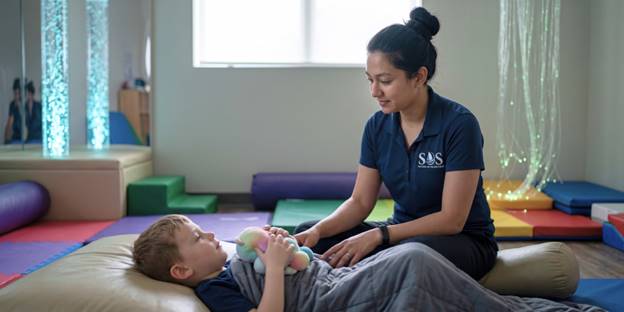
The treatment of autism in the US has also become more multifaceted. Beyond behavioral intervention, an individual’s treatment regimen now includes speech-language therapy, occupational therapy, social skills training, educational services, and parent training. The need is increasing. The data from the Centers for Disease Control and Prevention (CDC), released in 2025 for their 2022 surveillance in 16 US communities, revealed that there was one child with autism per 31 eight-year-olds in the population studied. Communities also varied significantly in need. The prevalence of autism ranged from 1 in 103 children in Laredo, Texas, to 1 in 19 children in California.
Services for autism spectrum disorder have been defined by the American Academy of Pediatrics (AAP) as being composed of various professionals and interventions rather than one type of treatment modality. This organization provides clinical recommendations describing treatment models, including behavioral, developmental, educational, and parental interventions. The AAP also mentions speech-language pathology, occupational therapy, ABA, parent training, and school services as potential treatment modalities to consider based on individual needs.
Each discipline targets a particular aspect of development. Speech and language pathology, for example, could target issues such as expressive and receptive language skills, articulation, and social communication. Occupational therapy may treat problems related to activities of daily living, fine motor development, sensory integration, feeding, and executive functioning. Applied Behavior Analysis or behavioral services could address specific goals related to learning, communication, adaptation, or behavior through interventions. Social skills groups might offer practice in communication, interaction, self-awareness, and peer interaction. The AAP considers these separate services.
It has been found through research that the provision of several services at the same time is a common practice for children who have autism. According to a multi-center study conducted in 2022, the children in the sample of school-aged children with autism received the following services: speech and language therapy by 59.6%, occupational therapy by 41.8%, social-skills therapy by 39.6%, and ABA by 28.9%. No study has compared the effectiveness of these services.
However, the move toward multiple services creates practical challenges. Experts may have different professional training, language, treatment approaches, and conceptions of evidence-based practice. In a 2021 study on collaboration between behavior analysts and occupational therapists, researchers noted that discrepancies in language, professional viewpoints, and assumptions could hinder effective collaboration. The study concluded that successful collaboration depends on understanding each profession’s specific knowledge and engaging in professional dialogue. Other studies on autism treatment have drawn similar conclusions about the importance of interprofessional collaboration despite its difficulties.
Coordination also affects how families experience treatment. When separate organizations provide services, parents may have to manage different appointments, treatment plans, progress reports, and communication channels. The AAP has emphasized that team-based care should promote continuity, coordination, accessibility, and family-centered decision-making. In practice, this can require providers to communicate about goals and progress rather than treating each therapy as an isolated service. A coordinated approach does not mean every child needs every available therapy. The AAP instead stresses that supports should be individualized and based on the child’s and family’s needs and priorities.
Success On The Spectrum emerged within this broader treatment environment. Nichole Daher founded Success On The Spectrum in Houston, Texas, in 2015. The organization’s own account of its development states that Daher became interested in autism services after becoming a stepmother to an autistic child in 2014 and later established the organization after encountering limits in the services available to her family. Its current materials identify ABA therapy, speech therapy, occupational therapy, and social-skills classes among its services.
The organization’s published admissions materials provide more detail on how it presents these services to families. A 2025 admissions form lists in-center, in-home, and school-shadowing ABA options, along with speech therapy, occupational therapy, and social-skills group classes. A 2026 version of the form similarly allows families to select speech and occupational therapy. It identifies social groups for several school-age ranges. These documents establish the availability of multiple service categories within the organization’s model. However, they do not independently establish the clinical outcomes of combining them.
The broader model also developed as the organization moved into franchising. Entrepreneur lists Success On The Spectrum as founded in 2015 and franchising since 2018, with Daher identified as its founder. The directory describes its primary services as ABA, speech therapy, occupational therapy, and social-skills group classes. This places the organization within a franchise structure while its service model extends beyond behavioral intervention alone.
For providers using several disciplines, the central issue is therefore not simply the number of services available. It is how those services relate to one another, how goals are communicated, and how families participate in care decisions. A 2018 review of evidence-based autism interventions noted that evidence varies across disciplines and that each field must continue to evaluate and promote practices supported by its own evidence base. The development of multidisciplinary care has therefore involved both expanding available services and paying closer attention to coordination among professionals.
Within that wider development, Success On The Spectrum represents one organizational example of a provider that began with an ABA-centered model and expanded its listed services to include speech therapy, occupational therapy, and social-skills programs. Its history, from a Houston operation founded by Daher in 2015 to a franchise system established in 2018, reflects one way an autism treatment organization has responded to the demand for multiple forms of support. The model does not establish a universal approach to autism care, but it illustrates the broader shift toward service structures in which behavioral treatment operates alongside other professional disciplines.
