

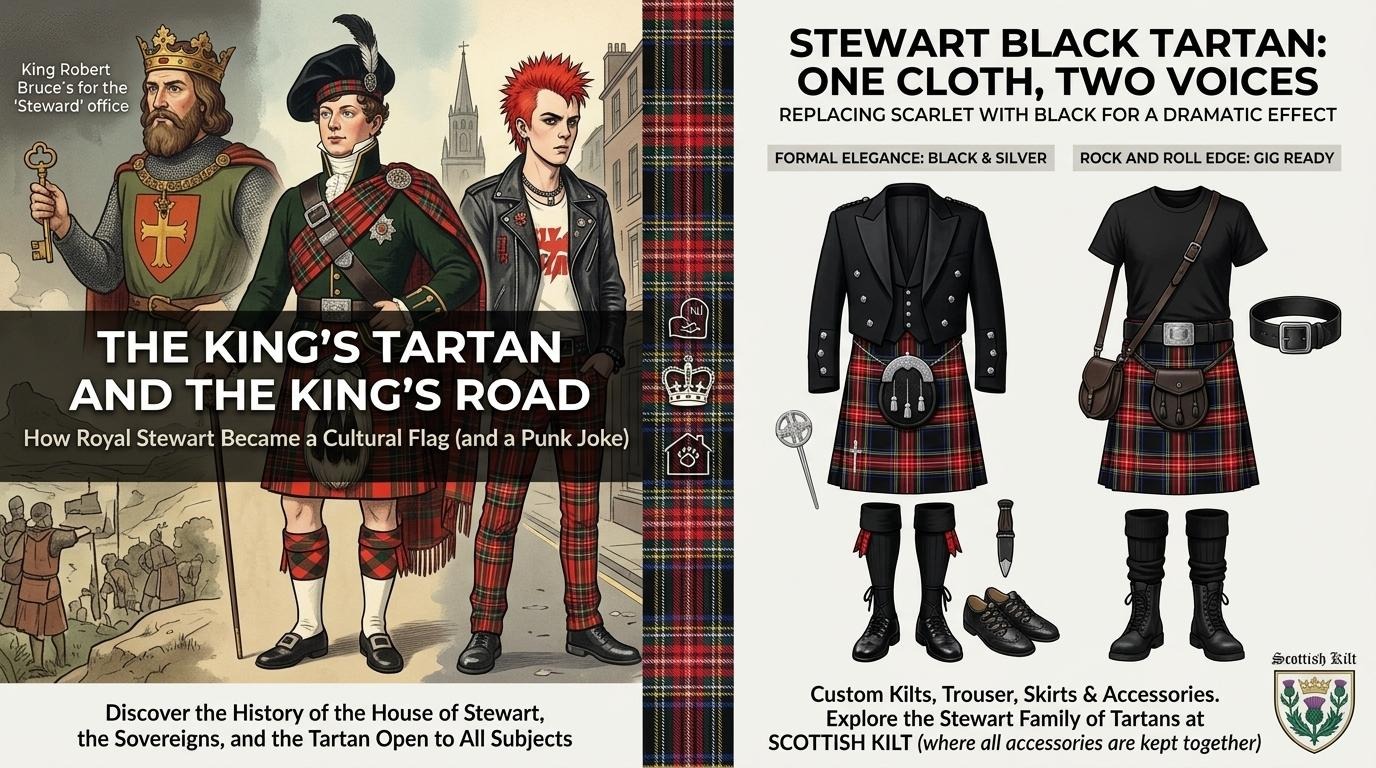
In the summer of 1977, Britain celebrated the Silver Jubilee of Queen Elizabeth II with street parties, bunting and commemorative mugs. On a barge on the Thames, a band called the Sex Pistols played a song called God Save the Queen until the river police boarded the boat. And in a shop at the wrong end of the King’s Road in Chelsea, customers were buying trousers with the legs strapped together at the knee, with zips in unlikely places and a flap hanging over the seat, cut from the brightest, most respectable, most royal cloth in the kingdom.
The cloth was Royal Stewart tartan. The shop belonged to Vivienne Westwood and Malcolm McLaren. They had chosen that tartan on purpose, and to understand why it was such a good joke, you have to know whose tartan it was. The Stewart name would later be represented in a darker variation, the Stewart Black tartan, which keeps the Royal Stewart pattern but replaces its dominant scarlet ground with black.
The stewards
Around the year 1150, King David I of Scotland gave a Breton-Norman knight named Walter fitz Alan the office of Steward of the royal household. It was a job: running the King’s domestic affairs and, in war, a wing of his army. Walter’s son inherited the post, and his son after him, and within a few generations the office had turned into a surname. They were the Stewards. In Scots, the Stewarts.
In 1315 the sixth High Steward married Marjorie, daughter of King Robert the Bruce. She died young, thrown from her horse while heavily pregnant, and the child was cut from her body and lived. In 1371, when Bruce’s own son died without an heir, that child became Robert II, King of Scots, and the household officials had become the royal house.
They kept the throne for three hundred and forty-three years. They were brilliant, charming, unlucky and frequently disastrous. Of the five kings named James who followed, two were murdered, two were killed in war, and every one of them left the throne to a child. Mary, Queen of Scots lost her head. Her son James united the crowns of Scotland and England in 1603. Her grandson Charles I lost his head too. The direct line was driven into exile in 1688, and the attempts of the last Stewart princes to win the crown back, in 1715 and 1745, brought ruin on the Highlands.
And yet the blood carried on. Every British monarch since has descended from the Stewarts through a daughter of James VI. When George IV came to Edinburgh in 1822 in full Highland dress, the tartan he chose to wear was the scarlet Royal Stewart, to make that very point. It has been regarded ever since as the personal tartan of the sovereign. By an old courtesy, since all clansmen may wear their chief’s tartan, all the monarch’s subjects may wear the monarch’s. That is why it ended up on shortbread tins, travelling rugs, and the lids of biscuit boxes in every corner of the world. It became the visual shorthand for everything safe, cosy and loyal about Britain.
Which is exactly why, in 1977, it was the perfect thing to rip up, strap together and fasten with safety pins. Punk did not choose tartan because it was rebellious. Punk chose it because it was the Queen’s.
The dark version
Somewhere between the palace and the King’s Road stands a third Stewart tartan, and it may be the most wearable of them all.
Take the Royal Stewart. Keep every line of it: the blocks of green and blue, the fine stripes of yellow and white, the narrow lines of red. Then remove the great field of scarlet that makes up most of the cloth, and put black in its place. The result is the Black Stewart. It is recorded in W. & A. K. Johnston’s great survey of clan tartans in 1906, with the simple description “black background.”
The effect is dramatic. All the colour in the design is now carried by the thin lines, which glow against the dark ground like neon on a wet street. It has the architecture of the most famous tartan in the world and none of the sweetness. Dressed formally, it is as sober as a dinner jacket, because most of it is, in effect, a dinner jacket. Dressed down, it has a distinct edge of rock and roll.
Retailers usually list Stewart Black tartan with the rest of the Stewart family, the Royal, the Dress, the Hunting, and make it to order as kilts, trousers, skirts, waistcoats and scarves, or sell it by the yard. Like the Royal Stewart it is treated as open to everybody.
The question with a cloth this dark is what to put with it. And the answer depends entirely on which of its two characters you want to bring out.
Glasgow, a Saturday in October
Craig Stewart is thirty-six and plays drums in a band that has been going, on and off, since he was nineteen. He is getting married at two o’clock in the Glasgow City Chambers, under about an acre of Italian marble. At nine o’clock tonight, by long-standing arrangement and with his bride’s full approval, his band is playing the reception.
He has one kilt, in Black Stewart. He needs it to do two jobs on the same day. What he has worked out, laying everything on the bed the night before, is that the kilt does not change at all. The accessories do all the work.
He bought the lot from Scottish Kilt, where he had the kilt made, because their accessories for kilts are kept in one place: sporrans, kilt pins, belts and buckles, hose and flashes, fly plaids, brooches, bonnets and ghillie brogues. One source means one leather and one metal finish throughout, which on a black-ground tartan, where every bit of metal shows up like a lit window, matters more than usual.
Finish was the first decision. There are broadly two. Bright chrome, which is crisp and formal. And antique, a dull pewter grey, which is softer and older looking. On most tartans it is a matter of taste. On black, he found, bright silver is the clear winner. It is the same logic as cufflinks with a dinner suit.
So for the ceremony: a black Prince Charlie jacket and waistcoat. A full-dress sporran with a black fur front and a polished chrome cantle. A kilt pin in bright silver, plain, pushed through the front apron only, low on the right. Black hose, with flashes in red to pick out the finest line in the tartan and lift the leg. The sgian-dubh in his right sock, black handle, chrome cap. Black ghillie brogues, laces tied low at the ankle. A black bow tie. Every piece of metal on him matches. The whole effect is black and silver, with the tartan’s colours running through the middle of it like wiring.
At the City Chambers, on the marble staircase, his new mother-in-law tells him he looks like a Bond villain, and means it kindly.
Then, at half past eight, he goes upstairs to change, and changes almost nothing.
The jacket and waistcoat come off. So does the bow tie. The dress sporran comes off, and in its place goes a plain black leather day sporran on a leather strap, no fur, no chain. Now that the waistcoat is gone he can wear a belt: wide black leather with a heavy chrome buckle, which does not hold the kilt up but looks as if it does. The ghillie brogues are swapped for his old black boots, and the black hose are pushed down to the top of them. A black T-shirt. The kilt pin stays.
It takes six minutes. The same eight yards of cloth that stood under a chandelier all afternoon now look as though they were made for a stage.
His best man, who plays bass, watches him come down the stairs.
“You know that’s the Queen’s tartan,” he says. “Basically. With the lights off.”
“King’s, now.”
“King’s. And you know who else wore it.”
“Aye,” says Craig, picking up his sticks. “Everybody who ever bought a tin of shortbread, and everybody who ever spat at one. That’s the beauty of it. One, two, three, four.”
Both at once
No other pattern in the world means as many contradictory things as the Stewart tartan. It is the badge of a royal house that lost its throne, the uniform of the monarchy that replaced it, the wrapping on a million souvenirs, and the flag of the people who wanted to tear all that down. It has been to coronations and to the 100 Club.
The black version holds all of it at once. It can stand under a chandelier in silver buckles, or behind a drum kit in boots, and the only difference between the two is a handful of small objects chosen with a bit of care. The stewards who started it all made their name by getting the details of a king’s household right, and would have understood that.
