

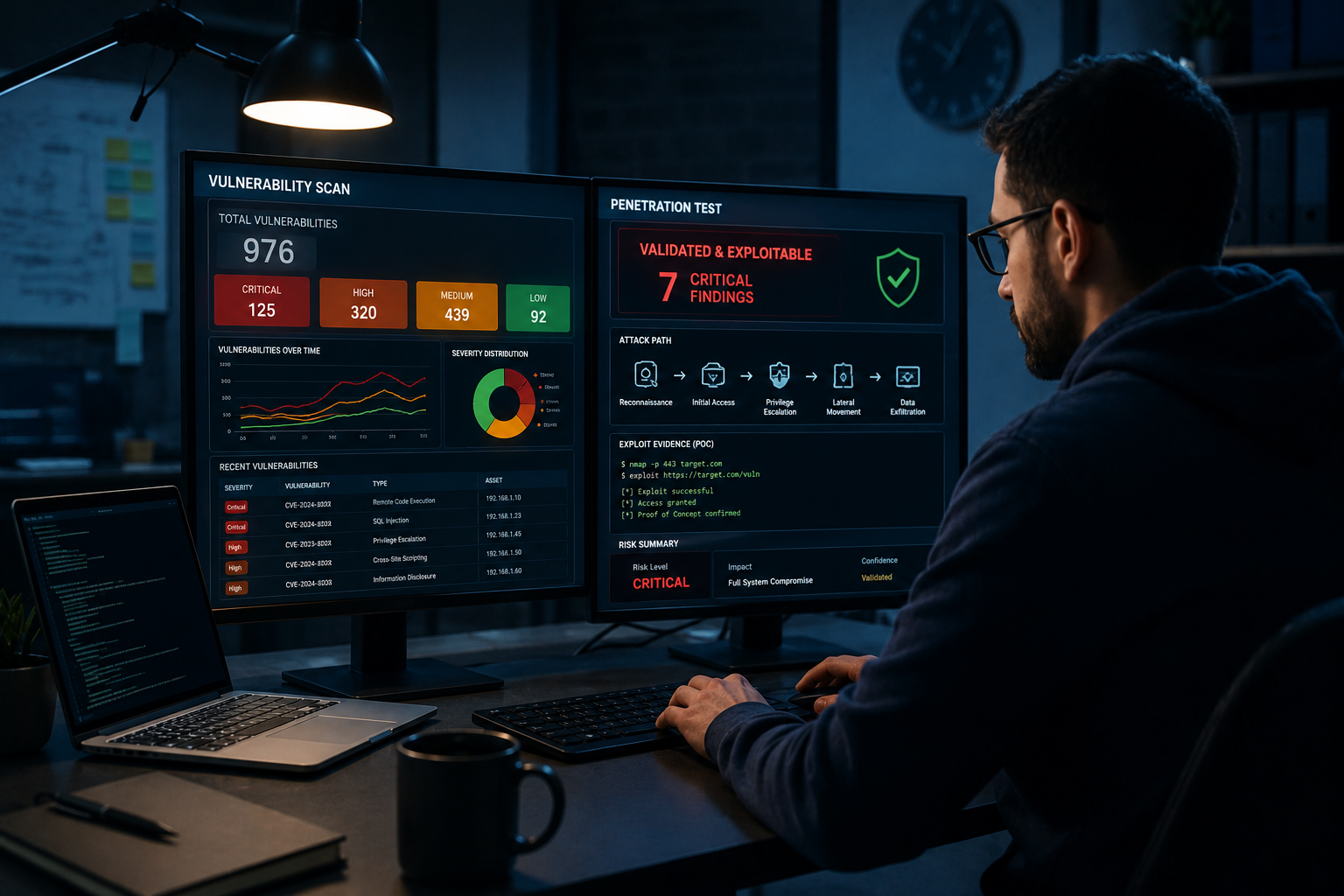
Quick Answer: A vulnerability scan tells you what might be wrong. A validated penetration test tells you what is actually exploitable. If your security program stops at the scan, you are paying to generate a list, not to reduce risk. That gap is exactly where security budgets quietly get wasted.
I have spent years watching security teams drown in reports nobody trusts. So let me say this plainly: vulnerability scanning alone is not security. It is noise wearing a lab coat.
Here is the problem. Automated vulnerability scanners are fast and cheap. They spit out a fresh list every week, sometimes every day if you are running continuous scans across a growing cloud footprint. But speed is not the same as accuracy, and volume is not the same as value. A tool that finds five hundred vulnerabilities has not necessarily made you safer. It has just made your inbox heavier.
You have probably felt this yourself. A scanner flags a critical finding. Your team drops everything. Hours later? Turns out it was not even exploitable in your environment, because the vulnerable function was never reachable, the dependency was already patched upstream, or the configuration made the flaw irrelevant in practice.
That is not security. That is alert fatigue with extra steps.
Why Critical Does Not Always Mean Dangerous
Let talk numbers, because numbers do not lie. Every scanner report hands you a severity score and expects you to treat it like gospel. But severity and exploitability are different questions, and confusing them is exactly how security budgets get quietly drained year after year.
Research on the Exploit Prediction Scoring System found something wild: When organizations patch every vulnerability scored CVSS 7 or higher, only 2.3% were ever actually exploited in the wild. Read that again. 97.7% of urgent patching work? Wasted. Burned. Gone. That is most of your remediation budget spent on vulnerabilities that were never going to hurt you.
This is exactly why exploitation validation matters more than raw severity scores. A number on a scanner report tells you what could happen in theory. A working proof of concept tells you what will happen in practice. That difference is where your budget gets protected or destroyed. It is also why more security teams pair severity scores with exploit prediction models. A critical label without evidence is just an opinion dressed up as a fact.
The Real Cost of Skipping Validation
I am not exaggerating when I say false positives are expensive. Every unvalidated finding your team chases is an hour someone is not spending on something that matters, whether that is a real threat, a product deadline, or an actual security improvement.
High-fidelity false positives, the kind that trigger full incident response, can cost $10,000 to $50,000 per incident in wasted staff time. Mid-sized teams torch $500,000 to $1 million a year chasing ghosts, and that number only grows as tool sprawl adds more scanners, more dashboards, and more conflicting severity ratings to the pile.
Meanwhile, nearly half of SOC analysts say alert fatigue is their single biggest challenge, and most of what lands in their queue is benign. So here is the honest question: what is the point of detection if nobody trusts, or acts on, what is detected? A finding that never gets validated is not a security control. It is a line item.
Vulnerability Scan vs. Penetration Test: What Is Actually Different?
People use these terms interchangeably, and that is part of the problem. They answer completely different questions, and knowing which one you are actually buying changes how you should budget for it.
| Aspect | Vulnerability Scan | Penetration Test |
| What it does | Automatically flags known weaknesses | Actively attempts to exploit weaknesses |
| Validation | None (findings are theoretical) | Every finding is proven with a working PoC |
| False Positive Rate | 40% to 70% | Under 2% on validated platforms |
| Report Output | Raw list of CVEs and scores | Reproduction steps, attack chains, evidence |
| Best Used For | Continuous visibility | Confirming real, exploitable risk |
| Cost of Wasted Finding | Hours of unpaid triage | Near zero (findings are pre-validated) |
The takeaway is simple: a scan tells you where to look. A pentest tells you what to fix first, and it proves it.
What Real Validation Actually Looks Like
This is where penetration testing that validates every finding changes the equation. Validation is not an extra step tacked onto the end. It is the entire point.
A proper pentest follows a consistent process:
- Attempt the exploit safely, in a controlled environment that mirrors how a real attacker would approach the target.
- Confirm the attack path end-to-end, including any chaining across multiple weaknesses.
- Document reproduction steps for your dev team, so a fix can be verified without guesswork.
- Prioritize fixes by real risk, not theoretical severity, so your team spends time where it actually matters.
This is the difference between a vulnerability assessment and an actual penetration test. One guesses. The other proves. Platforms with proper exploit validation pipelines run false positive rates under 2%, compared to 40-70% for scan-only tools. That is the whole ballgame.
Why This Matters More Than Ever in 2026
Breaches are still brutally expensive, and clever scanning does not change that math. IBM’s 2025 Cost of a Data Breach Report puts the global average at $4.44 million per incident, down slightly from the year before thanks to faster detection, but still high enough to make prevention the obvious financial choice.
Compare that to the cost of a validated pentest, often a fraction of a single breach, and the math genuinely is not close. Meanwhile, proof-of-concept exploit code for new vulnerabilities keeps climbing year over year, which means attackers already have working exploits for many of the same flaws your scanner is quietly flagging as theoretical.
Frequently Asked Questions
Is a vulnerability scan the same thing as a penetration test?
No. A scan automatically flags potential weaknesses based on known signatures and version checks. A penetration test goes further by actually attempting to exploit those weaknesses to confirm whether they are real and how far an attacker could get.
Why do scanners produce so many false positives?
Scanners lack context. They flag a vulnerable-looking version string or configuration without knowing whether the flaw is reachable, already patched, or mitigated by something else in your environment. That missing context is exactly what exploitation validation fills in.
How much does an unvalidated finding actually cost?
Industry estimates put the cost of chasing a single high-fidelity false positive at $10,000 to $50,000 in wasted staff time, and mid-sized teams can lose $500,000 or more a year to this problem.
How often should I run a validated pentest?
Ideally every major release, or at minimum quarterly, since new code and new dependencies constantly change your actual attack surface regardless of what last quarter’s scan found.
Here Is My Honest Recommendation
If you are still relying on scanner output alone, you are not managing risk. You are managing paperwork, and paperwork does not stop attackers.
What you actually need is proof-based penetration testing: findings backed by real, reproducible proof-of-concept exploits, not theoretical CVSS scores. This is where a professional penetration testing strategy earns its place in your security budget, because it turns a pile of maybes into a short, confirmed list of things you actually need to fix.
Curious what that looks like? You can see a validated pentest report to understand exactly how validated findings get documented, start to finish.
Stop paying for lists of maybes. Start paying for proof.
