

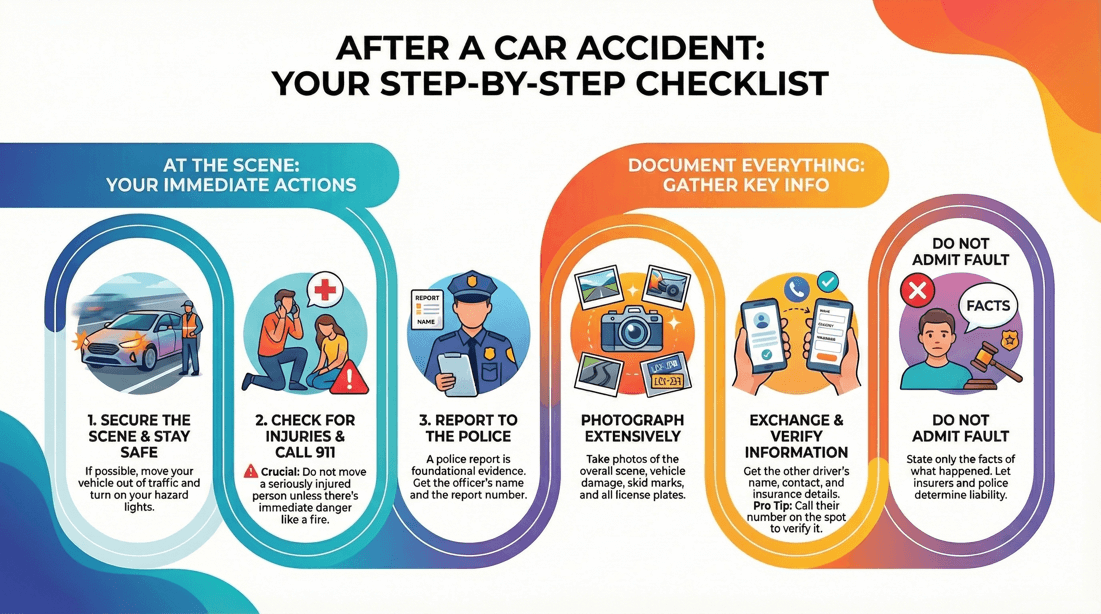
You’ve just been in an accident. There is broken glass on the road, your car is damaged, and you are likely in shock. You might want to call the insurance company quickly, but that should not be the first thing you should be doing.
Before you call the insurance agent, you must handle two things, one of which is a requirement stated by the law. Most advice tells you to call your insurer first, but what you do at the accident scene matters more. If you handle the scene correctly, your insurance claim will go smoothly instead of turning into a six-month argument. Here is what you should do first.
Look at The Injured People First, And Then The Paperwork
Section 134 of the Motor Vehicles Act, 1988 places a duty on you before anything else, and that is to take reasonable steps to get an injured person to the nearest doctor or hospital, unless a crowd or something beyond your control makes that impossible.
The timing also carries real weight here. The law calls the first hour after an accident the golden hour, as getting medical help here can save a life.
You should also not let money worry you from helping others, as under the Cashless Treatment of Road Accident Victims Scheme by the Ministry of Road Transport and Highways, any person injured in a road accident can get free treatment of up to ₹1.5 lakh at any hospital, for about seven days.
If you help someone injured, this too does not carry any legal problem. So you can take them to the hospital and cannot be dragged into the case for stepping in.
After the injured person has reached the hospital, the next thing to do is:
- Turn on the car’s hazard lights
- Move people off the carriageway and onto the verge
- Switch off the car engine if the fuel is leaking
- Place a warning triangle behind the car if you have one
24-Hour Rule Most Drivers Don’t Know About
If there is no police officer present at the accident scene, then legally you need to report the accident at the nearest police station within 24 hours.
If you skip this step to stay out of danger, it can become a costly mistake later on. Courts look at official police records first. If you don’t file one, you won’t have any evidence and will have to rely only on your own memory to prove what happened.
Your car insurance policy also has its own deadline for reporting an accident, which is separate from the legal requirement. They expect you to call and inform them quickly, rather than waiting for a convenient time later.
If you miss either deadline, a simple car insurance file can start collecting questions and delay the process even more.
Photos To Take Right After The Incident
- The positions come first, and almost everyone gets this wrong as they try to move the cars immediately.
- The correct way is to move a little back and shoot both vehicles exactly where they stopped, with the lane markings, and any signal in frame. Taking photos from both angles is also very important.
- Next are close-up shots of the exact damage on both cars, both number plates, marks, scattered glass, and the road surface if it was wet or broken.
- You should also take photos of the important documents like your registration certificate, driver’s licence, and policy document.
- Take one wide shot of the shop board or a milestone near the crash or accident, so nobody can later argue about which part of the road the accident scene was on.
What Not to Say at an Accident Scene
Don’t admit fault at the scene. While it’s natural to say “I’m sorry,” doing so can be used against you later. Let the car insurance companies and the legal system decide who was at fault.
Blame in India is decided by a Motor Accident Claims Tribunal, the court that handles road accident compensation using the surveyor’s report. A normal sorry doesn’t carry any legal weight but follows you into every conversation afterwards.
Be very careful about offering or accepting cash settlements. You might feel fine at the scene, but injuries can show up days later. A quick, informal deal will rarely cover your actual medical costs, which is why having third party car insurance is a legal requirement, not just an option.
Also, keep all the documents with you as well. Only hand them to a police officer if they ask for them. Do not give them to anyone else at the accident scene.
Be careful in documenting the scene with photos and a police report, as they will act as clear evidence. They will help prevent arguments later on and avoid the car insurance claim process from dragging on for months.
