

A molding machine alone cannot guarantee stable production. At Topstar, as Product Marketing Manager with deep expertise in complete cell solutions, I regularly see plants invest in high-performance presses only to struggle with moisture-related defects, temperature drift, inconsistent cycles, and unplanned downtime because the supporting systems were underspecified or poorly integrated. Auxiliary equipment—from material preparation through temperature control and part handling—determines whether process parameters remain inside the window that yields acceptable parts. When auxiliary equipment is correctly selected and maintained, the entire cell operates as a coordinated system rather than as a collection of isolated machines.
Material Preparation Stability Through Auxiliary Equipment
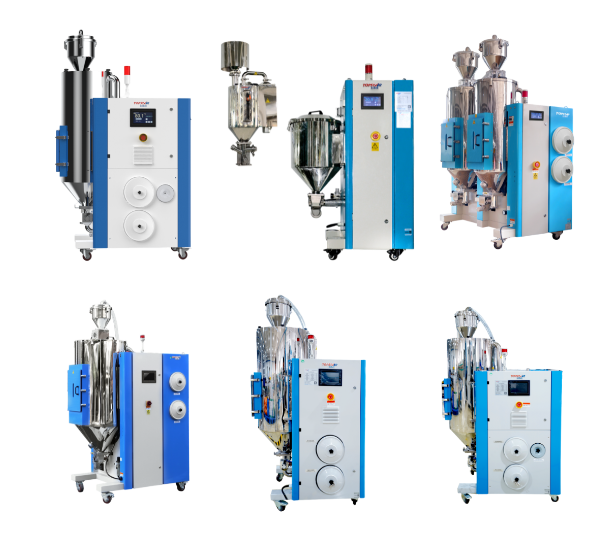
Material preparation stability begins with auxiliary equipment that delivers resin at the correct moisture level and temperature to the machine throat. Hygroscopic resins absorb moisture from the surrounding air. If processors don’t remove that moisture before processing, the finished parts may develop splay and voids, show greater dimensional variation, and lose mechanical strength. Dehumidifying dryers and related drying systems form the first line of defense by providing controlled dew-point air and consistent residence time so that material enters the barrel in a predictable state. Topstar designs and applies drying auxiliary equipment so that moisture content stays within the limits required by the resin grade.
When dehumidifying dryers are sized for throughput and linked to proper hopper management, the molding machine receives a stable feedstock shot after shot. Without this preparation layer, even the most precise injection and holding profiles cannot overcome upstream variation. Material-side auxiliary equipment is therefore indispensable to process stability from the first moment resin leaves the bag or silo.
Thermal Consistency Delivered by Auxiliary Equipment
Thermal consistency across the mold and machine depends on temperature-control auxiliary equipment. Mold temperature controllers circulate fluid through cooling channels to hold cavity and core surfaces at the set-point required for shrinkage control, surface quality, and cycle time. Chillers and cooling systems remove process heat so that both the mold and the hydraulic or electric systems of the press remain within design limits. When these units drift or lack capacity, hot spots appear, cooling times lengthen, and dimensional capability declines. Topstar specifies mold temperature controllers and related thermal auxiliary equipment to match mold mass, channel design, and production rate. Stable fluid temperature and adequate flow keep every cavity in a multi-impression tool under similar thermal conditions.
The result is more uniform shrinkage and fewer temperature-driven defects. Thermal auxiliary equipment converts the set-points defined in the process sheet into physical reality at the tool surface and is therefore central to a stable injection molding process.
Cycle Time and Handling Reliability with Auxiliary Equipment
Cycle time and handling reliability improve when automated auxiliary equipment removes parts consistently and clears the mold area without delay. Cartesian robots and related take-out systems enter the open mold, grip the part, extract it along a controlled path, and deposit it for downstream operations. Manual removal introduces variation in timing and handling force; inconsistent automation does the same. Reliable robotic auxiliary equipment keeps mold-open time short and repeatable so that the press returns to injection on a fixed rhythm. Topstar integrates injection molding robots as auxiliary equipment that interlock tightly with the machine.
When the robot signals clear at the earliest safe moment, the clamp can close without waiting for operator action or conservative fixed delays. Stable take-out protects both cycle time and part quality—especially for deep-cavity, thin-wall, or cosmetic parts that suffer from delayed or rough handling. Automation auxiliary equipment is a direct contributor to process stability measured in seconds per cycle and in reduced handling scrap.
Process Window Protection Through Integrated Auxiliary Equipment
Process window protection is the combined effect of well-matched auxiliary equipment working with the molding machine. Drying stability, mold temperature stability, and consistent part removal reduce the number of uncontrolled variables that the process engineer must fight. When upstream and downstream systems hold their set-points, the injection, packing, and cooling profiles defined on the press remain effective for longer periods and across more material lots. Topstar approaches the cell as an integrated system: dehumidifying dryer, mold temperature controllers, robots, and other auxiliary equipment are selected and commissioned so that they support rather than undermine the machine’s capability. Plants that treat auxiliary equipment as optional or secondary often discover that the process window is narrower than the press specifications suggest. Integrated auxiliary equipment widens the practical operating window and makes stability achievable under real production conditions rather than only under ideal laboratory trials.
Quality Metrics and Scrap Reduction Linked to Auxiliary Equipment
Quality metrics and scrap reduction provide measurable evidence of the value of stable auxiliary equipment. Moisture-related visual defects decline when dehumidifying dryers maintain correct dew point and residence time. Dimensional scatter and warpage decrease when mold temperature controllers hold uniform tool temperatures. Handling marks and deformation drop when robotic auxiliary equipment extracts and places parts with consistent force and timing.
Each of these improvements appears in lower scrap rates, higher first-pass yield, and more predictable capacity planning. Topstar works with manufacturers to connect auxiliary equipment performance to quality data so that the contribution of drying, temperature control, and automation is visible in the same metrics used to judge the molding machine. When auxiliary equipment is reliable, quality becomes a property of the whole cell rather than a continuous struggle against upstream and downstream variation. This system-level stability is why professional plants invest in auxiliary equipment with the same seriousness they apply to the press itself.
Why Auxiliary Equipment Defines Process Stability
Auxiliary equipment is critical to a stable injection molding process because it controls material condition, mold and system temperatures, part removal timing and quality, and the overall consistency of the cell. Dehumidifying dryers stabilize feedstock moisture; temperature-control systems stabilize the thermal environment; automation stabilizes handling and cycle rhythm. Together they protect the process window that the molding machine is designed to run. Topstar supplies and integrates auxiliary equipment so that manufacturers can treat the cell as a single, reliable production system. By specifying drying, temperature control, and robotic handling with the same rigor applied to the press, plants achieve the dimensional consistency, cosmetic quality, and uptime that competitive markets demand.
