

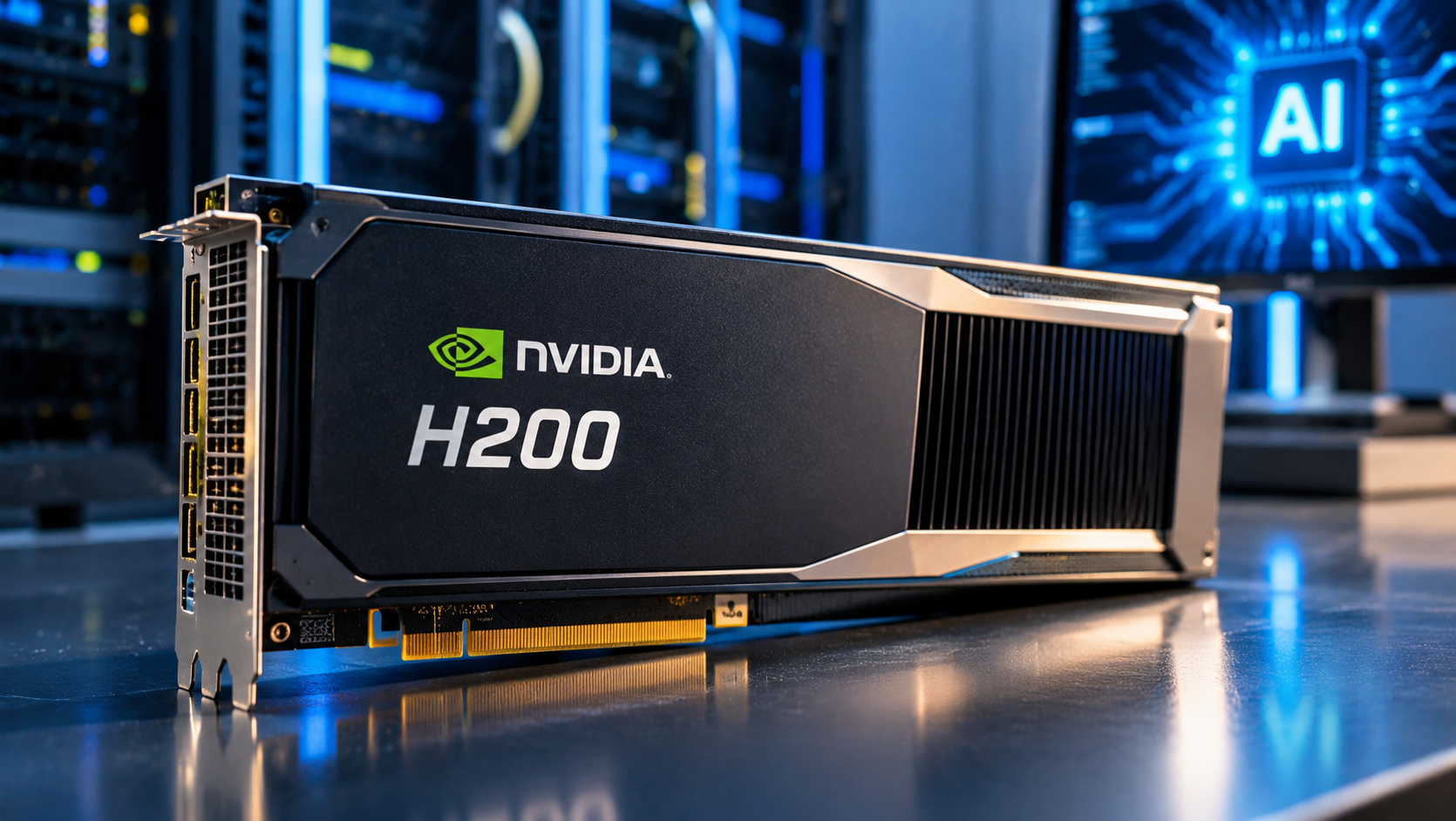
The H200 is more expensive due to its memory.
It features 141 GB of HBM3e memory operating at 4.8 TB/s, compared to 80 GB and 3.35 TB/s of H100. With scarcity and high server costs, the NVIDIA H200 comes with a purchase price of $30,000 to $45,000 or $2.43 to $13.78 per hour to rent, based on CloudPe H200 pricing.
This article will help you clarify the reasons for that expense, compare the H200 with other GPUs, and determine when the cost is justified.
Why is the H200 so expensive?
Since it offers the largest memory among its peers, along with supply that has remained constrained since launch in November 2024. The compute chip is the same as H100, so the difference in prices can be attributed to several aspects.
These include:
- Memory: 141 GB HBM3e, which is 76% higher than the H100
- Bandwidth: 4.8 TB/s, which is 43% higher than the H100
- Supply: constrained since launch, which makes it expensive
- Cost of server: An 8-GPU H200 server costs $300,000 to $400,000 or more
- Demand: A 70B model in 16-bit precision requires around 140 GB of memory for the weight model itself
How much of the price comes from memory?
Almost all of that price comes from memory. H200 and H100 use the same number of CUDA cores (16,896) and have the same power requirement (700W). What makes them different is the memory architecture.
HBM3e is stacked memory, which is placed near the processor itself. It is more difficult and expensive to manufacture and pack than the memory used in cheaper graphics cards. The cost is transferred to the consumer. In the case where workload runs out of memory in the H100, additional memory can result in fewer GPUs, simpler networking, and coding.
How does the H200 compare with other GPUs on price?
Hourly rate-wise, the H200 is many times expensive compared to an affordable inference GPU. However, the price per GB of memory is comparatively low.
Consider the NVIDIA L4. According to CloudPe, the price for the L4 instance is ₹35.86 per hour. The L4 has a memory capacity of 24 GB. According to CloudPe, the H200 costs ₹300 per hour with a memory capacity of 141 GB.
Here is the same math per gigabyte:
- H200: ₹300 divided by 141 GB is about ₹2.13 per GB per hour
- L4: ₹35.86 divided by 24 GB is about ₹1.49 per GB per hour
So the H200 costs roughly 1.4x more per gigabyte. This is a rough measure, since bandwidth and compute differ too, and it shows the premium is smaller than the sticker price suggests.
Want to see the full breakdown? Read the guide on the NVIDIA H200 GPU for buy and rent numbers.
Why do hyperscalers charge so much more for the H200?
They usually sell it in 8-GPU nodes and price it at a premium. Specialised GPU clouds often charge far less for the same card.
According to the CloudPe pricing guide, per-GPU rates look like this:
- Azure: about $13.78 per GPU hour
- Google Cloud: about $10.85
- Oracle: about $10
- AWS (p5en): about $7.91
- Specialized AI clouds: $2.43 to $4.50
- CloudPe: ₹300 per hour, roughly $3.40 to $3.60, with single-GPU options
The 8-GPU minimum matters. A team that needs one H200 can end up paying for eight.
Will H200 prices come down?
The above-mentioned guide suggests that there have been shortages of B200, which were even running in millions of units by mid-2026. Hyperscalers increased the price of H200 chips in January 2026.
There are other reasons why it can become expensive. CloudPe has indicated its expectation of increase in GPU prices in India from 15% to 20% within 12 to 18 months owing to rising memory costs and shortage of availability of these chips.
Planning a budget? Check the current H200 GPU price in India before you commit.
When is the H200 worth the price?
Your money is well-spent if you have memory-constrained workloads. Given that the model and context, along with the batch size, fits into 80 GB, H100 is generally more economical for delivering similar performance.
H200 makes sense for:
- Inference with long contexts beyond 100,000 tokens
- Fine-tuning large models, such as 70B parameter models or even larger
- Hosting several models or users on a single GPU
These scenarios reduce the number of required GPUs and sharding, which balances out the higher cost per hour.
Should you buy or rent an H200?
Rent in most cases. An 8-GPU server costs roughly $300,000 to $400,000. In India, a single GPU can land at Rs 40 to 50 lakh after import duties.
At a market median of $3.94 per GPU-hour, renting eight GPUs costs about $23,000 per month at full-time use. Buying only breaks even after 14 to 16 months of continuous, fully used rental, before power, cooling, and staff. Buy only if you can keep utilization near 100% for 18 months or more.
Not sure you need 141 GB? See the NVIDIA L4 GPU price in India for a lighter and cheaper option.
Conclusion
The H200 is expensive because of its 141 GB of HBM3e memory, tight supply, and costly 8-GPU servers. Per gigabyte, the premium over a GPU like the L4 is about 1.4x, which is smaller than the hourly gap suggests. Check whether your model needs the memory, price your workload on a few providers, and rent unless you can keep the card busy for well over a year.
Frequently Asked Questions
Is H200 faster than H100?
Yes, but only on memory-bound tasks. The compute is the same, so tasks that require long context inference and large batch fine-tuning benefit the most. Compute-bound tasks show very little difference.
Why is the H200 so expensive compared to the L4?
The H200 has around 5.9x more memory with significantly greater bandwidth and is built for large language models. The L4 is meant for inference and video tasks on smaller models.
What is the cheapest way to rent an H200?
Rental from a specialized GPU cloud is generally cheaper than hyperscaler rental. Spot pricing could even be cheaper with the risk that your job is interrupted.
Should I wait until the price drops?
There is risk involved. The supply remained scarce throughout mid-2026 and memory costs could put upward pressure on prices. Rent by the hour so you can change providers when necessary.
