

TL;DR
Your lunar zodiac sign is determined by the Chinese lunar calendar, which assigns one of twelve animal signs to each year in a repeating cycle. Finding yours requires knowing your birth year and whether you were born before or after that year’s Lunar New Year date. Each sign carries distinct personality traits rooted in thousands of years of Chinese cultural tradition.
Introduction
Have you ever wondered why your Western horoscope never quite felt like the full picture? The Chinese lunar zodiac offers a parallel system of self-understanding that over a billion people across East and Southeast Asia have relied on for more than two millennia. Rooted in astronomy, agriculture, and Confucian philosophy, it assigns every person an animal sign based on the lunar year of their birth. This piece walks you through exactly how that system works, how to pinpoint your sign accurately, and what the twelve animals actually say about the people born under them.
How the Lunar Calendar Differs from the Gregorian One
Most people assume their lunar zodiac sign simply matches their birth year on the standard calendar. That assumption causes one of the most common errors people make when looking up their sign. The Chinese lunar calendar does not flip to a new year on January 1st. Instead, Lunar New Year falls on a different date each year, somewhere between late January and mid-February, based on the cycles of the moon.
This means that if you were born in January or early February, your lunar zodiac sign might belong to the previous year rather than the one printed on your birth certificate. Someone born on February 3, 1990, for instance, would not be a Horse as a standard year-lookup would suggest. That year’s Lunar New Year fell on January 27, 1990, so a February 3rd birthday falls squarely within the Year of the Horse. But someone born on January 20, 1990 would still carry the sign of the Snake, because Lunar New Year had not yet arrived.
The distinction matters more than most people realize. Apps like “Chinese Zodiac” on iOS and websites maintained by cultural institutions in Hong Kong and Taiwan specifically account for this lunar boundary when calculating your sign. Always verify the Lunar New Year date for your birth year before settling on your animal.
The Twelve Animals and Their Sixty-Year Cycle
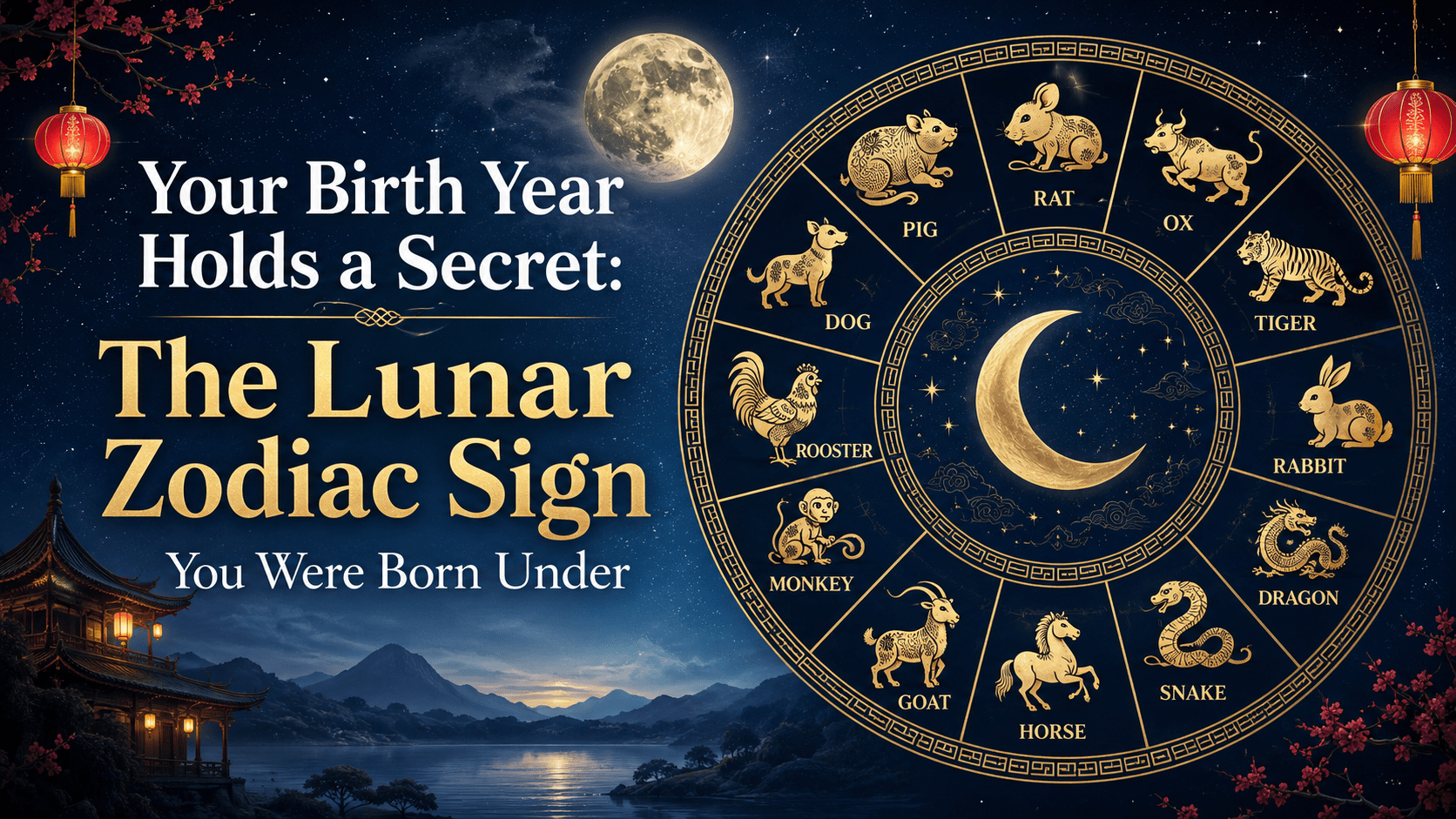
The lunar zodiac operates on a twelve-year cycle, with each year governed by one animal in a fixed sequence: Rat, Ox, Tiger, Rabbit, Dragon, Snake, Horse, Goat, Monkey, Rooster, Dog, and Pig. After twelve years, the cycle starts again. The system pairs this animal cycle with five elements (Wood, Fire, Earth, Metal, Water) in a longer sixty-year pattern, which is why practitioners sometimes say your “full sign” includes both the animal and the element.
The Year of the Dragon, for example, occurred in 1952, 1964, 1976, 1988, 2000, 2012, and 2024. Each of those years carried a different element: 2000 was the Metal Dragon, 2012 was the Water Dragon, and 2024 opened the Year of the Wood Dragon. People born in all those years share the Dragon’s foundational traits, but the elemental layer adds nuance that serious practitioners of Chinese astrology study in depth.
Bruce Lee, born in both the hour and year of the Dragon (1940, a Metal Dragon year), is perhaps the most cited example of Dragon energy in popular culture, charismatic, intense, and unconventional. Whether you treat that as meaningful symbolism or cultural folklore, the framework has produced a rich vocabulary for discussing personality that persists across Chinese-speaking communities worldwide.
Finding Your Sign: A Practical Step-by-Step Method
Start with your birth year. Then locate the Lunar New Year date for that year, which is readily available on any Chinese cultural calendar. If your birthday falls on or after that Lunar New Year date, your zodiac animal is the one assigned to your birth year. If your birthday falls before that date, count back one year in the twelve-animal sequence to find your true sign.
Take the case of Priya Mehta, a Mumbai-based graphic designer born on February 9, 1992. She had long assumed she was a monkey, matching the year 1992 on a standard calendar. When she checked the 1992 Lunar New Year date (February 4, 1992), she realized her birthday came five days after the new year had already begun, confirming she is indeed a Monkey. Her colleague, born January 15, 1992, is a Goat because Lunar New Year had not yet arrived.
This check takes about two minutes online and eliminates the most frequent mistake in self-identifying your sign. Chinese zodiac reference tools like those on the Hong Kong Observatory’s educational pages or the dedicated sections on Taiwan’s Directorate-General of Budget databases include historical Lunar New Year dates going back over a century, making verification straightforward regardless of your birth decade.
What Each Animal Sign Actually Represents
The twelve animals are not arbitrary. Chinese cultural tradition explains their sequence through the legend of the Jade Emperor’s race, in which animals crossed a river and arrived in the order they now appear. Whether taken literally or as pedagogical mythology, each animal’s position carries attributed characteristics that practitioners have refined across dynasties.
The Rat, which opens the cycle, is associated with adaptability, sharp instincts, and a talent for seizing opportunity. Historical Chinese almanacs describe Rat-year individuals as resourceful under pressure, a characterization that feels consistent in modern parlance. The Dragon, the only mythical creature in the group, carries prestige: in China, Taiwan, and Vietnam, birth rates measurably spike in Dragon years as families plan pregnancies to coincide with the sign. Singapore’s Department of Statistics has documented this demographic pattern across multiple Dragon-year cycles.
The Snake is considered analytical and private, the Horse independent and energetic, the Rabbit diplomatic and creative. None of these is a judgment. The system reads more like a cultural personality typology than a prescriptive horoscope, similar in some ways to how Myers-Briggs or Enneagram frameworks function in Western professional development circles, offering a shared vocabulary rather than a fixed destiny.
The Difference Between Your Lunar Sign and Your Moon Sign
A persistent confusion arises when people conflate the Chinese lunar zodiac with the Western astrological “moon sign.” These are two entirely different systems with different origins and different methods. Your Western moon sign is determined by the position of the moon in a specific zodiac constellation at the exact moment of your birth. It changes every two to three days and requires your precise birth time and location to calculate your moon sign.
Your lunar zodiac sign, by contrast, is assigned at the level of the entire year and requires only your birth date. No birth time is needed. No geographic coordinates are required. The Chinese system does include hour-based calculations (the “Chinese zodiac hour” assigns an animal to each two-hour block of the day), but that layer is separate from your primary year sign and belongs to more advanced four-pillar (BaZi) analysis.
Apps like NightSky or astrology platforms like Co-Star deal exclusively in Western astrology and will not give you your Chinese lunar zodiac sign. For that, you need a tool specifically built around the Chinese lunisolar calendar. The distinction is worth understanding before you spend time entering your birth details into the wrong system.
Cultural Context That Shapes How the Sign Is Used
The lunar zodiac is not simply a personality quiz. In Chinese-speaking societies, it functions as a social and sometimes commercial touchstone. Businesses time product launches to align with auspicious animal years. The Year of the Pig in 2019 saw luxury brands including Louis Vuitton, Gucci, and Burberry release limited-edition Lunar New Year collections featuring pig motifs. Hallmark and greeting card companies began producing zodiac-year packaging in North American markets in the 1990s as Chinese diaspora communities grew in cities like Vancouver, San Francisco, and Sydney.
Compatibility frameworks built around the zodiac also influence matchmaking in parts of China, Taiwan, and Vietnam, particularly among older generations. The Rat, Dragon, and Monkey are considered mutually compatible, forming a triangle of affinity in classical texts. The Ox, Snake, and Rooster form another. These compatibilities appear in wedding planning conversations, business partnership discussions, and baby-naming practices throughout the region.
Understanding your sign in its cultural context gives you something richer than a personality label. It offers a lens into how identity, timing, and community belonging have been organized across one of the world’s oldest continuous civilizations.
Wrap Up
Your lunar zodiac sign is tied to the Chinese lunisolar calendar, not the Gregorian year, which means verifying the Lunar New Year date for your birth year is the one step most people skip and the one step that matters most. Once you have that confirmed, matching your birth year to the twelve-animal cycle takes seconds.
The sign you land on connects you to a cultural tradition spanning thousands of years, one still actively shaping how hundreds of millions of people think about personality, timing, and identity today.
FAQs
What is my lunar zodiac sign by birth year?
Your lunar zodiac sign is the animal assigned to your Chinese lunar birth year. Because the lunar new year falls between late January and mid-February, you need to confirm whether your birthday comes before or after that year’s Lunar New Year date to get the correct sign.
Is the lunar zodiac the same as the Chinese zodiac?
Yes, the lunar zodiac and the Chinese zodiac refer to the same system. Both describe the twelve-animal cycle based on the Chinese lunisolar calendar, and the terms are used interchangeably in most English-language contexts.
Can I have two lunar zodiac signs?
No, you have one primary lunar zodiac sign based on your birth year. The Chinese BaZi system does assign additional animals to your birth month, day, and hour, but your year sign is the one most people refer to as their zodiac sign in everyday conversation.
