

Let’s be honest for a second: modern life can feel like a non-stop barrage of pinging notifications, endless to-do lists, and background noise that never quite turns off. By the time 5:00 PM rolls around, most of us aren’t just tired—we’re running on absolute fumes.
When stress hits, the usual advice often feels completely out of reach. We’re told to go on a 90-minute gym run, book a weekend retreat, or commit to an hour of silent meditation before dawn. But when you’re already overwhelmed, adding a complex relaxation ritual to your schedule feels less like self-care and more like another exhausting item on your chore list.
Here’s the good news: managing daily stress doesn’t require a total life overhaul. In fact, tiny, low-effort micro-habits often work much better. When practiced consistently, these small adjustments create a compounding effect that keeps your nervous system grounded.
If you’re looking for practical ways to find your calm without blowing up your schedule, here are 7 effortless habits worth trying.
1. Reclaim the First 5 Minutes of Your Morning
How do you usually start your day? If you’re like millions of people, your hand probably reaches for your smartphone before your eyes are even fully open. Within seconds, your brain is bombarded with work emails, breaking news, and social media updates. You’ve barely woken up, and your cortisol levels are already spiking.
Try giving yourself a 5-minute buffer instead.
When you open your eyes, resist the urge to check your phone. Instead, sit up, sip a glass of water, look out the window, or take a few deep breaths. Letting your brain transition smoothly from sleep to wakefulness—without immediate digital stimulation—sets a calm, controlled tone for everything that follows.
2. Take Quick “Micro-Breaks” with Low-Pressure Brain Teasers
When we hit an afternoon slump, our instinct is usually to scroll aimlessly through social media. But doomscrolling doesn’t actually give your brain a break; it just swaps work stress for information overload.
A much better approach is to take a 3-to-5-minute “cognitive detour.” Giving your mind a lightweight, structured problem to solve allows your work-related worries to pause while triggering a small, satisfying hit of dopamine.
Work Task (High Stress) ➔ 5-Min Word Puzzle (Focus Shift) ➔ Refreshed Brain (Low Stress)
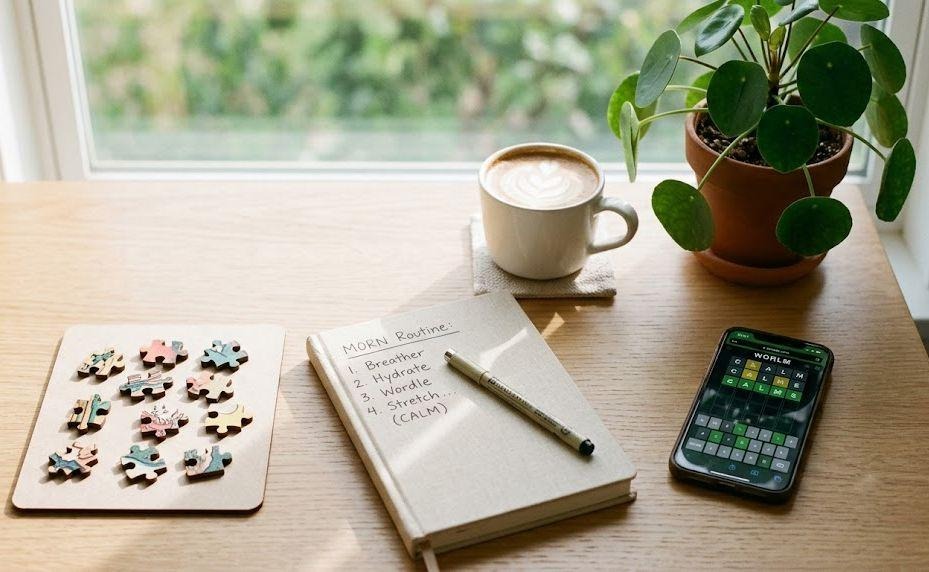
For instance, stepping away from your spreadsheets to play quick word games gives your analytical brain a chance to reset. It’s short, engaging, and completely low-stakes. You aren’t worrying about deadlines or replies; you’re just hunting for a 5-letter word. By the time you finish, your mental palette is cleansed, and you can jump back into work with fresh eyes.
3. Practice the “20-20-20” Rule and Unclench Your Body
Physical tension and mental stress are two sides of the same coin. When you sit hunched over a laptop for hours, your shoulders creep up toward your ears, your jaw clenches, and your eyes strain. Your body interprets this physical tightness as a sign of danger, keeping your stress response active.
To break this cycle, use the 20-20-20 rule:
- Every 20 minutes, look away from your screen.
- Focus on an object at least 20 feet away.
- Hold your gaze there for 20 seconds.
While doing this, take a quick physical inventory. Drop your shoulders, un-clench your teeth, and roll your neck gently from side to side. It takes less than half a minute, but it instantly cuts off the physical activity feedback loop that fuels mental fatigue.
4. Unwind in the Evening with Tactile, Screen-Free Hobbies
After staring at glowing rectangles all day, your brain needs a break from pixels. The problem with evening Netflix binges or late-night phone scrolling is that light from screens continues to stimulate your nervous system, making it harder to wind down.
Replacing screen time with hands-on, tactile activities is one of the fastest ways to enter a “flow state”—a meditative zone where your brain stops churning through worries about tomorrow.
Digital Fatigue (Overstimulated) ➔ Hands-on Tactile Activity ➔ Flow State (Calm & Grounded)
This is where physical or interactive spatial activities excel. Spending 15 to 20 minutes clearing off a table and piecing together offline or online jigsaw puzzles forces your brain to shift entirely into spatial thinking. Matching shapes, colors, and textures grounds you in the present moment. It’s quiet, immensely satisfying, and gently slows your heart rate down before bedtime.
5. Pair Hydration with “Trigger” Moments
Dehydration is a sneaky stress amplifier. Even mild dehydration can cause subtle physical symptoms—like light headaches, fatigue, and slight heart palpitations—that mirror the physical sensations of anxiety. When you’re busy, it’s easy to forget to drink water for hours on end.
Instead of trying to remember to drink two liters of water a day, use habit stacking. Link drinking a glass of water to something you already do routinely:
- Drink a full glass every time your coffee pot finishes brewing.
- Take three big sips right after you hang up a phone call.
- Refill your bottle every time you stand up to stretch.
By piggybacking on existing habits, you stay hydrated automatically without adding another task to your mental mental checklist.
6. Set a Hard “Digital Sunset”
We talk a lot about morning routines, but evening boundaries are just as crucial for keeping stress in check. The blue light emitted by phones, tablets, and TVs suppresses melatonin production, convincing your brain that it’s still daytime and keeping your stress hormones elevated.
Try setting a “digital sunset” 60 minutes before you plan to go to sleep.
When your alarm goes off for your digital sunset:
- Switch your phone to Do Not Disturb.
- Place your devices on a charger away from your bed.
- Switch to lower, warmer lighting in your living space.
Creating this physical distance between yourself and your screens signals to your body that the workday is officially over, allowing your nervous system to power down naturally.
7. Do a 2-Minute “Gratitude Dump”
It sounds cliché, but the human brain is hardwired with a “negativity bias” We naturally spend more energy dwelling on the one rude comment or unfinished task than on the ten things that went right during the day. Over time, this bias makes the world feel far more stressful than it actually is.
You don’t need a fancy journal to counter this. Right before bed, grab a scrap piece of paper or a small notebook and jot down three specific things that went well that day.
They don’t have to be life-changing events:
- “The weather was surprisingly nice on my walk home.”
- “My afternoon coffee tasted great.”
- “I finished a tough work proposal ahead of time.”
Writing these down forces your brain to scan your day for positives, balance out the negativity bias, and leave you in a peaceful frame of mind before sleep.
Final Thoughts: Start Small, Stay Consistent
You don’t need to adopt all 7 of these habits overnight. In fact, trying to do so would defeat the entire purpose of stress relief.
Pick just one or two that resonate with you right now. Maybe that means keeping a quick word game handy for your afternoon coffee break, or setting up a small puzzle on your coffee table for quiet evenings. As those small changes start to feel natural, you can gradually layer in others.
Remember: managing stress isn’t about radically changing your life—it’s about making quiet, intentional spaces within the day you already have.
