

If you’ve ever watched a young child go through a full-blown meltdown, you know how helpless it can feel for both of you. One minute everything is fine, and the next, tears are flowing, fists are clenched, or there’s a complete refusal to speak.
As adults, we often respond by asking, “What’s wrong? Just talk to me.”
But here is the hard reality: young children rarely have the vocabulary to explain what’s going on inside. Words like anxious, overwhelmed, envious, or grieved are abstract concepts to a brain that is still developing. When big emotions flood their small bodies, their brain’s language centers practically go offline. Expecting them to articulate their feelings verbally is like asking someone to speak a foreign language while standing under a cold shower.
This is where art steps in.
Long before children learn to label their feelings with words, they express their inner world through shape, pressure, and color. Transforming your home into a safe space for visual expression doesn’t require a degree in child psychology. By using accessible tools like structured activity sheets, interactive play, and blank paper, you can give your child a non-verbal language for their emotions—helping them regulate and heal without saying a single word.
The Science of Art as an Emotional Valve
Why does picking up a simple crayon have such a grounding effect on a distressed child?
It comes down to how the human brain processes stress. When a child experiences emotional overload, their sympathetic nervous system fires up—the classic “fight, flight, or freeze” response. Their heart rate ticks up, their muscles tense, and logic takes a backseat.
Emotional Overload ➔ Fight/Flight Response ➔ Rhythmic Visual Art ➔ Nervous System Calmed
Engaging in rhythmic, fine-motor tasks (like shading in a shape or tracing a line) acts as a physical handbrake for that stress response. It requires both hemispheres of the brain to coordinate, effectively drawing focus away from the emotional storm and back into the physical present.
Furthermore, children project their feelings onto paper subconsciously:
- Heavy, jagged strokes often discharge physical tension and pent-up frustration.
- Soft, repetitive shading provides a soothing sensation that lowers heart rate.
- Color choices reflect inner energy levels, giving parents a gentle window into what the child is experiencing.
1. Creating a “Mood-Matching” Routine
When a child is overwhelmed, staring at a blank, empty piece of paper can actually feel intimidating. It’s too open-ended. They don’t know where to start, which can spike their anxiety higher.
A gentler approach is offering structured visual themes that match—or help transition—their current emotional state.
Think of it like setting up an emotional toolbox at home. If your child comes home hyperactive or anxious, intricate geometric patterns or mandalas work wonders because they require slow, deliberate hand control. If they seem sad, quiet, or withdrawn, simple animal scenes or nature motifs offer a comforting, familiar presence.
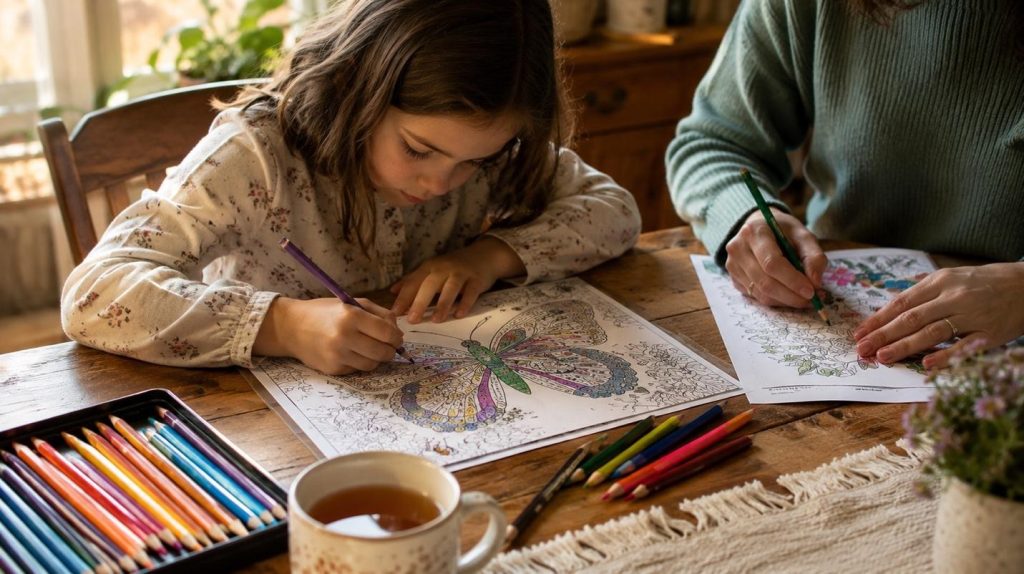
Keeping a organized folder of varied coloring pages allows your child to browse and pick a design that “feels right” in that moment. Giving them the autonomy to choose their own page restores a sense of control when their internal feelings feel completely out of control.
2. Low-Pressure Play for Acute Anxiety
We don’t always have the luxury of sitting down at a quiet kitchen table with a full set of colored pencils. Emotional spikes often happen on the go—in traffic, in crowded waiting rooms, or right before a doctor’s appointment.
In high-stress situations where physical art supplies aren’t practical, interactive visual play can serve as an immediate emotional bridge.
Using low-stakes digital options or guided coloring games eliminates the anxiety of “making a physical mess” or messing up paper. The instant feedback of tapping to fill in vibrant hues gives a child an immediate sense of accomplishment. It gently interrupts panic or sensory overload, shifting their brain back into a calm, focused state until you can get to a quiet space and talk about what happened.
3. Transitioning from Boundaries to Freeform Expression
While structured sheets provide a safe starting point, the ultimate goal of home art therapy is helping kids move toward freeform expression.
Think of filled-in lines as emotional training wheels:
- The Safety Net: Filling in pre-drawn shapes calms the nervous system and builds initial focus.
- The Release: Once their hands are steady and their breathing slows, encourage them to move to blank paper.
This is where true non-verbal storytelling happens. You can guide them with gentle, curiosity-based prompts:
- “If your anger was a monster, what shape would it be?”
- “Can you draw what your morning felt like using only lines and squiggles?”
- “Draw a big bubble and fill it with all the things that made you feel happy today.”
Encouraging this transition to open-ended drawing gives kids a safe container to externalize abstract inner thoughts. Once an emotion is sitting safely on a piece of paper in front of them, it suddenly becomes far less scary to manage.
How Parents Can Facilitate (Without Ruining the Magic)
If you want art to remain an authentic emotional release for your child, your role needs to be that of an observer, not an instructor. Here are three simple rules to keep in mind:
Ditch the “Correct” Colors
If your child decides to color a tree bright purple, a dog blue, or the sun black, resist the urge to correct them. In art therapy, there are no wrong choices. A black sun might represent fatigue; a purple tree might represent magic or mystery. Let their choices be valid without imposing real-world rules.
Ask “Tell Me About This” Instead of “What Is It?”
Asking “What is that supposed to be?” can inadvertently communicate to a child that their drawing failed to look realistic. Instead, use open-ended prompts like:
- “I notice you used a lot of red in this corner. How did that feel to shade in?”
- “Tell me the story behind this picture.”
Value the Process, Not the Product
We live in a culture obsessed with end results and fridge-worthy masterpieces. But emotional art therapy is about the act of creating, not the final picture. If a child spends twenty minutes angrily scribbling dark circles on a page and then wants to crumple it up and throw it away, let them. The release happened in the action itself.
Final Thoughts: Hand Them a Crayon
At the end of the day, helping our kids navigate their emotional world isn’t about having all the right answers or delivering flawless parenting speeches. Most of the time, it’s simply about giving them a safe, non-judgmental way to let off steam.
The next time you see your child struggling to express a heavy emotion—when the words won’t come out and frustration starts to boil over—skip the interrogation.
Set out a few sheets of paper, lay down a handful of crayons, and let art do the quiet work of healing.
